Types of Employee Recognition: 14 Kinds, With Examples
The main types of employee recognition are peer-to-peer, manager, formal, performance-based, values-based, milestone, team, spot, everyday, public, private, digital, monetary and non-monetary. Here's what each one is, an example, and when it works best.

The main types of employee recognition are peer-to-peer, manager, formal (top-down), performance-based, values-based, milestone and service, team, spot, everyday (informal), public, private, digital, monetary and non-monetary. They sort along five questions: who gives it, what it's for, when it happens, how it's delivered, and what it's worth. Many teams use several at once, and a recognition platform like Give River covers the everyday, peer-to-peer and values-based kinds in one shared feed.
The types overlap by design. A thank-you a teammate posts in the team feed the same afternoon, tagged with a company value, is peer-to-peer, spot, values-based, public and digital recognition all at once. Use the table to find the kind you need, then read its section for a definition, an example, when it works best, and our deeper guide.
Types of employee recognition at a glance
| Type | What it is | Best for |
|---|---|---|
| Peer-to-peer | Coworkers thank each other directly | Help that managers don't see |
| Manager | A manager recognizes someone on their own team | Effort, growth and day-to-day work |
| Formal (top-down) | Company awards with set criteria, often presented by leadership | Major contributions; showing what the company values |
| Performance-based | Recognition tied to results or goals | Targets met and big work delivered |
| Values-based | Recognition linked to a company value | Making values concrete |
| Milestone and service | Marks work anniversaries, years of service and life events | Loyalty and long-tenure moments |
| Team | Recognizes a group for a shared result | Wins no one person owns |
| Spot | Immediate recognition for a specific act | Reinforcing behavior while it's fresh |
| Everyday (informal) | Unplanned thanks in conversation or chat | Building the habit |
| Public (social) | Recognition others can see | Spreading credit and good examples |
| Private | One-to-one thanks | Personal help; people who dislike attention |
| Digital | Recognition through an app, chat tool or platform | Remote, hybrid and frontline teams |
| Monetary | Bonuses, gift cards or redeemable points | Exceptional results, when the amount is meaningful |
| Non-monetary | Praise, badges, opportunities or time | Frequent recognition on any budget |
Who gives it
1. Peer-to-peer recognition
Coworkers recognize each other directly, without going through a manager. It catches the help a manager never sees, especially across teams.
- Example: A support agent thanks an engineer in the team channel for fixing a billing bug the same afternoon a customer reported it.
- Works best: for cross-team help and daily collaboration, when sending it takes seconds and the rest of the team can see it.
Go deeper: peer-to-peer recognition activities and free peer-to-peer recognition software.
2. Manager recognition
A manager recognizes someone on their own team, usually for effort, progress or a specific piece of work. It carries weight because it comes from the person who sets priorities and writes reviews.
- Example: A warehouse supervisor tells a new picker, in front of the shift, that her error-free first month is why she's next in line for forklift training.
- Works best: every week, in one-on-ones and team meetings, and for growth that peers might not notice.
Go deeper: employee recognition examples.
3. Formal (top-down) recognition
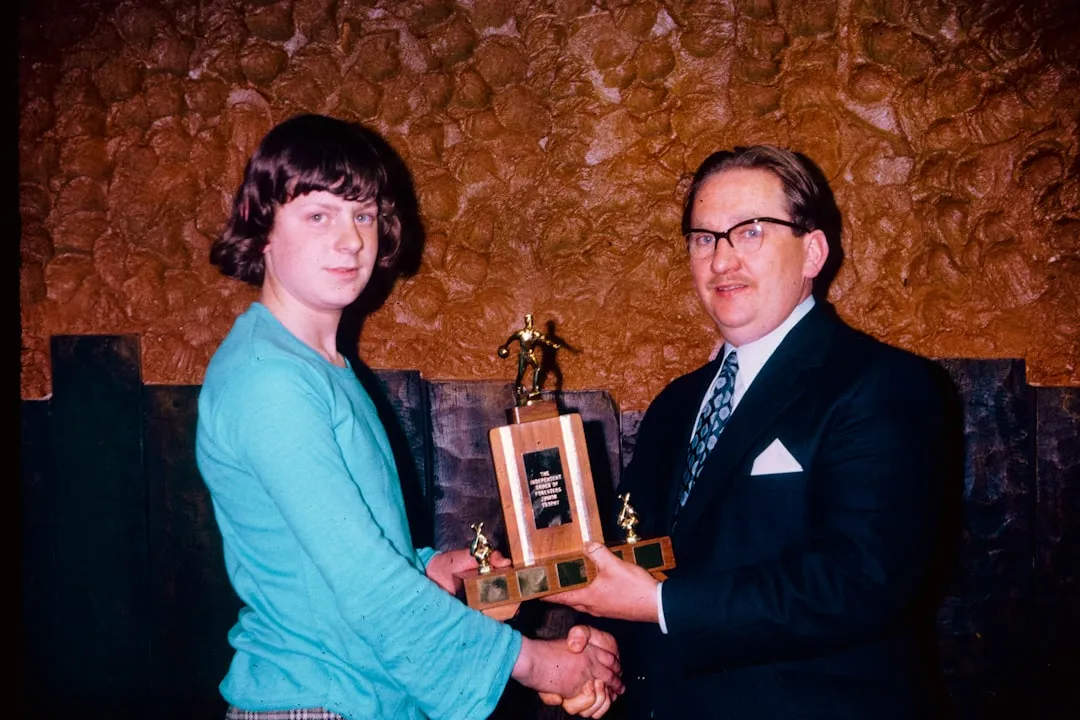
Structured programs run by the company, such as employee of the month or employee of the year, with published criteria, nominations and a presentation. It signals what leadership values most.
- Example: A regional bank names a Branch Employee of the Year from peer nominations judged against three published criteria, and the CEO presents it at the annual meeting.
- Works best: for major contributions, a few times a year, when the criteria are public and anyone can be nominated.
Go deeper: workplace recognition awards, the employee of the year award, and award nomination examples.
What it recognizes
4. Performance-based recognition
Recognition tied to measurable results: a target met, a project delivered, a quality or safety goal reached. It pairs naturally with bonuses or incentives.
- Example: A manufacturing plant recognizes the line that went a full quarter without a quality hold, and names the changes the crew made to get there.
- Works best: when the goal was clear in advance, and when you recognize how the result was reached, not only the number.
Go deeper: employee performance awards.
5. Values-based recognition
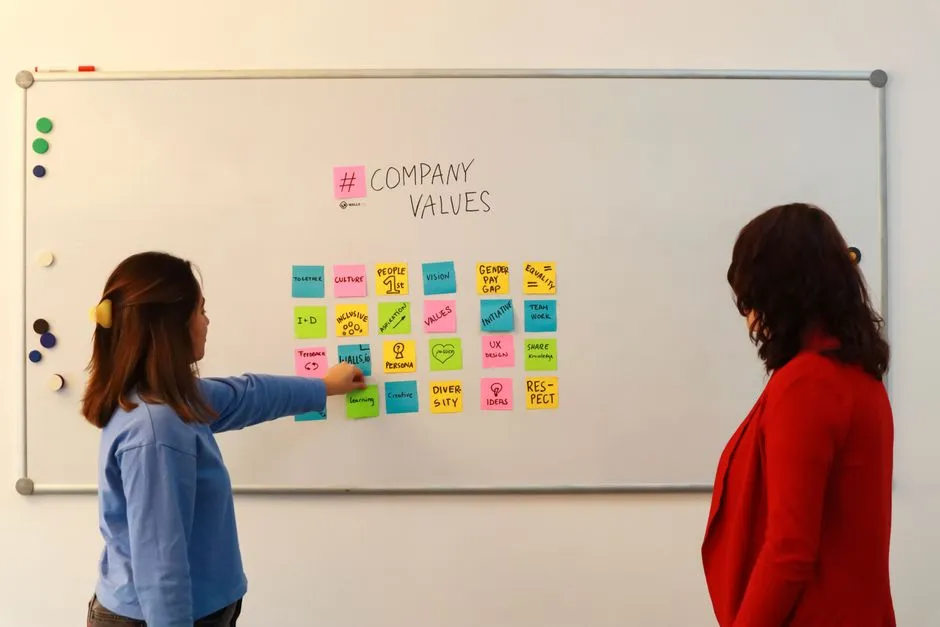
Recognition that names the company value someone's action shows. It turns a values poster into examples people can picture and repeat.
- Example: A teammate thanks a colleague for telling a client about her own mistake before the client noticed, and tags the thank-you with the company value Own It.
- Works best: when your values are few, specific and written in everyday language, and anyone can attach one to a thank-you.
Go deeper: the "Living a company value" examples in our employee of the month nomination examples.
6. Milestone and service recognition
Recognition for time and life events: work anniversaries, years-of-service awards, birthdays, a certification earned. It tells someone the company noticed their commitment, not just their output.
- Example: On a nurse's tenth work anniversary, her unit posts a thank-you naming the new nurses she has trained, and the hospital presents her service award.
- Works best: on the day, and personal: say what the person contributed over those years, not only how many there were.
Go deeper: work anniversary awards, what to write on a work anniversary award, and 10-year service award ideas.
7. Team recognition
Recognition for a group's shared result. It credits work no one person owns, and it avoids singling out one name when many people made something happen.
- Example: After a product recall is handled without a single missed shipment, the operations director thanks the logistics team in the company update, naming everyone on it.
- Works best: for shared wins and team challenges. Pair it with individual thanks so standout contributions aren't lost in "great job, everyone".
Go deeper: workplace challenge ideas and gamification in the workplace.
When it happens
8. Spot recognition
Immediate recognition for a specific act, given on the spot instead of saved for a review. Sometimes it comes with a small reward; often it's a quick public thank-you.
- Example: A shift lead watches a cashier calm an upset customer and sort out the refund, and thanks her at the end-of-shift huddle that evening.
- Works best: when the gap between the act and the thanks is hours, not weeks, so the connection is obvious.
Go deeper: easy employee recognition ideas, including spot bonuses.
9. Everyday (informal) recognition
Unplanned thanks in conversation, chat or a quick note, with no program, budget or approval. It can happen many times a day, which makes it the everyday backbone of recognition.
- Example: A designer messages a copywriter: "Your headline made the whole page work. Thanks for the late rewrite."
- Works best: daily, from everyone. Build this habit first; it gives formal awards more to stand on.
Go deeper: 40 thank-you messages for coworkers and staff appreciation ideas.
How it's delivered
10. Public (social) recognition
Recognition others can see: in a team meeting, a company channel, a newsletter or a recognition feed. It spreads credit and shows everyone what good work looks like.
- Example: In the Monday all-hands, a manager reads out a customer's email praising a field technician, then thanks him by name.
- Works best: for work that helped others, when the person is comfortable with attention. Ask first if you're not sure.
Go deeper: how to make recognition reach every location and shift.
11. Private recognition
One-to-one thanks: a direct message, a handwritten note, a word after a meeting. It suits personal help, sensitive situations and people who would rather not be in the spotlight.
- Example: A team lead sends a direct message thanking an analyst who quietly took on a colleague's work during a family emergency, something neither of them would want announced.
- Works best: alongside public recognition, not instead of it. Private thanks means a lot to the person, but it doesn't build their reputation with the wider team.
Go deeper: the public-or-private guide in thank-you messages for coworkers.
12. Digital recognition
Recognition sent through software: a recognition platform, a chat tool such as Slack or Microsoft Teams, or a mobile app. It gives remote, hybrid and frontline staff the same recognition as people in the office, and it leaves a record you can look back on.
- Example: A night-shift nurse opens an app on her break and finds a thank-you from the day-shift charge nurse for a thorough handoff.
- Works best: when it lives where people already work, at a desk or on a phone.
Go deeper: recognition platforms for Microsoft Teams and Slack and remote team recognition.
What it's worth
13. Monetary recognition
Recognition with cash value: bonuses, gift cards, or points people redeem for rewards. It works best when it's attached to a clear reason rather than standing in for one.
- Example: After a clinic passes its accreditation review with no findings, every staff member gets a gift card with a note from the director naming what each team did to prepare.
- Works best: for exceptional results, when the amount is meaningful and the reason is spelled out. A gift card with no message says less than a specific thank-you.
If you give gift cards, check the tax treatment first; our employee holiday gift ideas cover the US rules. Go deeper: employee incentive programs and Give River rewards.
14. Non-monetary recognition
Recognition without a cash payout: specific praise, a handwritten note, a badge, a stretch assignment, a learning opportunity, an afternoon off. It's cheap enough to give often, and trust and opportunity are rewards in their own right.
- Example: A manager recognizes an analyst's fix to the month-end process by asking her to present it to the leadership team and lead the rollout.
- Works best: most of the time, and especially for frequent, everyday recognition.
Go deeper: staff appreciation ideas and the no-cost ideas in easy employee recognition ideas.
How to combine the types
You don't need all 14 at once. A simple rhythm covers most of them:
| How often | What to do | Types it covers |
|---|---|---|
| Every day | Thank coworkers for specific help, in person, in chat or in a shared feed | Everyday, peer-to-peer, spot, digital |
| Every week | Managers name one specific contribution per person in one-on-ones or team meetings | Manager, public, private |
| Every month | Share a few thank-yous that show each company value | Values-based, public |
| Every quarter | Celebrate team results, or close out a team challenge | Team, performance-based |
| Every year | Run formal awards, and mark each service milestone on the day | Formal, milestone, monetary or non-monetary |
To check the mix is working, ask whether people feel recognized for their work in your next pulse survey. Our guide to pulse survey questions and cadence has wording and timing.
Where Give River fits
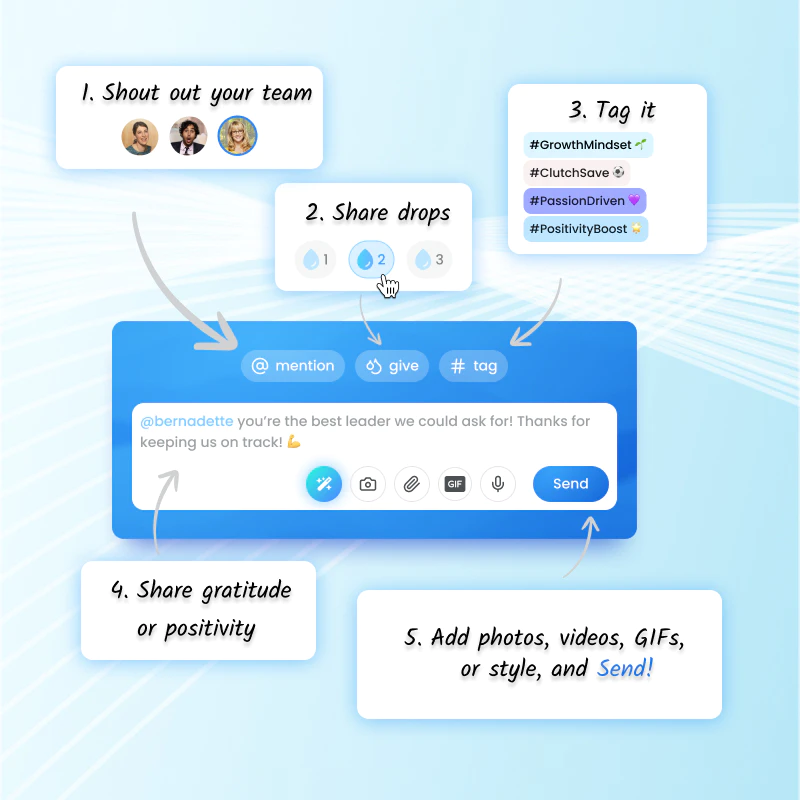
Give River is a recognition platform built on the 5G Method, where recognition is the first G, Gratitude. Here's which types it covers, with the plan where it matters:
- Peer-to-peer, everyday and spot (Free): anyone can send a Drop, a thank-you that lands in the team feed, to one teammate or several at once.
- Values-based (Free): tag a Drop with one of your custom company values, and anyone can tap the tag to see every post that carries it. Tagging is optional.
- Manager: managers get a Recognize your team card on Home, and the list of teammates who haven't been recognized lately shows their own team first.
- Public or private: a Drop can go to the whole team, to certain locations or departments, or only to members you select.
- Milestone and service (Free): birthdays and work anniversaries appear in Celebrations on Home with a Congratulate button, and badges are awarded automatically when someone reaches a target you set, such as a number of Drops earned.
- Formal (Core): custom awards, such as an employee of the month award, are given by an admin and can be shared to the feed.
- Monetary (Core): the Drops people receive can be redeemed for gift cards and custom company rewards.
- Digital: the web app and the iOS and Android apps on every plan, including Free; giving Drops from Slack and Microsoft Teams on Core.
Core is $4.99 per user per month, with a 30-day trial. The Help Center covers sending a Drop, birthdays and work anniversaries, badges, custom awards and the Drop Shop.
Frequently asked questions
What are the main types of employee recognition?
The common types are peer-to-peer, manager, formal, performance-based, values-based, milestone and service, team, spot, everyday, public, private, digital, monetary and non-monetary. They overlap, so a single thank-you can be several types at once.
What is the difference between formal and informal recognition?
Formal recognition is planned and structured, with criteria, nominations and often an award, such as employee of the year. Informal recognition is unplanned, everyday thanks that anyone can give at any time. Most teams benefit from both: everyday thanks keep recognition frequent, and formal awards mark the bigger moments.
What is the difference between monetary and non-monetary recognition?
Monetary recognition has cash value, such as bonuses, gift cards or redeemable points. Non-monetary recognition, such as specific praise, a badge, a new opportunity or time off, costs little or nothing and can happen far more often.
What is spot recognition?
Spot recognition is given right after a specific act, instead of being saved for a review or an annual award. It can be a quick public thank-you or come with a small reward.
Which type of employee recognition works best?
No single type does; it depends on what you want to encourage and on the person receiving it. A mix of frequent, specific thanks from peers and managers, plus a few formal awards and milestones each year, covers most needs. Ask people how they like to be recognized.
Which types of recognition does Give River support?
Peer-to-peer, everyday, spot, values-based, public and digital recognition through Drops, plus badges and milestones, all on Free for up to 25 members. Core, at $4.99 per user per month, adds custom awards, gift cards and custom company rewards, and Slack and Microsoft Teams.
More from this category.

Employee Holiday Gift Ideas: What to Give by Budget and Team Type
The best employee holiday gifts are useful, inclusive, and easy to get to everyone, wherever they work. Here are ideas by budget and team type, how to deliver them to remote and global teams, and why gift cards count as taxable wages in the US.

Thank-You Messages for Coworkers: 40 Examples for Every Situation
The best thank-you message for a coworker names what they did and what it changed. Here are 40 original examples by situation, from a covered shift to a farewell, plus a three-part formula and short versions for chat.

5 Awardco Alternatives in 2026, Compared by Price and Fit
The right Awardco alternative depends on how you want to reward people and how you want to pay for it. Give River, Bonusly, Motivosity, WorkTango, and Workhuman compared by reward options, fees, and fit.
See the platform in action.
Free for up to 25 members, or try Core or Growth free for 30 days. A card is required; Free is never charged, and a trial bills when it ends unless you cancel.