Employee of the Month Nomination Examples: 36 Write-Ups and a Template
A strong Employee of the Month nomination names the person, the specific thing they did, what changed because of it, and the company value it shows. Here are 36 examples to adapt, a fill-in-the-blank template, and how to run monthly nominations fairly.

A strong employee of the month nomination does four things in a few sentences: it names the person, describes one specific thing they did, says what changed because of it, and ties it to a company value. Below are a fill-in-the-blank template and 36 examples to adapt, grouped by what you're recognizing, plus how to keep monthly nominations fair. Teams that thank each other all month in a recognition tool like Give River start the nomination with that evidence already written down.
The difference between a compliment and a nomination is detail. "Sam is a great team player" could describe anyone; "Sam rewrote the returns checklist, and we stopped sending replacements to the wrong address" tells the judges what happened and why it counts.
What a strong nomination includes
| Part | What to write | Example |
|---|---|---|
| Who | Name, role and team, so judges outside the team know who you mean | Priya, support specialist, customer care |
| The action | One specific thing they did this month, and when | Tracked down a lost shipment herself instead of passing the ticket on |
| The impact | What changed, and for whom. Add a number only if you have a real one | The customer had a delivery date the same afternoon |
| The value | Which company value it shows, in your values' own words | Customer First |
Keep it to one short paragraph, and nominate for something that happened this month. A year of sustained excellence belongs to an employee of the year award.
Employee of the month nomination template

Copy either version into your nomination form, chat channel or email, and replace the brackets.
Short version (one or two sentences)
I nominate [Name] for Employee of the Month because [specific action] during [when]. It [impact on customers, colleagues or the business], which is what [company value] looks like.
Long version (a paragraph for a committee)
I'm nominating [Name], [role] on [team], for Employee of the Month for [month].
What they did: In [week or situation], [Name] [specific action]. [One more sentence: what made it hard, or what they did that wasn't required.]
Why it mattered: [Who benefited, and how. A real number if you have one.]
The value it shows: This is [company value] because [one sentence].
Anything else: [A second example, or the recognition they received from teammates this month.]
36 employee of the month nomination examples
Swap in your own names, details and values. Where a number is in brackets, use your real figure or leave it out: an invented number weakens a nomination.
Customer service
- The lost shipment. Priya found a customer's order sitting at the wrong warehouse, tracked it down herself, and called back the same afternoon with a delivery date instead of passing the ticket on. That's Customer First.
- The third call. When a client called about the same billing error for the third time, Marcus fixed the invoice while they talked, then rewrote the help article that had confused them.
- The repeat questions. Dana noticed the same three questions in the support inbox every week, wrote answers for the help page, and flagged the pattern to product. Tickets on those topics fell from [X] a week to [Y].
- The Saturday save. When a client's check-in system failed on the morning of their event, Luis walked their staff through a workaround over video and stayed on until the doors opened.
Teamwork
- The quiet cover. When a teammate went on unexpected leave at quarter close, Aisha took over his reconciliations unasked, kept notes for his return, and still closed her own accounts on time.
- The cross-team fix. Mei spent two afternoons with sales learning why quotes stalled in legal review, then rewrote the contract checklist with them. Quotes now reach legal complete the first time.
- Sharing the credit. Jordan led this month's office move, and every update named the people doing the work: facilities, IT and the volunteers who labeled every box. It finished a day early.
- The open offer. Bea offered to pair with anyone stuck on the new reporting tool and ran six half-hour sessions. The whole team had switched before the old tool shut down.
Going above and beyond
- The flooded room. When the training room flooded the night before orientation, Grace found another room, moved the equipment with two colleagues, and emailed every new starter the new address before 8 a.m.
- The outdated binder. Andre noticed the warehouse's safety data sheets were out of date and checked every one against the supplier's site. Nobody asked him to; he didn't want anyone relying on the wrong sheet.
- The translated guide. Fatima translated our benefits enrollment guide into Spanish for colleagues who had asked for it, then held two drop-in sessions so nobody had to guess at their choices.
- Launch week. With the project lead out sick, Kofi ran the daily stand-ups, kept the checklist current, and made sure every open item had an owner. We launched on the planned date.
Innovation and problem solving
- The double entry. Elena noticed we typed the same order details into two systems, built a simple import that does it in one step, and taught the team to use it. It saves each coordinator about [X] hours a week.
- The jamming printer. Raj traced the label printer's peak-hour jams to a setting changed in the last update, fixed it, and taped a two-line note to the printer so anyone can fix it next time.
- The shorter meeting. Sofia replaced our hour-long Monday planning meeting with a shared doc updated by Friday and a 15-minute call. Decisions are written down, and the team got its Monday morning back.
- The faster setup. Noah tested three ways to speed up new-client setup, kept the one that worked, and documented it. Our two newest clients went live [X] days sooner.
Leadership without a title
- The go-to person. Ben isn't a manager, but he's who new hires go to. This month he ran a lunch-and-learn on our ticketing system for four new teammates, on his own initiative.
- Getting unstuck. When the team couldn't agree on the backlog order, Chloe put the options on one page and helped everyone settle on a plan. She didn't push her view; she got us moving.
- The Friday thread. After a hard quarter, Isaac started a Friday thread where everyone shares one thing that went well. It's now the post the whole team looks forward to.
Reliability
- The Saturday opener. Maria opened the store every Saturday this month, never late, with the floor ready before the first customer. Nobody notices this work until it doesn't happen, so we're noticing it.
- The report you can trust. Hannah's reports go out on time, double-checked, with the numbers explained in plain words. This month that let leadership make a staffing decision a week early.
- The calm on-call. Victor covered on-call through our busiest month, resolved every alert within our response target, and wrote up each fix for the next person.
New hires
- The better checklist. Six weeks in, Leah has rewritten our onboarding checklist based on what confused her, so the next new hire won't hit the same gaps.
- Learning every station. In his first month, Omar asked to shadow every role for a day. He now covers three stations and has spotted two steps in our process we can drop.
- Up to speed mid-launch. Zara joined in the middle of a launch, read every past release note instead of waiting to be trained, and by week three was answering customer questions on her own.
Remote and hybrid staff
- Across time zones. Eight hours ahead of most of the team, Jun records short video walkthroughs of his code changes so reviewers can watch them in their own morning. Reviews now usually finish overnight.
- Closing the hallway gap. Camila noticed remote teammates were missing decisions made in hallway chats, so she now posts a short written summary after every in-office meeting.
- The onboarding buddy. Pete paired each new remote hire with an experienced buddy for their first two weeks, so they had someone to ask the questions they didn't want to post in a channel.
Frontline and shift workers
- The short-staffed night. Keisha covered two units on a short-staffed night shift, kept every handoff note complete, and still stopped to walk a worried family through visiting hours.
- The loose guardrail. Diego spotted a loose guardrail on loading dock 3, taped off the area, reported it, and stayed past his shift until maintenance confirmed the fix.
- The late delivery. When the evening delivery arrived two hours late, Ana reorganized the stocking plan with her shift so the shelves were full before the dinner rush.
- The pocket card. Sam trains every new cashier on his shift, and this month he wrote a pocket card on the five register problems new hires ask about most.
Living a company value
Name the value and say why the action fits it. Replace these sample values with your own.
- Own It. When a shipment went out with the wrong labels, Rosa didn't wait to find out whose mistake it was. She fixed it with the carrier, then proposed the double-check step we now use.
- Better Together. Ethan spent part of every Friday this month helping finance clean up old vendor records. It wasn't his job, but the backlog was holding up both teams.
- Always Learning. Nadia took a data visualization course in her own time, rebuilt our weekly dashboard to fit on one screen, and ran a 20-minute session so others can do the same.
- Do the Right Thing. Michael found we had been slightly overcharging a long-time client. He flagged it, worked with finance on the refund, and called the client himself to explain.
For manager, safety, rising star and other awards, see our employee award nomination examples.
How to run fair monthly nominations
Employee of the Month only motivates people if they believe anyone can win it. Publish three or four criteria tied to your values before nominations open, let anyone nominate anyone, and announce each winner with the nomination text so everyone sees what earned it. Then fix what makes monthly awards feel rigged:
| Problem | Fix |
|---|---|
| The same people keep winning | A cooldown, such as no repeat win within 12 months |
| It feels like a popularity contest | Judge each nomination against the criteria. Don't count votes: one specific nomination can beat five vague ones |
| One manager decides everything | A panel of three to five that rotates each quarter, with at least one peer and one past winner |
| Nominations are vague | Require the four parts, and send back any nomination that is only adjectives |
| Remote and frontline staff are overlooked | Take nominations on mobile and in chat, ask each shift lead to nominate monthly, and check each quarter who has never been nominated |
If nominations stay thin, build the habit of noticing each other's work first with these peer-to-peer recognition activities. For where a monthly award sits among your other awards, see our guide to workplace recognition awards.
Let a month of recognition do the groundwork
The hardest part of a nomination is remembering what someone did three weeks ago. In Give River, teammates send Drops as things happen: a short thank-you message tagged with one of your company values. By the end of the month, the Drops someone received are a dated record of specific moments, written by the people who saw the work, and they bring quiet contributors forward too.
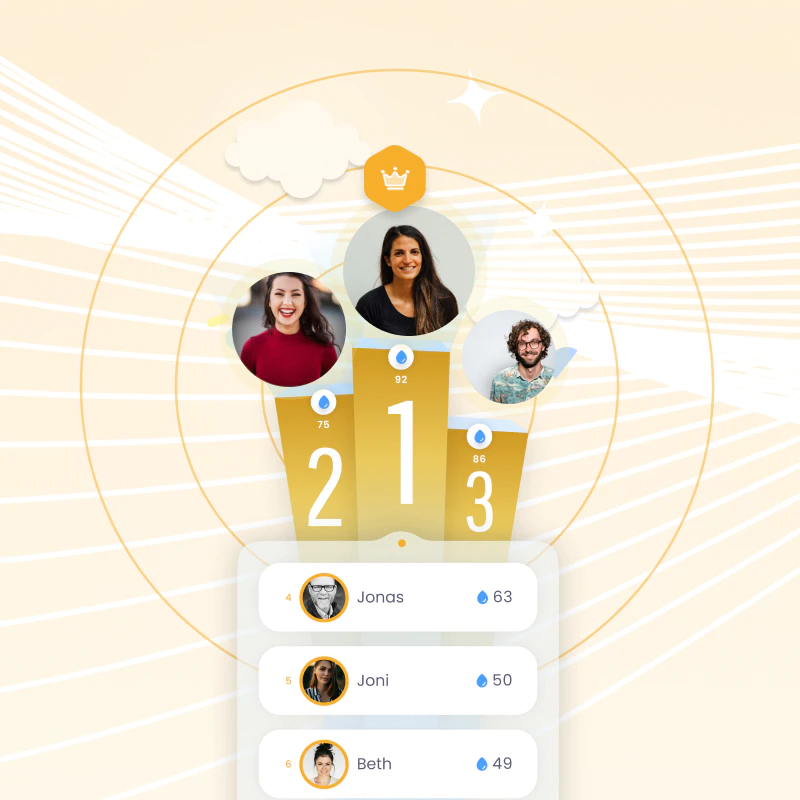
The River Rankings leaderboard and milestones such as work anniversaries are on every plan, including Free for up to 25 members. Treat the leaderboard as a shortlist, not the answer: the most-thanked person isn't always the strongest nominee. On Core, custom awards let you give Employee of the Month in the same place as the recognition behind it, and your monthly winners make a natural shortlist for employee of the year.
Frequently asked questions
What should I write in an employee of the month nomination?
Name the person and their role, one specific thing they did this month, what changed because of it, and the company value it shows. One short paragraph is enough; use a number only if it's real.
How long should an employee of the month nomination be?
One or two sentences for a form or chat post, or about 100 to 150 words for a committee. One clear example persuades more than a list of adjectives.
How do you stop the same people winning every month?
Add a cooldown, such as no repeat win within 12 months, and rotate the judges each quarter. Check regularly which teams and shifts have never had a nomination.
What are good criteria for employee of the month?
Three or four, published in advance: a specific contribution this month, a clear impact on customers or colleagues, and a company value in action. Keep them the same every month so winners are comparable.
Can Give River help run employee of the month?
Yes. Teammates send Drops tagged to your values all month, and River Rankings and milestones are on every plan, including Free for up to 25 members. Custom awards come with Core at $4.99 per user per month, with a 30-day trial.
More from this category.

5 Awardco Alternatives in 2026, Compared by Price and Fit
The right Awardco alternative depends on how you want to reward people and how you want to pay for it. Give River, Bonusly, Motivosity, WorkTango, and Workhuman compared by reward options, fees, and fit.

Best Microsoft Teams Apps for Employee Recognition in 2026
The best Microsoft Teams recognition apps let people thank each other without leaving Teams, tie each shout-out to a company value, and add rewards or a leaderboard. We compare Give River, Bonusly, Matter, HeyTaco, Kudos, WorkTango and Culture Amp, with Microsoft's built-in Praise as the baseline.

Best Slack Apps for Employee Recognition in 2026
The best Slack recognition apps let people thank each other without leaving Slack, tie each shout-out to a company value, and give the team a reason to keep going. We compare Give River, Bonusly, Matter, HeyTaco, GoProfiles, Kudos, Nectar and WorkTango from each vendor's own site.
See the platform in action.
Free for up to 25 members, or try Core or Growth free for 30 days. A card is required; Free is never charged, and a trial bills when it ends unless you cancel.