Pulse Survey Questions and Cadence: How Often, How Many and What to Ask
A good starting point is a monthly pulse of three to five questions: the same anchor questions every time, plus a theme that rotates. Here's a sample 12-month cadence, a question bank by theme, and how to act on the results.
How often should you run a pulse survey? A good starting point is once a month, with three to five questions that take a couple of minutes: one or two anchor questions you ask every time, plus one or two that rotate through themes such as workload, recognition and growth. Run it only as often as you can act on what you hear, because the rhythm only works if people see something change between rounds. In Give River, surveys with ready-made templates, anonymous results and round-by-round comparison for recurring series are on the Core plan, and one-question polls are on the Free plan.
New to pulse surveys? Start with our guide to employee pulse surveys; this post is the operating plan.
How often to run a pulse survey
The common options and their trade-offs:
| Cadence | Length | Good for | Watch out for |
|---|---|---|---|
| Weekly | 1 question | A short period of change, such as a reorganization or a launch | Fatigue, and no time to act between rounds |
| Every two weeks | 1–3 questions | Fast-moving teams whose managers can act quickly | The same questions start to feel repetitive |
| Monthly | 3–5 questions | A good default for most teams | Needs a visible action most months |
| Quarterly | 5–10 questions | Deeper themes, or changes that take longer to make | Problems surface later |
| Yearly | A full engagement survey | A complete baseline across every theme | Too slow on its own |
For eNPS specifically, Bain & Company says companies most commonly request feedback monthly. Whatever you pick, the test is simple: don't ask again until you can say what changed since last time. If your fixes take a quarter, survey quarterly. Keep the timing steady too, such as the first Tuesday of each month with a week to respond.
How many questions to ask
Three to five for a monthly pulse, or one for a weekly check. Length costs you twice: in a 2009 web-survey experiment published in Public Opinion Quarterly, the longer the stated length, the fewer people started and finished the questionnaire, and answers to questions placed later were faster, shorter and more uniform. So put the question you care about most first, and end with a single optional open question.
A monthly pulse that follows those rules looks like this:
- One or two anchor questions on a 1–5 scale, worded identically every round so you can track them.
- One or two rotating questions on this month's theme.
- One open question, such as "What's one thing that would make next month better?"
A sample 12-month pulse cadence

Copy this plan and adjust the themes to your year. Every month uses the same two anchors: "How supported do you feel by your team this month?" and "How manageable was your workload this month?" (both 1–5), plus the open question above. Each month adds a theme; send the ones marked Poll as a separate one-tap poll:
| Month | Theme | Rotating question | Format |
|---|---|---|---|
| Jan | Priorities + eNPS | I know what my top priority is for the next three months. | 1–5 agree, plus the 0–10 eNPS question |
| Feb | Recognition | Someone thanked me for specific work in the past month. | 1–5 agree |
| Mar | Growth | Which would you most like to learn this year? (five or six options) | Poll |
| Apr | Managers + eNPS | My manager helped me remove a blocker this month. | 1–5 agree, plus eNPS |
| May | Wellbeing | I was able to switch off from work outside working hours this month. | 1–5 agree |
| Jun | Where we work | Where I worked this month (home, office or on site) suited the work I was doing. | 1–5 agree |
| Jul | Mid-year + eNPS | What's one thing we should change for the second half of the year? | Open text, plus eNPS |
| Aug | Collaboration | I could get help from other teams when I needed it. | 1–5 agree |
| Sep | Communication | I heard about changes that affected me before they happened. | 1–5 agree |
| Oct | Burnout check + eNPS | What drained your energy most this month? (meetings, interruptions, unclear priorities, workload, other) | Poll, plus eNPS |
| Nov | Year-end plans | How would you like to celebrate the end of the year? (four or five options) | Poll |
| Dec | Retro | What should we start, stop and keep doing next year? | Open text |
eNPS runs quarterly here; see what a good eNPS score is for how to read it. If you run a yearly engagement survey, skip the pulse that month, and use our engagement survey best practices to plan it. The November poll can also guide your employee holiday gifts.
Pulse survey question bank by theme
Pick one or two per round: the 1–5 rating question, or the open or poll version when you want the why. For longer, non-pulse lists by topic, see our employee survey questions.
| Theme | Rating question (1–5 agree) | Open or poll version |
|---|---|---|
| Workload | My workload was manageable this month. | What would free up an hour of your week? |
| Wellbeing | I ended most workdays with energy left. | Poll: what would help most right now? (focus time, fewer meetings, flexible hours, clearer priorities, other) |
| Recognition | My work was noticed by the people I work with this month. | Who deserves a thank-you this month, and for what? |
| Managers | I got useful feedback from my manager in the past month. | What's one thing your manager could do more of? |
| Growth | I learned something at work this month that I'll use again. | What skill would make the biggest difference to your work this year? |
| Priorities | I knew what mattered most each week. | What's unclear about our goals right now? |
| Belonging | I felt part of my team this month. | What would help you feel more connected to the team? |
| Tools and process | Our tools and processes made my work easier this month. | Which tool or process slowed you down most? |
| Change | I understood why the recent changes were made. | What do you wish you'd heard sooner? |
Tips for writing pulse questions
- Time-box it. "This month" or "in the past two weeks" gets answers about the period, not all-time feelings.
- One idea per question. "My manager gives clear feedback and recognition" is two questions.
- Freeze the anchors. Change the wording or scale and you lose the trend.
- Ask only what you'll act on. Asking about what you won't change teaches people that answering is pointless.
How to act on pulse results

Bain describes the main purpose of eNPS feedback requests as helping teams and team leaders recognize and prioritize issues at the team level, and the same goes for any pulse. A routine that does that:
- Check the response rate first. A falling rate is a result in itself, and can mean people don't see their answers going anywhere.
- Read the trend, not one round. Compare each anchor with the last three rounds before you react.
- Find the theme in the comments, and pick one thing to change before the next round.
- Close the loop within a week or two. Share what you heard and what you'll do, in a team meeting or an announcement.
- Ask again, and say whether the change worked.
| If this is low | Try this first |
|---|---|
| Response rate | Shorten the pulse, move it off your busiest day, and open the next round by sharing what changed |
| Recognition | Make thanking each other part of the week; see our guide to types of employee recognition |
| Belonging | Give people a shared goal and a reason to talk; these workplace challenge ideas work for office and remote teams |
| Workload or wellbeing | Look for the cause (meetings, staffing, unclear priorities) before adding perks |
For a deeper method, see engagement survey analysis.
Running pulse surveys in Give River
Admins build surveys under Engage › Surveys, from scratch or from a template, and members answer one question at a time with a progress bar:
- Templates for common pulses, including Wellbeing and burnout check, Manager effectiveness, Meeting effectiveness, Hybrid and remote work preferences, and New-hire check-in, each yours to edit.
- Question types for multiple choice, short and long text, and scales shown as numbers, emoji, stars, drops, thumbs or a slider.
- Anonymous when you want it. Admins see totals and comments without names, and nothing until at least 5 people have answered. That rule applies to each question too, so an optional comment box on a small team may stay hidden.
- Who and when. Send to everyone or pick by team, location, department or role, with a start and end date; the end date defaults to a week after the start.
- Drops for taking part. Set a Drop reward for completing a survey or voting in a poll.
- Repeat without retyping. An eNPS series repeats monthly, quarterly or on a custom interval, and any survey whose first question is a 0–10 scale can be converted into one, so a pulse that opens with the eNPS question can schedule itself. A series repeats the same questions every round and is always anonymous, so run rotating themes as a separate survey. For other pulses, duplicate last round's survey or start again from the same template.
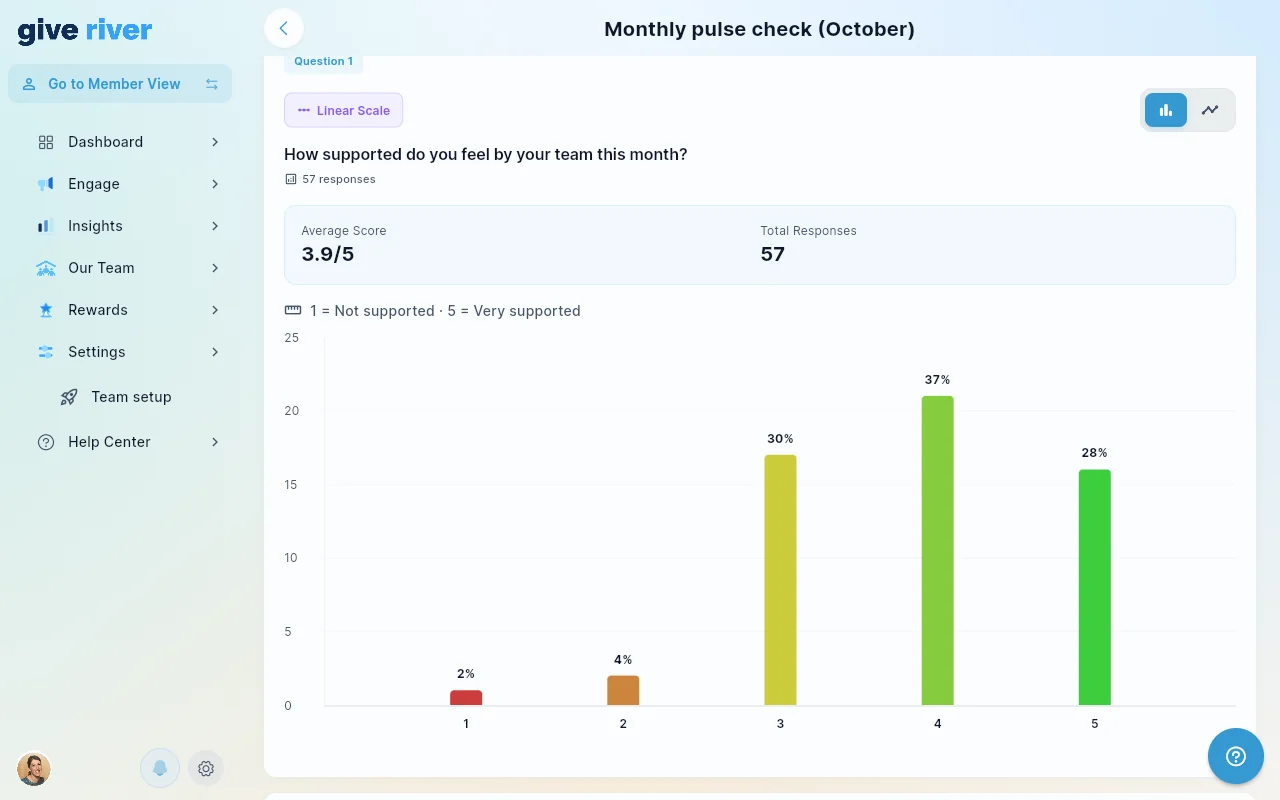
Results land in Insights › Surveys and Polls: each question's chart with the share of answers on each bar, the response rate ("70 of 120 recipients (58%)"), a short written summary of your survey totals, and PDF or CSV export. Surveys and Insights are on Core. On Free, polls cover the one-question pulse: up to six answer options, a Pulse check template group, and results members see as soon as they vote.
Frequently asked questions
How often should you run a pulse survey?
Monthly is a sensible default for a pulse of three to five questions. Weekly suits a single question during a short period of change, and quarterly suits deeper themes or slower fixes. Run it only as often as you can act on the results.
How many questions should a pulse survey have?
Three to five for a monthly pulse, or one for a weekly check, so it takes a couple of minutes. Put your most important question first: in a 2009 web-survey experiment, answers to later questions were faster, shorter and more uniform.
What's the difference between a pulse survey and an engagement survey?
An engagement survey is a long check across every theme, usually once a year. A pulse is a short, frequent check on a few questions, so you can spot changes early and see whether your actions worked.
Should pulse surveys be anonymous?
For questions about managers, workload or wellbeing, yes. Bain says employee feedback must be kept confidential to encourage honest answers. In Give River, anonymous results appear once at least 5 people have answered.
What should you do when pulse response rates drop?
Shorten the survey, check the timing, and open the next round by sharing what changed since the last one. If people can't see their answers being used, they have little reason to keep answering.
Can you run a pulse survey for free?
Yes, for one-question pulses. Give River's Free plan includes polls for up to 25 members, with up to six answer options, Pulse check templates and Drop rewards for voting. Multi-question surveys, eNPS and Insights are on Core.
Sources
Outside sources checked November 23, 2026. Give River features are described from our Help Center.
- Bain & Company: The Employee Net Promoter System
- Mirta Galesic and Michael Bosnjak, "Effects of Questionnaire Length on Participation and Indicators of Response Quality in a Web Survey", Public Opinion Quarterly 73(2), 2009
- Give River Help Center: Surveys (Including eNPS), Survey Templates, Survey Series Comparison, Polls, Survey Summary, Admin Insights and Analytics
More from this category.

What Is a Good eNPS Score? How to Calculate It, Read It and Follow Up
Any eNPS above 0 means your promoters outnumber your detractors. Published benchmarks disagree on what counts as good, so here's how to calculate eNPS, read it against your own trend, and the follow-up questions that explain it.

The 5 Best Employee Engagement Platforms in 2026, Compared
Give River, Culture Amp, WorkTango, Engagedly, and Kudos compared from each vendor's own site: pricing, gamification, learning, surveys, and who each one fits.

Employee Engagement Software for Companies With 50–200 Employees (2026)
What a 50–200 person company needs from engagement software, what six platforms cost at that size, who each fits, and how fast you can launch.
See the platform in action.
Free for up to 25 members, or try Core or Growth free for 30 days. A card is required; Free is never charged, and a trial bills when it ends unless you cancel.