Why Employee Engagement Surveys Are Critical to Your Organization's Success
An employee engagement survey is a strategic tool for measuring employee commitment, motivation, and enthusiasm. Unlike satisfaction surveys, it pinpoints the drivers behind discretionary effort and long-term retention.

Why Employee Engagement Surveys Are Critical to Your Organization's Success
An employee engagement survey is a strategic tool for measuring employee commitment, motivation, and enthusiasm. Unlike satisfaction surveys, it pinpoints the drivers behind discretionary effort and long-term retention.
Key reasons to conduct employee engagement surveys:
- Measure what matters: Track commitment, motivation, and growth opportunities.
- Identify risks: Spot cultural issues and retention risks early.
- Drive results: Acting on feedback can nearly double engagement rates.
- Reduce turnover: Engaged teams have significantly lower turnover.
- Improve business outcomes: Boost productivity, profitability, and customer loyalty.
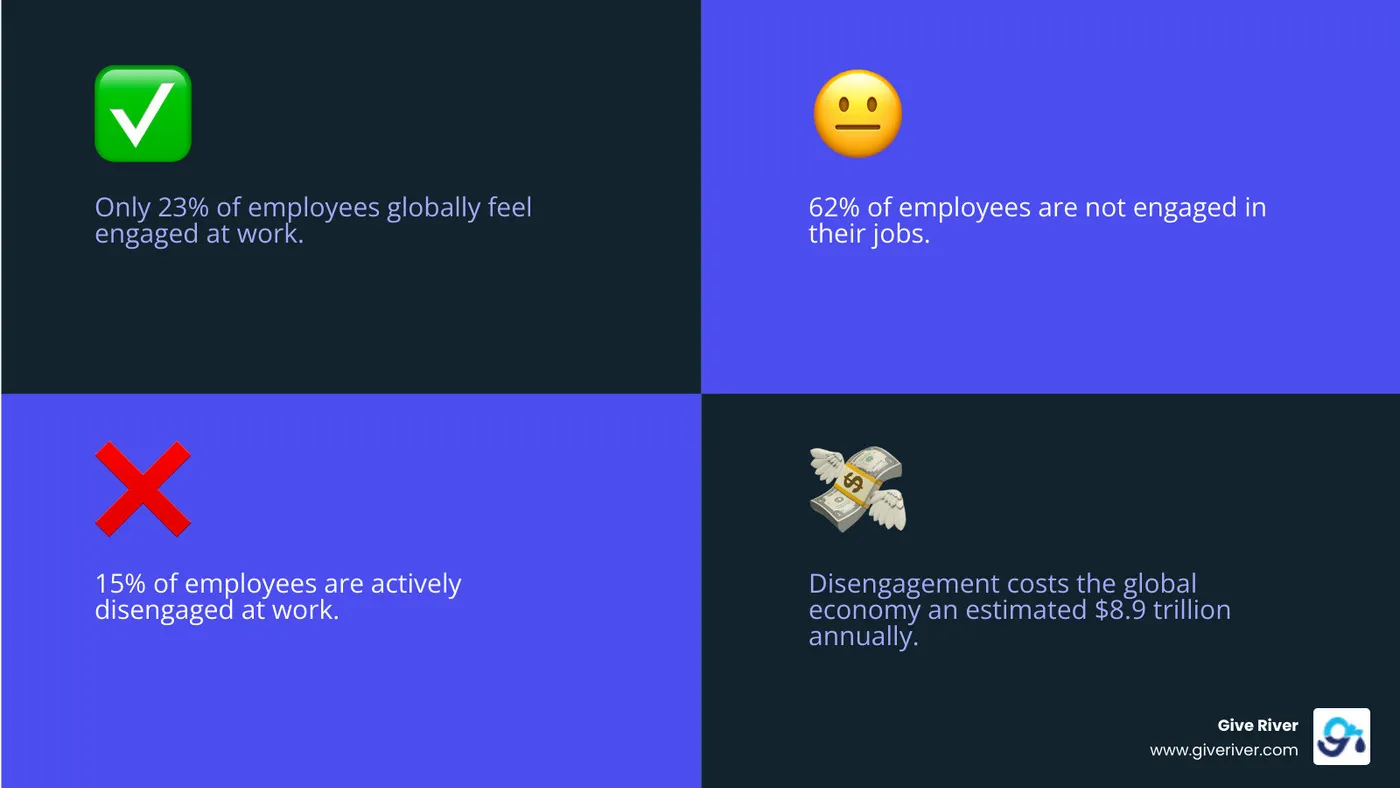
The reality is sobering: disengagement costs the global economy an estimated $8.9 trillion annually. With only 23% of employees feeling engaged and nearly half of professionals considering quitting, the stakes are higher than ever. The problem isn't a lack of care; it's often a failure to act. When employees see their feedback lead to real change, engagement soars. When it doesn't, cynicism grows.
This guide covers everything you need to know: from designing effective questions to changing insights into action that boosts retention, productivity, and culture.
I'm Meghan Calhoun, Co-Founder of Give River. With over two decades of experience building high-performing teams, I've learned that sustainable performance comes from creating cultures where people feel valued and connected. Acting on employee engagement survey data is central to this work.
Employee engagement survey glossary:
The Ultimate Guide to the Employee Engagement Survey
Defining the Employee Engagement Survey: More Than Just Satisfaction
An employee engagement survey is a diagnostic tool that gauges an employee's emotional commitment to the organization and its goals. It moves beyond simple job satisfaction to measure how invested and enthusiastic people are about their work. Engaged employees don't just show up; they are inspired, find their work meaningful, and feel a strong connection to their company.
This is a crucial distinction from employee satisfaction surveys. Satisfaction is transactional—an employee can be satisfied with their pay but still lack passion or a connection to the company's mission. Engagement is changeal, digging into the factors that drive motivation and commitment.
Let's break down the differences:

| Feature | Employee Engagement Surveys | Employee Satisfaction Surveys |
|---|---|---|
| Goal | Measure emotional commitment, motivation, and connection to organizational goals. Understand what drives high performance and retention. | Gauge contentment with various job aspects (pay, benefits, work-life balance, etc.). Understand basic happiness levels. |
| Focus | Explores meaning, purpose, growth opportunities, recognition, manager support, team dynamics, and alignment with company values. | Focuses on extrinsic factors and immediate feelings about job conditions. |
| Question Types | Often includes questions about career development, sense of purpose, feeling valued, leadership effectiveness, and opportunities to contribute. | Typically asks about salary, benefits, physical work environment, and general happiness. |
| Outcome | Provides actionable insights to foster a more productive, innovative, and committed workforce, leading to improved business results. | Identifies areas where basic needs are met or unmet, but may not reveal drivers of discretionary effort or long-term commitment. |
| Impact | Directly linked to business outcomes like productivity, profitability, customer loyalty, safety, and retention. | Indirectly linked to outcomes; a satisfied employee might still leave for a slightly better offer or lack passion for their work. |
At Give River, we understand that true fulfillment goes beyond mere satisfaction. It's about creating a holistic employee experience where people feel valued, grow professionally, and contribute meaningfully. This is why focusing on engagement is paramount.
The benefits of measuring engagement are significant:
- Improved Performance: Engaged employees are more focused and innovative, which can lead to an 8% improvement in customer engagement and a 46% reduction in safety incidents.
- Higher Retention: Engaged employees are far less likely to leave, saving significant costs in recruitment and training.
- Stronger Culture: Surveys provide a direct line to understanding your culture, allowing you to address challenges and build on strengths.
- Reduced Absenteeism: Employees who feel valued and connected are more present and committed. Doubling the ratio of employees who feel cared for can cut absenteeism by 41%.
By regularly measuring engagement, organizations can proactively build a thriving, high-performing culture. For more detailed insights, check out our resources on employee satisfaction survey tools and our employee satisfaction platform.
Best Practices for a Successful Employee Engagement Survey
A successful employee engagement survey requires careful planning, from design to follow-up. Adopting best practices ensures you gather actionable insights.

1. Choose the Right Survey Type:
- Annual Surveys: Comprehensive, yearly surveys that provide a broad overview and track long-term trends.
- Pulse Surveys: Short, frequent surveys (quarterly or monthly) that track sentiment on specific themes and allow for timely interventions. Our employee pulse survey platform helps turn these questions into real insights.
- Gallup Q12: A renowned 12-question survey proven to predict team performance by measuring core employee needs.
2. Design Effective Questions:
The quality of your insights depends on your questions.
- Be Clear and Concise: Use simple language and avoid jargon.
- Use a Mix of Question Types: Use quantitative (rating scales) questions to measure trends and qualitative (open-ended) questions to understand the "why" behind the data.
- Focus on Key Drivers: Ensure questions cover critical areas like clarity, purpose, recognition, growth, belonging, and leadership.
Inspired by Gallup's Q12, here are 12 essential questions to consider for your employee engagement survey:
- I know what is expected of me at work.
- I have the materials and equipment I need to do my work right.
- At work, I have the opportunity to do what I do best every day.
- In the last seven days, I have received recognition or praise for doing good work.
- My supervisor, or someone at work, seems to care about me as a person.
- There is someone at work who encourages my development.
- At work, my opinions seem to count.
- The mission or purpose of my company makes me feel my job is important.
- My associates or fellow employees are committed to doing quality work.
- I have a best friend at work.
- In the last six months, someone at work has talked to me about my progress.
- This last year, I have had opportunities to learn and grow.
For more ideas, see our Top 30 Team Member Engagement Survey Questions to Boost Engagement.
3. Guarantee Anonymity to Build Trust:
Employees must feel safe to give honest feedback. Clearly communicate that responses are anonymous, often by using a third-party provider. This builds the psychological safety needed for candid input. Foster a culture where feedback is valued, not punished, and provide dedicated time for employees to complete the survey.
4. Administer Consistently:
Establish a regular survey rhythm, whether annual, quarterly, or a mix. Always communicate why the survey is being conducted and how the results will be used to reinforce the value of participation.
From Insights to Impact: Acting on Survey Feedback
Collecting data is just the start. The real power of an employee engagement survey is in action. Employees who see their feedback acted upon are 1.9 times more likely to be engaged!
1. Analyze the Data and Identify Themes:
Look beyond overall scores by segmenting data by department, team, or tenure. Identify recurring patterns around key drivers like leadership or recognition. Compare your results against industry benchmarks to understand your standing.
2. Empower Leaders and Managers:
Leadership must champion the process, but managers are the key. Since managers account for 70% of the variance in team engagement, they must be equipped to discuss results with their teams and co-create solutions. Hold leaders and managers accountable for demonstrating progress.
3. Communicate and Co-Create Action Plans:
Transparency is crucial. Share high-level, aggregated results with the organization. Empower managers to hold team-level discussions and co-create action plans with their employees. This fosters ownership and ensures solutions are relevant. Finally, communicate progress on these plans to close the feedback loop.
4. Drive Continuous Improvement:
Use survey insights as part of a holistic employee experience strategy. This is where choosing the right platform becomes crucial. For example, platforms like Bonusly or Kudos are well-regarded for their focus on peer-to-peer recognition, which is a powerful tool for morale. However, a truly comprehensive strategy addresses more than just appreciation. At Give River, our 5G Method (Gratitude, Guidance, Gamification, Generosity, and Growth) provides an integrated solution. We connect survey feedback to tangible initiatives in recognition, professional development, wellness, and community impact. This allows you to not just measure engagement, but actively build it by addressing the full spectrum of employee needs. Learn more about effective Strategies for Employee Engagement and the scientific research on the impact of manager engagement.
Conclusion: Changing Feedback into a Thriving Culture
The journey to a highly engaged workforce is continuous. An employee engagement survey isn't just an HR task; it's a strategic tool that can transform your organization.
We've covered the difference between satisfaction and true engagement, best practices for survey design, and the critical importance of turning insights into action. The data is clear: engaged teams are more productive, have lower turnover, and create a more profitable workplace.
At Give River, our holistic 5G Method—Gratitude, Guidance, Gamification, Generosity, and Growth—helps organizations move beyond measurement to actively cultivate fulfillment through recognition, development, and community impact.
Don't let your employee engagement survey results gather dust. Accept the feedback-to-action loop to build trust and create a workplace where everyone feels valued and inspired. By continuously listening and responding, you're not just improving metrics; you're building a workplace where everyone feels supported and inspired to contribute their best.
Ready to turn your employee engagement data into a blueprint for a more vibrant, productive, and fulfilling workplace? Find how our data-driven insights can help you understand and act on what truly matters to your people.
More from this category.

What Is a Digital Engagement Platform? (And Why It Matters Right Now)
Understanding the digital engagement platform definition starts with a simple idea: it's a technology framework that centralizes how an organization communicates with, supports, and motivates its people — employees or customers — across…

Understanding Gamification in the Workplace
Employee disengagement is a significant concern for many organizations today, impacting productivity and morale. Employee engagement through gamification offers an innovative solution by changing mundane tasks into exciting experiences. By…

Why Most Managers Are Flying Blind on Team Engagement
The best employee engagement tools for managers in 2025 include:
See the platform in action.
30-day free trial. No credit card. River Guide included on Core and Growth.