The Power of Listening to Your Team
Free employee survey tools are your gateway to understanding what drives—or drains—your team. Here's a quick overview:

Free employee survey tools are your gateway to understanding what drives—or drains—your team. Here's a quick overview:
Quick Answer: What Is a Free Employee Survey?
- Definition: A no-cost questionnaire that collects employee feedback on satisfaction, engagement, and culture.
- Common Types: Engagement, satisfaction, pulse, exit, and onboarding surveys.
- Key Features: Anonymous responses, pre-built templates, basic analytics, and response caps (often 500-1,000).
- Top Free Tools: SurveyMonkey, Jotform, LimeSurvey, and Qualtrics.
- Primary Benefit: Identify retention risks and culture issues before they lead to turnover.
The numbers tell a stark story: 73% of organizations experienced disruptive change in the past year, yet only 45% of employees have clear role expectations. Meanwhile, connection to company mission dropped from 38% to 30% between 2021 and 2024—a decline that directly impacts turnover and productivity.
Your employees see the blind spots leadership can't. A well-designed employee survey gives them a discreet channel to share those observations—without the awkwardness of walking into your office to tell you they don't feel valued or supported.
The catch? Most organizations collect feedback and then do nothing. When employees see their concerns disappear into a data void, the survey itself becomes proof that leadership isn't listening, and they become more disengaged than before.
This article shows you how to break that cycle. You'll learn how to select the right free employee survey tool, design questions that uncover actionable insights, and—most importantly—turn feedback into real change.
I'm Meghan Calhoun, Co-Founder of Give River. After nearly burning out in high-pressure Fortune 100 roles, I've dedicated my career to helping organizations use free employee survey tools to build happier, healthier, high-performing teams. Let me show you how to make employee feedback your competitive advantage.
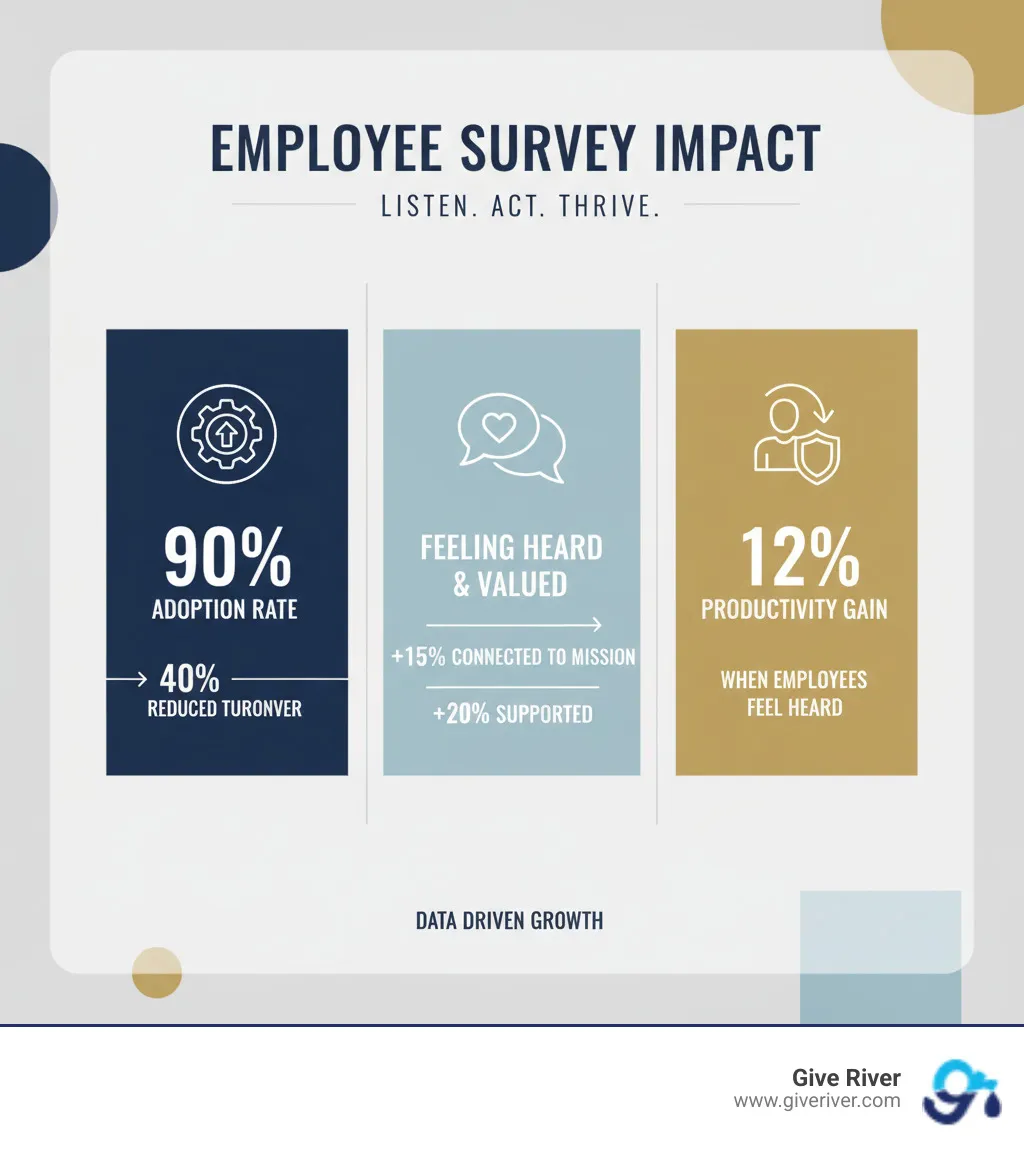
This infographic illustrates how regular employee surveys drive measurable business outcomes: 90% adoption rates lead to 40% reduction in turnover, double-digit increases in feeling supported and connected to mission, and 12% productivity gains when employees feel heard and valued.
Your Guide to Using a Free Employee Survey for Maximum Impact
Employee surveys are your direct line to understanding what's really happening in your organization—the frustrations that fester in silence and the brilliant ideas that never make it past the water cooler. Free employee survey tools give you a structured way to capture it all, measure satisfaction, and drive better business outcomes.
Here are the most common types of surveys you can deploy:
- Engagement surveys dig into emotional commitment and motivation.
- Satisfaction surveys focus on contentment with job roles, work-life balance, and compensation.
- Pulse surveys are short, frequent check-ins (monthly or quarterly) to track sentiment in real-time.
- Exit interviews capture feedback from departing employees to improve retention strategies.
- Onboarding surveys gather feedback from new hires to refine their critical first impression.
- 360-degree feedback collects input from supervisors, peers, and subordinates for a comprehensive view of performance.
Using free employee survey templates removes the guesswork. Pre-designed templates save time, offer expert-designed questions, and provide a standardized structure to compare results over time. When employees see you collecting and acting on their feedback, engagement and retention improve dramatically. For deeper insights, explore our articles on Employee Engagement and Retention and building an effective Employee Satisfaction Platform.
What to Look for in a Free Employee Survey Tool
Free tiers often come with limitations, so your goal is to find the most value without frustrating restrictions.
- Anonymity and confidentiality are non-negotiable for honest feedback. Look for tools that hide individual results until a minimum response threshold (usually 5-10) is met.
- Pre-built templates are massive time-savers, allowing you to launch expert-designed surveys in minutes.
- Question types should include a mix of multiple-choice, rating scales (like the 5-star Likert scale), and open-ended text boxes for both quantitative and qualitative data.
- Response limits vary across free tiers. Know your team size and choose a tool with a cap that works for you (e.g., 500 responses or unlimited).
- Logic capabilities like skip logic personalize the survey experience, making it more relevant and reducing fatigue.
- Customization options let you add your logo and company colors, making the survey feel professional and integrated.
- Ease of use is critical. A drag-and-drop interface allows you to build and deploy surveys quickly.
- Basic reporting and analytics should be standard, offering at least average scores and trend data.
While many platforms excel in specific areas—for example, Bonusly and Kudos are well-known for their strong peer-to-peer recognition features—they may not connect survey data to a broader set of engagement drivers. Give River takes a more holistic approach with our unique 5G Method. We integrate recognition, wellness, and growth so that survey feedback can be tied directly into actionable strategies that boost employee fulfillment. For a deeper dive, check out our Employee Engagement Platform Features.
Best Practices for Designing Effective Survey Questions
Asking the right questions in the right way is key to getting honest, actionable feedback.
- Start with clear objectives. Define what you want to achieve before writing a single question.
- Use clear and concise language. Avoid jargon and complex sentences. Questions should be easy for everyone to understand.
- Mix your question types. Use closed-ended questions (like Likert scales) for quantitative data and open-ended questions for the qualitative “why” behind the numbers.
- Avoid bias. Leading questions (“Don’t you agree…?”) and double-barreled questions (“Are you satisfied with your pay and benefits?”) produce unreliable data. Ask about one thing at a time.
- Reassure employees about anonymity. Explicitly state that their individual responses are confidential to encourage candor.
- Keep it focused. Aim for a survey that takes 10-15 minutes or less to complete to avoid fatigue and increase completion rates.
- Pre-test your survey with a small group to catch confusing questions or technical glitches before a company-wide launch.
Following these practices helps you collect meaningful data. For more insights, check out our Modern Employee Recognition Programs Best Practices and the scientific research on survey design from Pew Research.
Examples of a Free Employee Survey: Questions & Templates
Here are 15 essential questions you can adapt for your next employee survey, covering key areas from culture to growth:
- I understand our company's mission and values.
- Our company culture promotes a positive and inclusive work environment.
- I feel a sense of belonging at our company.
- My manager communicates expectations clearly.
- I feel informed about important company updates and decisions.
- I find my work meaningful and challenging.
- I have the resources and tools needed to do my job effectively.
- My workload is manageable and allows for a healthy work-life balance.
- I have opportunities for professional growth and career advancement.
- My manager supports my development goals.
- I receive constructive feedback that helps me improve.
- I feel recognized and appreciated for my contributions.
- My compensation and benefits package is fair and competitive.
- On a scale of 0-10, how likely are you to recommend our company as a great place to work?
- What is one thing we could do to improve your work experience?
These questions provide a solid foundation. Always tailor them to your specific context and organizational needs. For more inspiration, explore our Employee Pulse Survey Platform and Employee Recognition Examples.
From Data to Action: Analyzing and Acting on Survey Results
Collecting feedback is the easy part. The real test of leadership is what you do with the data. An unaddressed survey is worse than no survey at all—it actively erodes trust and signals that employee voices don't matter.
When feedback disappears into a void, engagement drops and your most candid employees stop sharing. Throughout this process, protecting anonymity is the foundation of honest feedback. At Give River, our system ensures no single response can be traced to an individual. We also allow anonymous comments and provide moderation tools, creating a balance of psychological safety and accountability.

How to Analyze and Share Your Survey Results
Once responses are in, it's time to find the story in the data.
- Identify trends over time. Are satisfaction scores climbing or declining? A score chart showing trends from previous periods reveals patterns you might otherwise miss.
- Benchmark your data. Comparing against your own historical data is highly valuable. If your satisfaction score dropped from 4.2 to 3.5 in one year, you have a clear problem to address.
- Segment results. Break down data by department, tenure, or location. Averages can hide issues; segmentation might reveal that remote workers feel disconnected or new hires are struggling.
- Analyze open-ended comments. These qualitative responses are goldmines of context. Look for recurring themes and specific suggestions.
- Share findings transparently. Present the good, the bad, and the uncomfortable truths to the entire organization. Explain what you learned and what you're committing to change.
- Develop concrete action plans. Vague promises don't work. Assign specific owners, set realistic timelines, and define measurable outcomes. For example, if career development scores are low, an action plan could be to launch a mentorship program by Q2.
Effective HR Data Reporting is crucial for tracking progress. For more on this, see our guide on Employee Engagement Insights.
Common Pitfalls to Avoid When Conducting Surveys
Even with the best free employee survey tools, certain mistakes can undermine your efforts.
- Survey fatigue. Asking for feedback too often or with overly long surveys causes employees to tune out. Supplement annual surveys with short, quarterly pulse surveys.
- Lack of action. This is the cardinal sin. If employees share feedback and nothing changes, they will stop participating and become cynical.
- Breaking anonymity. This instantly destroys trust. Ensure your tools and processes strictly protect respondent identities.
- Unclear or biased questions. Ambiguous or leading questions produce unreliable data that you can't act on.
- Poor timing. Sending surveys during year-end close or major product launches guarantees low participation. Choose a time when employees can be thoughtful.
- Ignoring negative feedback. Don't just highlight positive results. Criticism illuminates the blind spots that surveys are designed to uncover.
This disconnect directly impacts Why Employee Fulfillment Is More Important Than Engagement.
Turning Feedback into a Thriving Workplace Culture
True change happens when you create a Holistic Employee Experience by continuously looping feedback into your strategy.
Closing the feedback loop is non-negotiable. Communicate what you heard, what you're changing, and why. This transparency shows that employee voices drive real decisions. When employees see their feedback lead to tangible change, they feel valued. This creates a virtuous cycle of trust and honest communication, helping you build a Winning Workplace Culture.
While platforms like Bonusly and Kudos are excellent for fostering recognition, their primary focus can limit how you act on broader survey feedback. Our unique 5G Method at Give River takes a more comprehensive approach. We integrate Gratitude (recognition), Gamification (engagement), Generosity (community impact), Guidance (mentorship), and Growth (wellness and learning).
Insights from your free employee survey tell you exactly where to focus. Low recognition scores? Amplify gratitude initiatives. Poor work-life balance? Introduce wellness challenges. This data-driven approach ensures your efforts are targeted and effective, moving beyond superficial engagement to genuine employee fulfillment.
A free employee survey is an investment in your people. It's the first step toward building a workplace where every voice is heard and every contribution is valued.
Ready to transform your workplace with actionable insights? Find how Give River's data-driven approach can help you build happier, healthier, high-performing teams.
More from this category.

Why Most Work Meetings Start on the Wrong Foot (And How to Fix It)
The best 2 truths and a lie ideas for work can transform an awkward, silent meeting opener into a moment your team actually looks forward to. Whether you're onboarding new hires, kicking off a remote all-hands, or just trying to shake off…

The Trust Deficit in Remote Work
Building trust in a virtual team is a critical challenge for modern organizations. While remote work offers flexibility, it can erode team cohesion if not managed intentionally.

Why Connection Building Activities Are the Secret to High-Performing Teams
Connection building activities are structured exercises that help teams develop trust, improve communication, and foster genuine relationships at work — and they're one of the most overlooked drivers of team performance.
See the platform in action.
Free for up to 25 members, or try Core or Growth free for 30 days. A card is required; Free is never charged, and a trial bills when it ends unless you cancel.