Why Most Corporate Training Fails (and How Yours Can Succeed)
Creating elearning content isn't just about putting slides online anymore—it's about building learning experiences that transform behavior, boost performance, and actually stick. Here's what you need to know:

Why Most Corporate Training Fails (and How Yours Can Succeed)
Creating elearning content isn't just about putting slides online anymore—it's about building learning experiences that transform behavior, boost performance, and actually stick. Here's what you need to know:
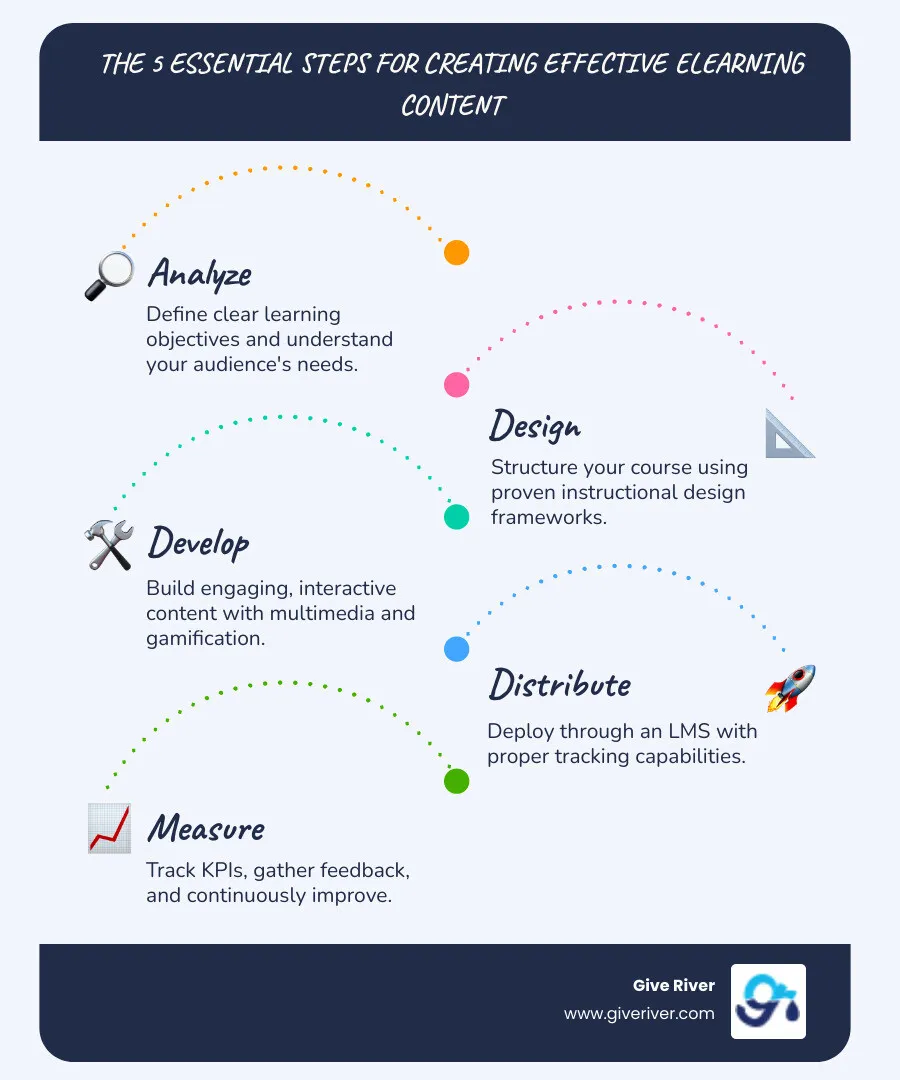
The 5 Essential Steps for Creating Effective eLearning Content:
- Analyze - Define clear learning objectives and understand your audience's needs
- Design - Structure your course using proven instructional design frameworks
- Develop - Build engaging, interactive content with multimedia and gamification
- Distribute - Deploy through an LMS with proper tracking capabilities
- Measure - Track KPIs, gather feedback, and continuously improve
Let's face it—most corporate training is forgettable. Employees click through slides, take a quiz, and promptly forget what they "learned." The problem? Traditional "click-next" training treats learning like a checkbox exercise instead of a transformative experience.
The stakes are high. With 93% of global firms switching to digital learning, many are simply digitizing ineffective approaches. But here's the opportunity: when done right, creating elearning content drives fulfillment, boosts engagement, and builds high-performing teams. The difference isn't budget or technology—it's intentional design that treats learners as humans, not data points.
Effective eLearning engages through interactivity, connects to real-world application, and motivates through gamification. It acknowledges that adults learn differently and remember experiences far better than information dumps. This guide will walk you through creating elearning content that drives both learning outcomes and business impact.
I'm Meghan Calhoun, Co-Founder of Give River. After two decades building high-performing teams, I learned that creating elearning content that combines growth, recognition, and purpose is the key to sustainable performance. That's why we built Give River's 5G Method to transform workplace learning into engaging, fulfilling experiences. Let's explore the framework.
Relevant articles related to creating elearning content:
- AI Video Creation L&D Guide
- Applied AI for Learning and Development Tools and Agents
- AI Tools for Learning and Development
The Core Framework for Creating eLearning Content
Step 1: Laying the Foundation with Clear Objectives and Audience Analysis
Before creating content, understand the "why." Is training the right solution for an observed performance gap, or are there other root causes? The first step in creating elearning content is a thorough training needs analysis, which involves talking to stakeholders and observing workflows to confirm elearning is the right solution.
Once the need is confirmed, define clear, measurable learning objectives using the SMART goal framework. Instead of "Learn cybersecurity," a SMART objective is: "By the end of this 20-minute module, employees will be able to identify and report three common phishing attempts." These objectives guide all content development.
Next, get to know your audience by creating learner personas—profiles representing their roles, experience, and motivations. Tailoring content to their needs and answering "What's in it for me?" is crucial for engagement. Finally, align learning objectives with broader business goals to demonstrate how improved skills translate into organizational success.
Step 2: Structuring and Developing Your Course for Effective eLearning Content Creation
With clear objectives and audience analysis, we structure the learning journey using instructional design models like ADDIE or frameworks like Bloom's Taxonomy. Bloom's helps categorize objectives from basic recall to higher-order skills like creating and evaluating, ensuring a well-rounded experience.
Storyboarding is the blueprint, mapping the course flow, content, media, and interactions. A prototype—a functional draft in an authoring tool—allows stakeholders to review the course early and provide feedback. Content is gathered by collaborating with Subject Matter Experts (SMEs), reviewing existing resources, and conducting research to ensure accuracy.
Key structural elements include an introduction, learning objectives, main content (with mixed media), practice activities, knowledge checks, a summary, and additional resources.
When creating elearning content, AI tools can streamline the process. AI can generate drafts, quizzes, and media assets. Give River's AI capabilities, for example, transform raw data into engaging modules, personalize learning paths, and generate AI avatars for video content. This allows teams to focus on the human-centered design elements that make learning stick.
Step 3: Boosting Engagement with Interactivity and Visual Design
Passive learning is forgettable. To make training stick, infuse it with interactivity and thoughtful visual design.
Interactive elements are the lifeblood of engaging elearning. Use quizzes for formal assessment, knowledge checks for informal reflection, branching scenarios for decision-making practice, and drag-and-drop or click-to-reveal interactions to chunk content.
Gamification is another powerful tool and central to Give River's 5G Method. We go beyond badges to tap into intrinsic motivations with points, leaderboards, and challenges. Unlike platforms with basic features like Bonusly or Kudos, Give River integrates gamified learning into a broader ecosystem of recognition and growth, making it a celebrated part of the employee journey.
Visual design and user-friendly interfaces are paramount. Prioritize clarity, simplicity, purposeful visuals, readability, and intuitive navigation. Good design respects the learner and prevents them from getting lost or overwhelmed.
Video is also powerful, with 83% of people preferring it for instructional content. Use it for demonstrations and storytelling, but don't forget captions. 80% of viewers are more likely to watch a captioned video, and it boosts retention.
Accessibility and inclusion are non-negotiable. Follow WCAG guidelines by providing alt text, captions, keyboard navigation, and proper color contrast. AI can help by automating video dubbing and subtitles, making content more inclusive globally.
Step 4: Distributing and Measuring Your eLearning Program
Once developed, content must be distributed effectively and its impact measured. A Learning Management System (LMS) is the central hub for this. Give River integrates with your existing LMS, enhancing it with our 5G Method for a more engaging experience. Learn more in our Learning and Development Solution.
To ensure compatibility, publish courses using standards like SCORM for basic tracking or xAPI for more detailed data on learner interactions.
Measuring success goes beyond completion rates. Track Key Performance Indicators (KPIs) like knowledge retention, skill application, changes in performance metrics, and learner satisfaction. Gather learner feedback through surveys and analytics to identify areas for improvement and iterate on the content.
Give River differentiates itself by integrating learning into a holistic framework. Unlike standalone recognition tools like Bonusly or Kudos, our 5G Method weaves learning into daily work through guided growth and gamified achievements. This ensures your investment in creating elearning content translates into tangible improvements in fulfillment, productivity, and retention.
Elevating Your eLearning: Advanced Strategies and Future Trends
The Future of Creating eLearning Content: AI, Immersive Tech, and Microlearning
The elearning landscape is constantly evolving. Staying ahead means embracing trends that make creating elearning content more impactful.
One of the most transformative trends is the integration of Artificial Intelligence (AI). AI is key in content creation and personalizing learning paths. Adaptive learning, powered by AI, tailors content to each learner's needs and pace. AI can also provide instant feedback, automate grading, and offer data-driven insights. At Give River, we use AI to improve our 5G Method with personalized guidance and gamified experiences. For a deeper dive, check out our Applied AI for Learning and Development Tools and Agents and Best AI Tools L&D Teams 2024.
Immersive learning, utilizing Virtual Reality (VR) and Augmented Reality (AR), replicates real-world situations in a safe online environment, perfect for practicing technical or problem-solving skills.
Microlearning breaks content into digestible 5-10 minute chunks, preventing cognitive overload for busy professionals. This mobile-friendly approach meets learners where they are. Our Micro Learning for Training Employees article provides more insights into this effective strategy.
These trends—AI, immersive tech, and microlearning—improve personalization and engagement, which are core to Give River's 5G Method of guiding learners through custom, gamified experiences.

Strategic Decisions: In-House vs. Outsourcing and Proving ROI
When creating elearning content, organizations must decide whether to develop in-house or outsource. Both approaches have merits.
Creating custom e-learning content is highly beneficial, as it aligns with company culture and addresses specific performance gaps, leading to higher engagement.
In-house development offers maximum control and builds internal expertise but requires significant resources and time—an average of 48 hours to create a 20-minute e-learning course. Outsourcing provides external expertise and can be faster and more cost-effective for large projects. A hybrid approach often strikes the best balance.
Regardless of the method, proving ROI (Return on Investment) is essential. Measure ROI by comparing development costs to benefits like increased productivity, better performance, and higher retention. Connecting learning outcomes to business metrics builds a strong case for interactive, gamified training.
Give River's 5G Method supports this by making learning a rewarding and recognized activity. By guiding employees through gamified learning paths, the ROI of elearning extends beyond cost savings to building a happier, higher-performing team. This lifts creating elearning content from a task to a strategic imperative.
Conclusion
Creating elearning content that truly sticks is no longer a luxury; it's a necessity for fostering an engaged, high-performing workforce. By following a systematic approach—from analyzing needs and defining clear objectives, to structuring content with instructional design principles, boosting engagement with interactivity and visual appeal, and finally, distributing and measuring its impact—we can transform passive training into transformative learning experiences.
The future of elearning is bright, with AI, immersive technologies, and microlearning offering incredible opportunities for personalization and engagement. Whether developing in-house or strategically outsourcing, the focus must remain on the learner and the measurable outcomes we aim to achieve.
At Give River, we believe that learning and development should be an empowering and fulfilling journey. Our unique 5G Method provides the tools and framework to make that a reality, integrating guided growth, gamified experiences, gratitude, and generosity into every aspect of employee development.
Ready to build a learning experience that truly captivates your employees and drives measurable results?
Find how Give River can transform your Learning and Development strategy today.
More from this category.

Why Most Work Meetings Start on the Wrong Foot (And How to Fix It)
The best 2 truths and a lie ideas for work can transform an awkward, silent meeting opener into a moment your team actually looks forward to. Whether you're onboarding new hires, kicking off a remote all-hands, or just trying to shake off…

The Trust Deficit in Remote Work
Building trust in a virtual team is a critical challenge for modern organizations. While remote work offers flexibility, it can erode team cohesion if not managed intentionally.

Why Connection Building Activities Are the Secret to High-Performing Teams
Connection building activities are structured exercises that help teams develop trust, improve communication, and foster genuine relationships at work — and they're one of the most overlooked drivers of team performance.
See the platform in action.
Free for up to 25 members, or try Core or Growth free for 30 days. A card is required; Free is never charged, and a trial bills when it ends unless you cancel.