Why Applied AI for Learning and Development Matters Now
Applied AI for learning and development: tools and agents are reshaping how organizations train and support employees. But with every vendor slapping "AI-powered" on their products, cutting through the hype to find what's truly useful is a…

Why Applied AI for Learning and Development Matters Now
Applied AI for learning and development: tools and agents are reshaping how organizations train and support employees. But with every vendor slapping "AI-powered" on their products, cutting through the hype to find what's truly useful is a major challenge. Most L&D teams are still trying to distinguish genuine AI from clever marketing while drowning in administrative tasks.
The reality is, AI isn't replacing L&D jobs—it's rewriting them. With 75% of companies ranking AI as a top-3 priority, understanding its role is critical. This guide will help you steer the landscape by clarifying the key differences between:
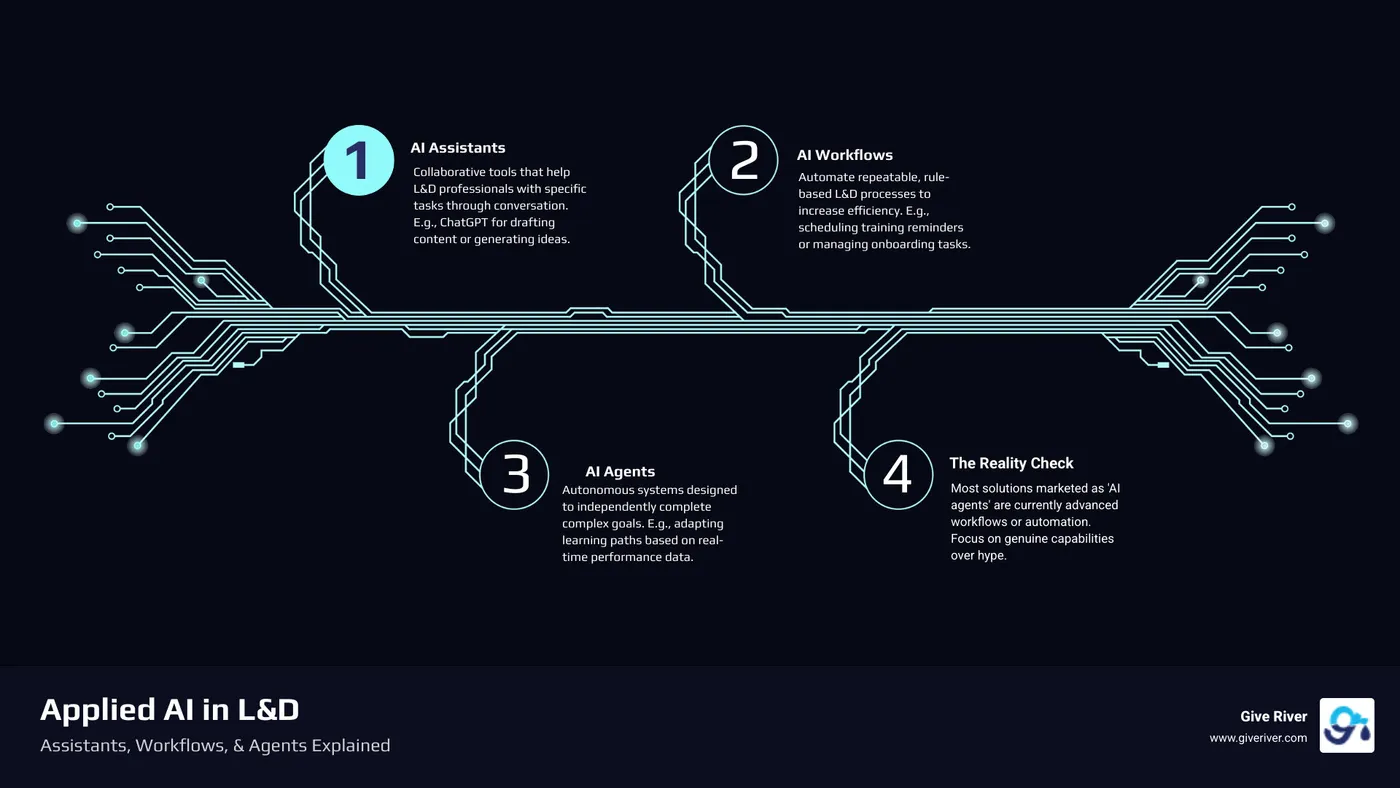
- AI Assistants: Collaborative tools that help with tasks through conversation (e.g., drafting content).
- AI Workflows: Systems that automate repeatable, rule-based processes (e.g., scheduling reminders).
- AI Agents: Autonomous systems that independently complete complex tasks to achieve goals (e.g., personalizing learning paths).
The gap between AI's promise and L&D's reality is wide, but bridgeable. Strategic AI use can lead to higher topic mastery, better adoption rates, and reduced turnover. This guide delivers a clear roadmap for adopting AI effectively and ethically.
I'm Meghan Calhoun, Co-Founder of Give River. We focus on holistic employee fulfillment by integrating AI into a framework of gratitude, growth, and guidance. Unlike platforms such as Bonusly or Kudos that add AI to existing recognition tools, we use it to create a more natural and impactful development experience.
Explaining AI in L&D: From Assistants to Autonomous Agents
The landscape of applied AI for learning and development: tools and agents can be confusing. Let's clarify the core concepts to help you steer this new ecosystem.
Assistants vs. Agents: What's the Real Difference for L&D?
The distinction is about autonomy.
- An AI assistant is like a travel agent: You provide requests, and it provides options and answers. In L&D, assistants like ChatGPT help you draft course outlines or brainstorm ideas. They are collaborative partners.
- An AI agent is like a self-driving car: You set a destination, and it handles the journey. In L&D, an agent might be tasked to "ensure all new hires complete compliance training," and it will autonomously monitor progress, identify struggling learners, and deliver customized support.
The key difference is that assistants help you complete tasks, while agents complete tasks for you.
| Characteristic | AI Assistant | AI Agent |
|---|---|---|
| Autonomy | Low to Medium | High |
| Goal | Help user complete a task | Independently achieve a goal |
| Interaction | Conversational, reactive | Proactive, dynamic, works in background |
| Example Task | Draft a course outline | Adapt learning path based on learner performance |
The Hype vs. Reality: Understanding AI Workflows and True Agents
The term "AI agent" is overused; experts estimate 90% of solutions marketed as agents are actually AI workflows.
- AI Workflows chain together multiple steps, some using AI, but the overall flow is predetermined and rule-based. They are excellent for predictable processes like sending training reminders or generating standard reports.
- True AI Agents are goal-oriented. They observe, make decisions, and use available tools to achieve an objective, adapting as they go. They don't just follow a script; they figure out the best path dynamically.
For simple, repeatable tasks, an AI workflow is efficient. Reserve true agents for complex goals that require dynamic problem-solving.
Practical Use Cases for Applied AI in Learning and Development
Genuine applied AI for learning and development: tools and agents can fundamentally change how L&D operates. Key applications include:
- Personalized learning paths: AI agents can observe learner progress, identify knowledge gaps, and dynamically adjust learning journeys with content in each user's preferred format.
- Real-time feedback and coaching: AI provides immediate, contextual guidance in simulations, like sales training. Research on AI-assisted tutoring shows such systems can improve student mastery significantly and affordably.
- Automated content creation: Agents can generate entire learning experiences—courses, assessments, and job aids—and automatically update them when regulations change.
- Adaptive assessments: AI adjusts question difficulty in real-time based on learner performance, creating a more accurate and personalized evaluation.
- Proactive skill gap analysis: By analyzing performance data, AI can identify and address skill gaps across the organization before they become critical.
- Administrative automation: Free your team from enrollment, scheduling, and reporting to focus on high-value strategic work.
Integrating Agentic AI: Technical Challenges and Data Quality
Implementing these systems comes with challenges. Be prepared to address:
- LMS Integration: Many legacy LMS platforms have limited APIs, hindering communication with AI agents.
- Data Synchronization: Real-time, accurate data flow between your AI and LMS is critical. Discrepancies lead to incorrect recommendations and compliance issues.
- Data Security and Compliance: Granting AI access to learner data requires robust security, clear privacy policies, and compliance with regulations like GDPR.
- Data Quality: AI is only as good as the data it's trained on. The "garbage in, garbage out" principle applies, so clean and accurate data is essential.
- Prompt Engineering: L&D professionals must learn to write clear, precise instructions (prompts) to guide AI effectively. Building prompt libraries ensures consistency.
- System Explainability: You must be able to understand why an AI made a certain decision to ensure fairness, troubleshoot issues, and build trust.
Addressing these technical problems is crucial for success. At Give River, we integrate AI into a holistic employee fulfillment framework, addressing data and integration from the ground up to ensure AI adoption feels natural, not bolted-on.
A Strategic Roadmap for Implementing Applied AI for Learning and Development: Tools and Agents
Adopting applied AI for learning and development: tools and agents requires a thoughtful strategy, not just enthusiasm for new tech. It's about rethinking how L&D serves your people and business goals.
Building Your AI Strategy for Applied AI in Learning and Development

A successful AI implementation starts with a clear plan.
- Define the Problem: Start by asking, "What problem are we trying to solve?" Identify specific, measurable issues, like slow new hire onboarding or low compliance training engagement. These become your North Star.
- Align with Business Goals: Ensure your AI initiatives support top-level business objectives. When leaders see AI as a solution to their challenges, you gain a strategic partnership.
- Pilot Before You Scale: Don't try to do everything at once. Choose one specific team or program for a pilot project. This allows you to test, learn, and iterate without risking major resources.
- Assess AI Readiness: Honestly evaluate your current state. Do you have clean data? Does your LMS have functional APIs? Understanding your capabilities highlights where you need to invest first.
- Measure ROI: Track both efficiency and effectiveness.
- Efficiency Metrics: Measure time and money saved on administrative tasks, content development, and updates.
- Effectiveness Indicators: Track improvements in skill acquisition, job performance, and key business outcomes like sales or retention.
The Human Element: Skills, Ethics, and Governance in the AI Era
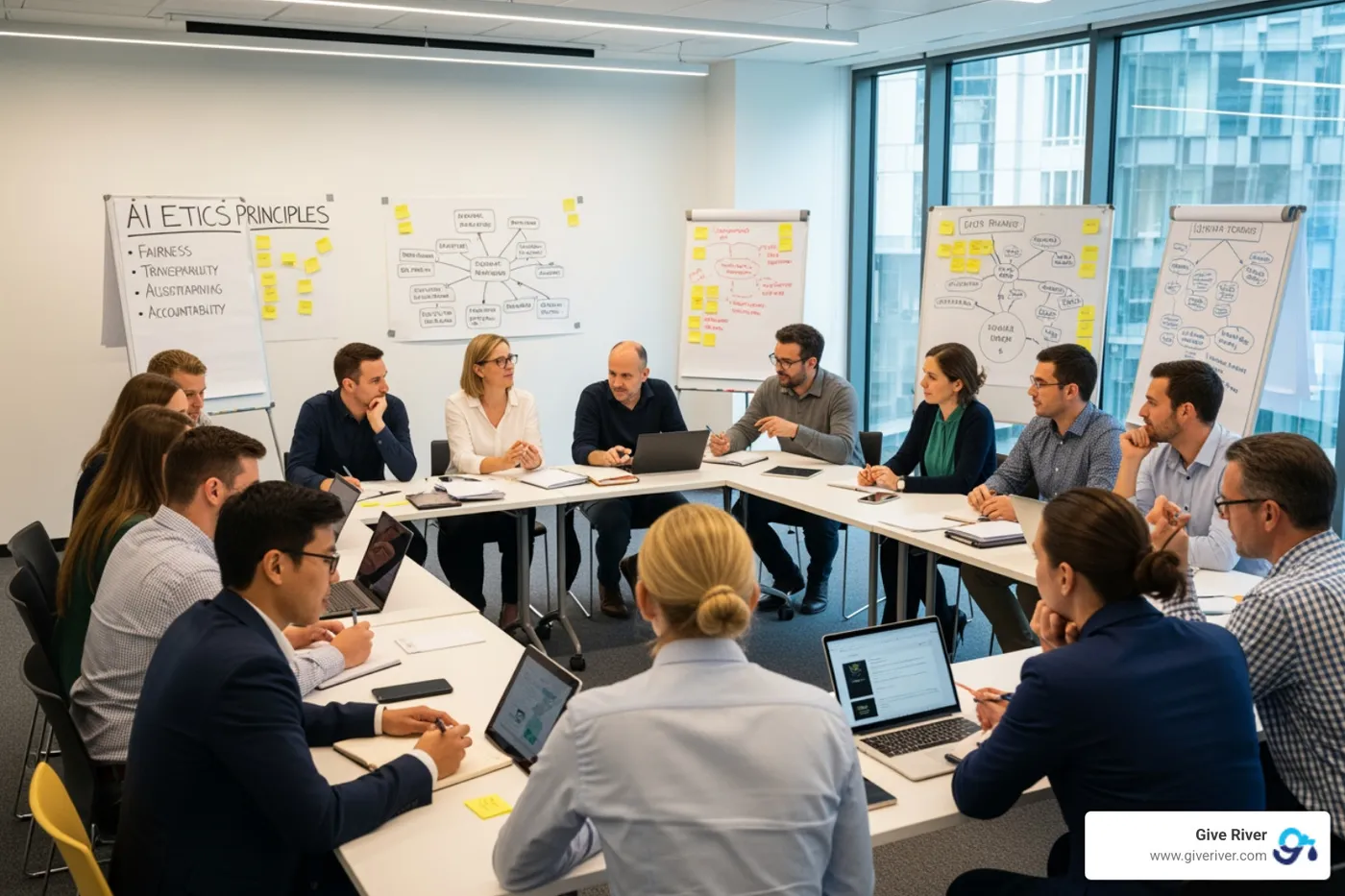
As AI tools become more advanced, human skills become more critical. The L&D role is evolving from administrator to a more strategic architect. Key skills now include:
- Strategic Thinking: Determining which learning interventions will drive business goals.
- Data Literacy: Interpreting learning analytics to make informed decisions.
- Ethical Oversight: Acting as the guardian to ensure AI systems are used fairly and respectfully.
- Change Management: Guiding your organization through the transition to AI-augmented work.
Establishing AI governance is about creating guardrails for responsible innovation.
- Address Algorithmic Bias: AI models reflect the data they're trained on. Audit your data for representation gaps and regularly check AI recommendations for fairness.
- Ensure Responsible Use: Safeguard learner data, ensure AI decisions are explainable, and establish clear boundaries for what AI can do autonomously versus what needs human approval.
At Give River, we've seen platforms like Bonusly and Kudos add AI features to recognition tools. Our approach is different. We believe AI must serve a broader purpose of fostering genuine growth and human connection. Our 5G Method (Gratitude, Guidance, Growth, Gamification, and Generosity) ensures AI is a supportive partner in our mission, not the mission itself. This makes AI a tool for holistic employee fulfillment.
Conclusion: Partnering with AI to Build a Future-Ready Workforce
Here's the truth about applied AI for learning and development: tools and agents: it's not here to replace you, but to partner with you. Think of AI as a force multiplier for your capabilities, handling the tedious administrative work so you can focus on what truly matters—strategic design, human connection, and creating impactful learning experiences.
The future of L&D is both human-centered and AI-powered. By strategically adopting AI, you can scale your efforts, deliver personalized development to every employee, and reduce burnout. This isn't just about technology; it's about creating a workforce that is not only skilled but also deeply fulfilled.
At Give River, our commitment is to holistic employee fulfillment. While platforms like Bonusly and Kudos add AI to their tools, we see it as part of a larger mission. Our 5G Method—Gratitude, Guidance, Growth, Gamification, and Generosity—ensures AI serves a deeper purpose, amplifying human connection rather than replacing it. By embracing AI wisely, we can build a future-ready workforce where every individual can thrive.
More from this category.

Why Choosing the Right Learning and Development Platforms Matters in 2026
Learning and development platforms have become one of the most critical investments a company can make — yet with over 800 competing systems on the market, finding the right fit feels overwhelming.

Why Investing in Career Development is a Win-Win
A career development program sample gives HR leaders and CEOs a concrete starting point for building structured, meaningful growth pathways for their teams — without having to reinvent the wheel. Here are seven proven program types you can…

Why Your L&D Toolkit Defines Your 2026 Workforce
Learning and development (L&D) tools are digital platforms that help organizations create, deliver, and optimize employee training. Companies with strong training programs see 218% higher income per employee and can reduce turnover by 40%…
See the platform in action.
30-day free trial. No credit card. River Guide included on Core and Growth.