Why the Employee Engagement Crisis Demands a Comprehensive Toolkit
An employee engagement toolkit is a comprehensive collection of resources, strategies, and tools designed to measure, understand, and improve employee engagement across an organization. It typically includes:

Why the Employee Engagement Crisis Demands a Comprehensive Toolkit
An employee engagement toolkit is a comprehensive collection of resources, strategies, and tools designed to measure, understand, and improve employee engagement across an organization. It typically includes:
- Survey instruments (like Gallup's Q12) to measure engagement levels
- Communication templates for different employee lifecycle stages
- Action planning frameworks to turn data into results
- Recognition and reward programs to celebrate contributions
- Development resources to support growth and learning
- Management guides to help leaders drive engagement daily
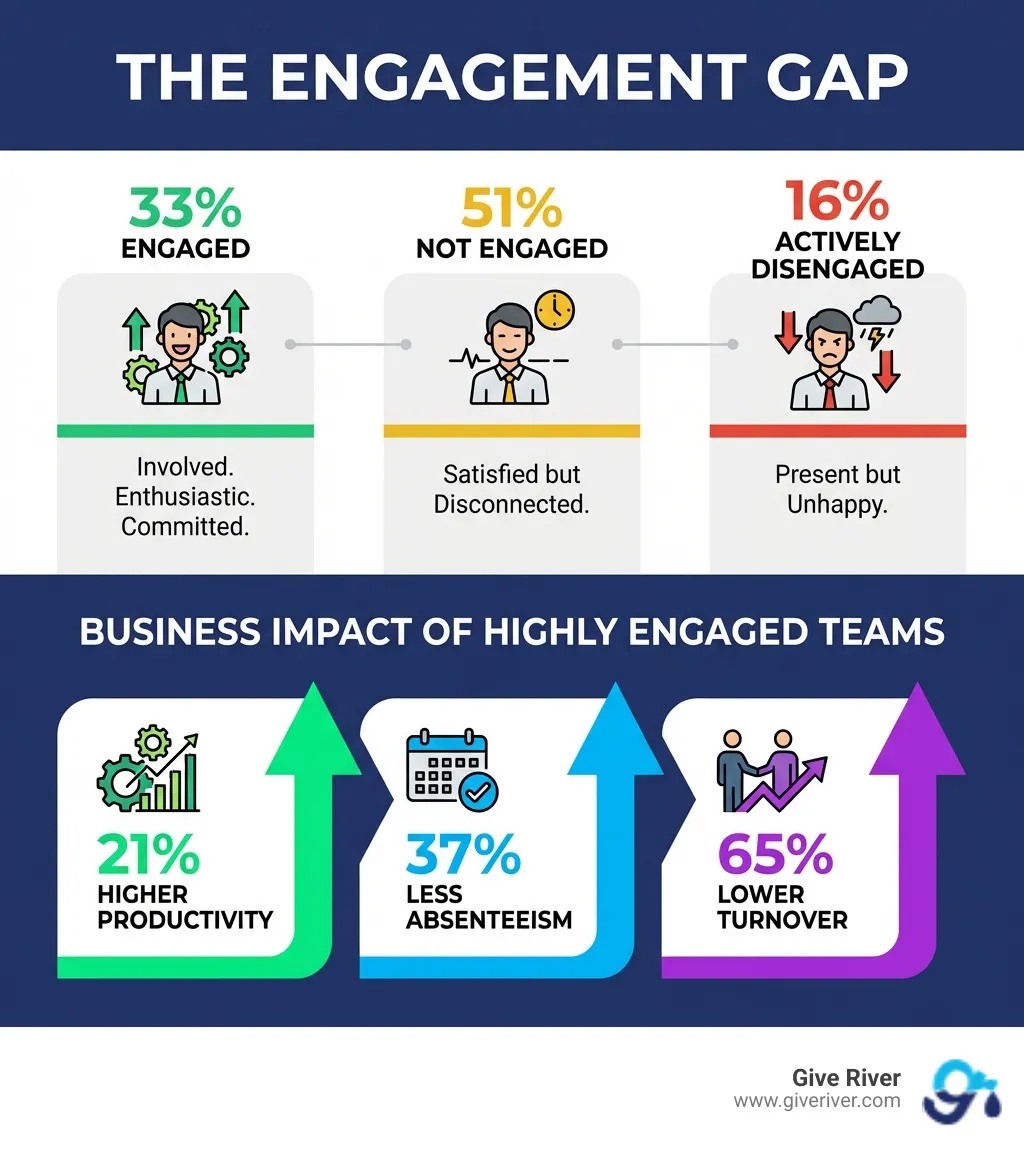
Only 33% of full-time employees in the American workforce are engaged at work. The rest? They're either going through the motions or actively working against your organization's success. This isn't just a "people problem"—it's a business crisis costing companies billions in lost productivity, safety incidents, and turnover.
The workplace trends we're seeing—quiet quitting, the hunt for "lazy girl jobs," and unprecedented turnover rates—aren't signs that employees have gotten lazy. They're symptoms of a fundamental disconnect between what organizations offer and what people actually need to thrive.
Here's what makes this urgent: the gap between engaged and disengaged employees directly impacts your bottom line. Teams with high engagement experience 21% higher productivity, 37% less absenteeism, and 65% lower turnover. Yet most organizations are still treating engagement as an annual survey event rather than a daily practice.
The traditional approach—pizza parties, generic recognition platforms, and once-a-year feedback—isn't working. Platforms like Bonusly and Kudos have made strides in digital recognition, but true engagement requires more than transactional praise. Unlike these point-focused platforms, Give River’s 5G Method addresses the complete employee experience by weaving together recognition with professional development and social purpose. It requires a systematic approach that addresses the complete employee experience: how people are recognized, how they grow, how they connect to purpose, and how managers support them daily.
The difference between job satisfaction and genuine engagement is emotional commitment. Satisfied employees show up and do their jobs. Engaged employees bring 44% greater discretionary effort and are 33% less likely to leave. That's the difference between a team that performs adequately and one that drives innovation, delights customers, and weathers challenges together.
I'm Meghan Calhoun, Co-Founder of Give River, and I've spent over two decades in high-pressure sales environments and leadership roles learning what actually drives sustainable performance—often by burning out first and rebuilding better. After nearly losing myself to the "grind harder" mentality, I developed the 5G Method that powers our employee engagement toolkit: a comprehensive approach integrating Guided support, Gamification, Gratitude, Growth, and Generosity to build teams that don't just perform well for a quarter, but thrive for years.
Common employee engagement toolkit vocab:
- employee communication and engagement platform
- platform for employees to share ideas
- talent engagement platform
Building a High-Impact employee engagement toolkit
To build a workforce that doesn't just show up but actually speaks up and steps up, we need a structured approach. An effective employee engagement toolkit isn't a dusty PDF on the company intranet; it’s a living set of resources that helps managers steer the complexities of human motivation.
When we look at the spectrum of engagement, it’s helpful to categorize employees into three distinct groups. Understanding these differences is the first step in moving the needle on performance and enhancing workplace culture.

| Employee Type | Characteristics | Impact on Business |
|---|---|---|
| Engaged | Enthusiastic, loyal, and proactive. They drive innovation and provide high levels of discretionary effort. | Boosts productivity by 21% and significantly lowers turnover. |
| Not Engaged | "Checked out." They are satisfied enough to stay but put in the bare minimum effort. Disconnected from goals. | Neutral impact, but represents a massive opportunity for growth. |
| Actively Disengaged | Unhappy and resentful. They act out their unhappiness and undermine what their engaged coworkers accomplish. | Toxic to culture; increases safety incidents and absenteeism. |
Scientific research on the impact of employee engagement on business growth proves that these categories aren't just HR theory—they are direct predictors of your company’s financial health.
The Foundation: Gallup Q12 and Measuring Success in Your employee engagement toolkit
At the heart of any world-class employee engagement toolkit is a reliable way to measure the "unmeasurable." We rely heavily on the Gallup Q12 framework, which identifies 12 core elements that predict high performance. These elements follow a hierarchy of needs, starting from the base:
- Basic Needs: Do I know what is expected of me? Do I have the materials and equipment to do my work right?
- Individual Needs: Do I have the opportunity to do what I do best every day? Have I received recognition in the last seven days?
- Teamwork: Does my supervisor care about me as a person? Is there someone who encourages my development?
- Growth: In the last six months, has someone talked to me about my progress? Have I had opportunities to learn and grow?
To interpret these results, we look at the Grand Mean (the average score of the 12 items) and the Net Promoter Score (NPS), which measures how likely employees are to recommend your organization as a great place to work. For deeper dives, check out our employee engagement survey best practices and employee engagement insights.
Lifecycle Communication: From New Starters to Nest Pensions
Engagement isn't a one-time event; it’s a journey that spans the entire employee lifecycle. Your employee engagement toolkit should provide custom communication for every stage:
- New Starters: First impressions are everything. A structured induction that clearly explains benefits—including workplace pensions—sets the tone for a long-term relationship.
- Re-enrolment: For UK-based employers, Nest Pensions offers a specific toolkit to help communicate pension duties. This ensures employees understand the value of their "future pay" and feel the organization is investing in their long-term security.
- Leavers: Even when someone leaves, engagement matters. A positive offboarding process preserves your employer brand and keeps the door open for "boomerang" employees.
Using resources like the Nest Pensions toolkit allows you to integrate complex benefit communication into your broader strategies for employee engagement. When employees understand their total rewards package, employee engagement and retention naturally increase.
Managerial Action Plans and Team Discussions
Managers account for at least 70% of the variance in employee engagement scores. This means your employee engagement toolkit must empower them to lead "Engagement Talks."
Instead of just presenting data, we encourage managers to use storytelling. Sharing a "Customer Impact Story" or a "Team Strength Story" builds emotional commitment far more effectively than a bar chart ever could.
The goal is to turn survey data into a collaborative action plan. We suggest focusing on the "First Six" Q12 items first—the foundational needs. If a team doesn't have the right tools (Q2), talking about their "mission and purpose" (Q8) will likely fall on deaf ears. For more tactical advice, explore our top 30 team member engagement survey questions to boost engagement and our guide on boosting employee engagement.
Sustaining Culture: Tools for Long-Term Growth
Engagement is not a project with a finish line; it is a continuous cycle of listening, acting, and recognizing. To sustain a high-performance culture, your employee engagement toolkit needs to move beyond the "what" and into the "how" of daily habits.
At Give River, we believe that long-term growth is fueled by what we call the 5G Method. This framework ensures that engagement isn't just a top-down mandate but a bottom-up movement.
Essential Components of a Modern employee engagement toolkit
A modern toolkit must be holistic. While platforms like Bonusly and Kudos provide excellent peer-to-peer recognition, they often focus primarily on the transactional side of rewards. Give River differentiates itself by moving beyond simple points-based systems to integrate professional growth, gamified team building, and community impact into a single, cohesive experience. A truly comprehensive talent engagement software complete guide should include:
- Recognition: Moving beyond "Employee of the Month" to real-time, values-based appreciation. See these employee recognition examples for inspiration.
- Wellness: Supporting the whole person, not just the worker. This includes mental health resources and physical wellness challenges.
- Professional Growth: Providing "bite-sized" learning and clear career pathing.
- Gamification: Using friendly competition and rewards to make development fun and engaging. Check out our employee engagement platform features to see how this works in practice.
- Community Impact: Connecting work to a larger purpose through social responsibility and generosity.
Driving Business Outcomes through Engagement
Why do we invest so much energy into an employee engagement toolkit? Because the ROI is undeniable. Scientific research on how employee engagement improves productivity and safety shows that high-engagement teams see:
- 21% Higher Productivity: Engaged employees work smarter and stay focused.
- 37% Less Absenteeism: When people feel valued, they want to show up.
- 65% Lower Turnover: Retention is the natural byproduct of a fulfilling culture.
- 48% Fewer Safety Incidents: Engaged workers are more mindful and aware of their environment.
- 10% Higher Customer Ratings: Happy employees create happy customers.
This connection between employee engagement and motivation is the engine that drives sustainable business growth.
Implementing the Give River 5G Method
We designed Give River to be the ultimate "engagement engine" for your organization. Our platform doesn't just measure engagement; it facilitates it through our signature 5G Method:
- Guided: We provide managers with the frameworks and "Engagement Talks" they need to lead effectively.
- Gamified: We turn culture-building into a rewarding experience, using points and leaderboards to drive participation.
- Gratitude: We make peer-to-peer recognition seamless and frequent through our recognition platform and peer-to-peer recognition activities.
- Growth: We integrate professional development content directly into the workflow, ensuring every role feels like a stepping stone to something greater.
- Generosity: We allow teams to turn their hard-earned rewards into community impact, fostering a sense of purpose.
By using these tools, you ensure that engagement remains visible and sustainable. You can find more details in our boosting employee engagement ultimate guide or explore our team building solutions to see how we can help you unite your workforce.
Conclusion: Writing Your Team's Engagement Story
An employee engagement toolkit is more than a set of documents; it is a commitment to your people. Whether you are using Nest Pensions' templates to explain benefits or utilizing Gallup's Q12 to diagnose team needs, the goal is the same: to create a workplace where people feel seen, heard, and valued.
Engagement is personal. It happens in the small moments—the seven-day recognition check-in, the career development chat, and the shared celebration of a team win. By moving beyond buzzwords and implementing a structured, data-driven, and human-centered toolkit, you aren't just improving "metrics." You are building a high-performing team that is resilient, innovative, and genuinely fulfilled.
It’s time to write the next chapter of your team’s engagement story. Are you ready to transform your culture from "not engaged" to "unstoppable"?
Ready to see how the 5G Method can revolutionize your workplace? Explore our team building solutions today.
More from this category.
What Is a Digital Engagement Platform? (And Why It Matters Right Now)
Understanding the digital engagement platform definition starts with a simple idea: it's a technology framework that centralizes how an organization communicates with, supports, and motivates its people — employees or customers — across…

Understanding Gamification in the Workplace
Employee disengagement is a significant concern for many organizations today, impacting productivity and morale. Employee engagement through gamification offers an innovative solution by changing mundane tasks into exciting experiences. By…

Why Most Managers Are Flying Blind on Team Engagement
The best employee engagement tools for managers in 2025 include:
See the platform in action.
30-day free trial. No credit card. River Guide included on Core and Growth.