Why Total Rewards Matter More Than Ever for Your Business
Total rewards represent everything of value that your organization provides to employees in exchange for their work—encompassing not just salary and benefits, but also well-being programs, career development opportunities, recognition, and…

Total rewards represent everything of value that your organization provides to employees in exchange for their work—encompassing not just salary and benefits, but also well-being programs, career development opportunities, recognition, and meaningful work.
Quick Definition:
- Total Compensation = Salary + bonuses + commissions + equity
- Benefits = Health insurance + paid time off + retirement plans
- Total Rewards = Compensation + Benefits + Well-being + Career Growth + Recognition + Work-Life Balance + Purpose
The stakes have never been higher. While 63% of workers would choose better work-life balance over higher pay, and 52% would accept a 5% pay cut for remote work flexibility, most organizations still lead with compensation alone when attracting and retaining talent. This disconnect is costing businesses dearly—with salaries now consuming 45% of operating expenses (up from 40.9% in 2022) and 56% of HR professionals reporting ongoing retention challenges.
The old playbook is broken. Traditional approaches that treat employees as resources to be compensated rather than humans to be fulfilled are driving the turnover crisis. Among Americans who quit their jobs in 2021, 63% cited low pay, but critically, 45% pointed to lack of flexibility and 43% to poor benefits. Money matters, but it's not everything.
The paradigm shift: Organizations winning the war for talent aren't just offering competitive salaries—they're building comprehensive total rewards strategies that address employees' financial, physical, emotional, and professional well-being. These programs combine compensation, benefits, wellness initiatives, career development, and recognition into an integrated system that drives engagement, reduces turnover, and creates sustainable high performance.
As Meghan Calhoun, Co-Founder of Give River, I've spent two decades in high-pressure sales and team leadership roles learning what truly drives fulfillment, and I've applied those insights to help organizations build total rewards strategies that create happier, healthier, high-performing teams. In this comprehensive guide, we'll explore how to design, implement, and communicate a total rewards program that transforms your workplace culture and delivers measurable business results.
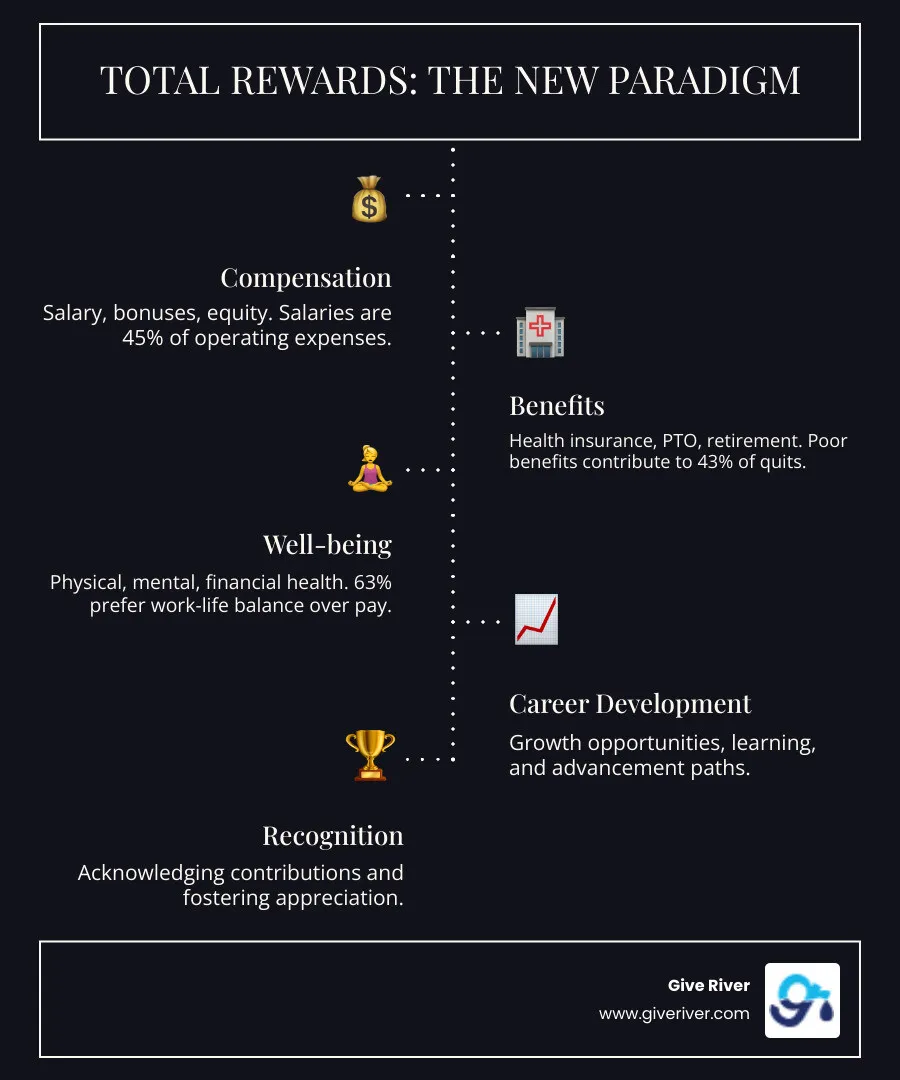
Key terms for total rewards:
The Core Components of a Modern Total Rewards Strategy

When we talk about a modern total rewards strategy, we are looking at a strategic portfolio of commitments. It is no longer enough to just hand over a paycheck and hope for the best. To truly nurture a skilled and engaged workforce, we must look at the "whole person" who shows up to work every day.
In today's market, compensation and benefits are among the largest expenses for any organization. In fact, research shows that by 2025, the median share of operating expenses attributed to salaries will rise to 45%. When managed strategically, these expenses aren't just costs—they are investments that deliver outsized returns in retention and engagement. You can learn more about how to design rewards that deliver to ensure your investment pays off.
Beyond Pay: The Five Pillars of Total Rewards
A successful total rewards program isn't a single item; it's an ecosystem. According to the WorldatWork model, there are five strategic elements that every leader should focus on:
- Compensation: This is the baseline. It includes fixed pay (salary) and variable pay (bonuses, commissions, and equity).
- Benefits: These provide security. Think health insurance, retirement plans, and paid time off.
- Well-being: This is the "hidden" driver of productivity. It encompasses physical, emotional, and financial wellness programs.
- Career Development: Employees stay when they see a future. This includes training, mentorship, and clear paths for advancement.
- Recognition: Humans crave appreciation. This involves formal and informal programs that acknowledge employee contributions.
Beyond these pillars, we often see high-performing cultures thrive by offering non-monetary incentives such as:
- Flexible work arrangements (remote or hybrid options)
- Mentorship programs
- Volunteer time off (VTO)
- Meaningful work that aligns with personal values
- A positive, inclusive work climate
Total Rewards vs. Total Compensation and Benefits
It is easy to get these terms mixed up, but the differences are crucial for your strategy. We like to think of them as concentric circles.
| Feature | Total Compensation | Benefits | Total Rewards |
|---|---|---|---|
| Financial Pay | Yes (Salary/Bonuses) | No | Yes |
| Health & Welfare | No | Yes | Yes |
| Work-Life Balance | No | No | Yes |
| Recognition | No | No | Yes |
| Career Growth | No | No | Yes |
While total compensation focuses on the "what" (the money), and benefits focus on the "how" (the security), total rewards focus on the "why." It is the holistic value proposition that makes an employee say, "I belong here."
Influencing Factors: Internal and External Drivers
Designing a total rewards strategy isn't done in a vacuum. We must account for the world around us. External factors like the labor market, inflation (which rose at a 2.7% annual pace in late 2025), and the rapid rise of AI technology are constantly shifting employee expectations. For instance, AI can automate mundane tasks, but it also creates a greater need for human-centric rewards like "upskilling" and emotional well-being support.
Internal factors are just as vital. Your organization's culture, business lifecycle (are you a scrappy startup or a mature enterprise?), and leadership style will dictate what rewards resonate most. If your culture is built on innovation, your rewards should prioritize professional growth. If it's built on stability, your benefits package might lead the way.
It is also important to remember the human element. Research from Pew Research Center found that while low pay was a top reason for quitting in 2021, feeling disrespected and having no opportunities for advancement were nearly as significant. Your strategy must address these "feeling" factors to be effective.
Designing and Communicating Your Strategy
Once you understand the pillars, the next step is implementation. This is where many companies stumble. They build a great program but fail to tell anyone about it, or they build a program that doesn't actually fit their people.
Data-Driven Design and Tailoring for Diversity
We cannot manage what we do not measure. Effective total rewards programs are built on data. This means using workforce analytics to understand what your employees actually value.
For example, 61% of HR pros say competitive compensation is extremely effective for retaining deskless workers, yet 56% still struggle with turnover in that group. This suggests that for deskless workers, "compensation" might need to include more than just a higher hourly wage—it might need to include "lifestyle spending accounts" or better mental health support.
Personalization is the future. A Gen Z employee might value career development and mental health days, while a mid-career parent might prioritize a robust health savings account (HSA) and flexible hours. By using data-driven benchmarking, we can ensure our packages are competitive and inclusive.
The Power of the Total Rewards Statement
One of the biggest mistakes we see is the "communication gap." Companies spend thousands on perks that employees don't even know exist. This is where the total rewards statement becomes your best friend.
A total rewards statement is a personalized document (digital or physical) that shows an employee the full value of their package. It doesn't just show their $80,000 salary; it shows the $15,000 the company pays for their health insurance, the $4,000 401(k) match, the value of their PTO, and the cost of the wellness programs they use.
When shared during performance reviews or with offer letters, these statements:
- Foster a sense of appreciation and transparency.
- Educate employees on available benefits they might be overlooking.
- Highlight the company’s commitment to their holistic well-being.
- Provide a clear picture of financial security beyond the base pay.
Best Practices for Implementation and Fulfillment
At Give River, we believe that the best total rewards programs are those that foster genuine fulfillment. While platforms like Bonusly and Kudos offer great ways to handle peer-to-peer recognition through transactional points and social feeds, Give River is different because we focus on the "whole human" experience. We take it a step further with our 5G Method: Guided, Gamified, Gratitude, Growth, and Generosity. While competitors often focus primarily on the act of giving a reward, Give River focuses on the long-term impact, integrating professional development and emotional well-being into the recognition cycle to drive deeper, more sustainable performance.
To implement a strategy that truly works, follow these best practices:
- Survey Your Team: Don't guess what they want. Ask them. Use surveys to identify the benefits that actually matter to your specific workforce.
- Align with Business Goals: Your rewards should influence behaviors that help the company succeed. If you want more innovation, reward risk-taking and learning.
- Keep it Simple: If a rewards program is too hard to understand or access, no one will use it.
- Communicate Constantly: Don't just talk about rewards during open enrollment. Mention them in newsletters, at all-hands meetings, and via dedicated platforms.
- Focus on "The Whole Human": Integrate wellness and growth into the daily workflow.
By focusing on more than just the paycheck, you create a "virtuous cycle" where engaged employees boost organizational performance, which in turn allows the company to reinvest in even better rewards. You can explore more about employee rewards services to see how to bring this vision to life.
Conclusion
Building a total rewards strategy is no longer an "HR project"—it is a business imperative. When talent is mobile and expectations are high, the organizations that thrive will be those that treat their employees with the same care and personalization they offer their best customers.
By integrating compensation, benefits, well-being, career growth, and recognition into a single, cohesive strategy, you move beyond "paying for work" and start "investing in people." This shift doesn't just reduce turnover; it builds a culture of gratitude and high performance that is hard to replicate.
Are you ready to transform your workplace culture? Start by evaluating your current pillars. Are you over-indexing on pay but ignoring well-being? Are you offering great benefits but failing to communicate their value? The path to a happier, healthier team starts with a single step toward holistic fulfillment.
Take the first step toward a holistic rewards program today. Your team—and your bottom line—will thank you.
More from this category.
Best Employee Recognition Software for Nonprofits (2026)
What nonprofits need from recognition software, what six platforms charge mission-driven teams, and how to get a grant-funded Season of Give River for free.

Employee Recognition Software Pricing in 2026: What 6 Platforms Charge
What Give River, Bonusly, Motivosity, Nectar, Awardco, and Workhuman charge in 2026, from their own sites: pricing models, minimums, fees, and contract terms.

How to Improve Employee Recognition Across Multiple Locations
Six practical ways to make recognition reach every site and shift, what to look for in a platform, and how a 25-location nonprofit did it.
See the platform in action.
Free for up to 25 members, or try Core or Growth free for 30 days. A card is required; Free is never charged, and a trial bills when it ends unless you cancel.