What an Employee Points System Actually Is (And Why It Works)
An employee points system is a structured program that assigns point values to specific workplace behaviors, achievements, or attendance patterns — and those points either unlock rewards or trigger disciplinary actions, depending on the…

What an Employee Points System Actually Is (And Why It Works)
An employee points system is a structured program that assigns point values to specific workplace behaviors, achievements, or attendance patterns — and those points either unlock rewards or trigger disciplinary actions, depending on the system's purpose.
There are two main types, and it helps to understand both upfront:
| Type | Purpose | How Points Work |
|---|---|---|
| Rewards & Recognition | Motivate positive behavior | Employees earn points for achievements, redeemable for rewards |
| Attendance Tracking | Enforce punctuality and presence | Employees accumulate points for infractions, leading to disciplinary action |
Many organizations run both in parallel — penalizing chronic absenteeism while simultaneously rewarding strong performance.
Here's a quick-reference breakdown of how each type typically works:
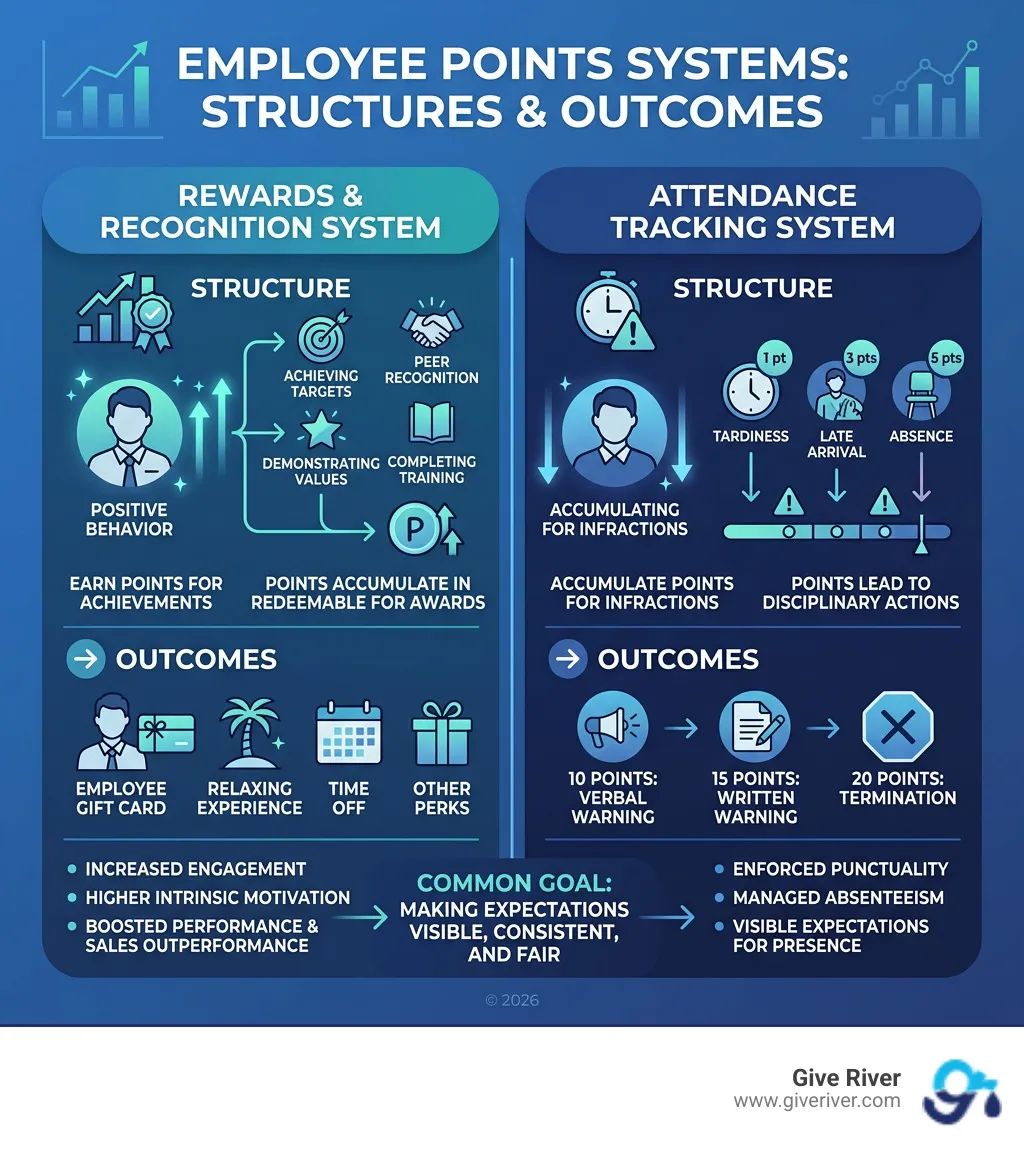
Rewards points system:
- Employees earn points for hitting targets, demonstrating company values, peer recognition, or completing training
- Points accumulate in a digital account and are redeemed for gift cards, experiences, time off, or other perks
- Recognition can flow from managers down, peer-to-peer, or both
Attendance points system:
- Tardiness (1-14 min late): 1 point
- Late arrival (15 min - 2 hours): 3 points
- Absence (more than 2 hours): 5 points
- No-call/no-show: immediate disciplinary action
- At 10 points: verbal warning; 15 points: written warning; 20 points: termination
Both systems share a common goal: making expectations visible, consistent, and fair.
The business case is compelling. Research shows that employees in points-based rewards programs outperformed those receiving cash bonuses by 46% in sales — generating $1.31 ROI per dollar invested, compared to just $0.80 for cash. And 79% of employees at organizations using points programs report higher engagement and intrinsic motivation than their counterparts without one.
Whether you're an HR manager trying to reduce absenteeism, a CEO looking to cut turnover costs, or a team lead who wants recognition to actually mean something — this guide walks you through everything: how to set one up, what the research says, real-world examples, and the pitfalls to avoid.
I'm Meghan Calhoun, co-founder of Give River and a workplace culture strategist with over two decades of experience building high-performing teams across high-pressure industries — experience that directly shaped how I think about designing an employee points system that drives genuine fulfillment, not just compliance. Read on for a complete framework you can start applying today.
Glossary for employee points system:
The Mechanics of a Modern employee points system
Digital dashboard; attendance tracking; disciplinary thresholds; Scientific research on the psychology of points; More info about employee reward programs
When we talk about an employee points system, we are essentially talking about a "workplace currency." Just as you use miles for travel or stars for coffee, your team uses points to quantify their contributions and reliability. In a modern setting, this is rarely done with a spreadsheet anymore. Instead, employee rewards and recognition software automates the process, ensuring that every "thank you" or "you're late" is logged with mathematical precision.
The beauty of this system lies in its transparency. When rules are clearly defined, bias is reduced. A manager is less likely to overlook a quiet high-performer if the system automatically triggers points for hitting a KPI. Conversely, an attendance system ensures that the same rules apply to everyone, regardless of who their supervisor is. This consistency is the bedrock of a healthy compensation reward system.
How an Attendance employee points system Tracks Absences
Tardiness; late; absent; no-call/no-show; FMLA; ADA; automation; HRIS integration.
For shift-based industries like retail, hospitality, and manufacturing, an attendance-focused employee points system is a survival tool. It categorizes infractions to prevent the "death by a thousand cuts" that happens when people are consistently five minutes late.
Typically, infractions are weighted:
- Tardy (1-14 minutes): 1 point. It's a nuisance but manageable.
- Late (15 minutes - 2 hours): 3 points. This usually requires someone else to cover or stay late.
- Absent (2+ hours): 5 points. A major disruption to productivity.
- No-Call/No-Show: This is the "red alert" of attendance. Most policies treat three consecutive days of this as job abandonment, resulting in automatic termination.
The system also needs to be smart enough to handle legal protections. Points should never be assigned for protected leaves like FMLA (Family and Medical Leave Act) or ADA (Americans with Disabilities Act) accommodations, provided the employee follows the proper notification procedures. By integrating this with your employee rewards and recognition platform, you can automate these triggers, sending alerts to managers when an employee hits a threshold-like a verbal warning at 10 points or a written warning at 15. For a general overview of the legal framework around family and medical leave, see Family and Medical Leave Act of 1993.
The Psychology of Points vs. Cash Rewards
Dopamine; anticipation; intrinsic motivation; 46% sales boost; Scientific research on cognitive pitfalls in incentive design.
You might wonder, "Why not just give them $50?" It's a fair question, but the science of motivation and reward systems suggests points are often more effective.
Psychologically, cash is often viewed as "compensation." It goes toward the electric bill or groceries and is quickly forgotten. Points, however, are perceived as "gifts of appreciation." According to research by the Incentive Research Foundation (IRF), points provide a compound psychological effect. There is the dopamine hit when you receive the points, another when you browse the reward catalog (anticipation), and a final one when you redeem them.
This "anticipation phase" is why points groups have been shown to outperform cash groups by 46% in sales performance. Points encourage "hedonic" spending-getting that high-end espresso machine or a spa day-which feels like a true reward, whereas cash feels like a utility. This shift from extrinsic to intrinsic motivation is a core pillar of a successful employee total rewards program.
Setting Up Your employee points system for Success
Point values; 100:1 ratio; expiration; peer-to-peer; manager-led; templates; More info about workplace rewards platforms.
Setting up your system requires a balance of logic and "fun." First, you need to define your point-to-dollar ratio. Common conversions include 10:1 or 100:1 (where 100 points = $1). A higher ratio often feels more "gamified"-it's more exciting to earn 500 points than 5 points, even if the value is the same.
Next, decide who gets to hand them out. A purely top-down system can feel rigid. We recommend a mix:
- Manager-Led: For hitting major milestones or project completions.
- Peer-to-Peer: This allows colleagues to recognize the "unsung heroes" who help out with small tasks. It scales appreciation across the whole company.
One controversial topic is expiration. Should points expire? The research suggests that while you want to encourage redemption, "use it or lose it" policies can create resentment. Instead, consider a "rolling" system where points expire after 12 months, or better yet, keep them active to respect the "savers" on your team who are eyeing a big-ticket item. For more on structuring these tiers, check out our guide on how to build the best total rewards package for your employees.
Maximizing ROI and Culture with Recognition Software

Team celebrating; [TABLE] Attendance vs Reward points; More info about gamification in the workplace; More info about team building.
The ultimate goal of any employee points system isn't just to track numbers—it's to build a culture where people feel seen. When you move beyond basic spreadsheets and into dedicated software, you unlock data that tells you who your most engaged employees are and which departments might be struggling with burnout.
By viewing recognition through the lens of total rewards, you transform the workplace from a place people have to be into a place they want to be.
Gamification and Personalized Redemption Options
Give River; 5G Method; personalized gifts; 70% preference; Bonusly; Kudos.
This is where things get exciting. Gamification in the workplace isn't about playing games; it's about using game elements like leaderboards, badges, and progress bars to make work more engaging.
At Give River, we use our 5G Method (Guided, Gamified, Gratitude, Growth, and Generosity) to ensure the system feels meaningful. While platforms like Bonusly or Kudos offer great peer-to-peer recognition, Give River differentiates itself by focusing on the 'Growth' and 'Generosity' aspects. Unlike standard recognition tools that focus primarily on social feeds, we allow employees to use their points for gamified personal growth or even donating to a charity of their choice. This ensures that your employee points system drives long-term development rather than just short-term buzz.
Personalization is key. Statistics show that 70% of employees find recognition more meaningful when it’s personalized. A generic $25 gift card is fine, but the ability to choose between a new pair of running shoes, a donation to a local shelter, or an extra day of PTO is what creates lasting loyalty. This is why an employee gamification platform is so much more effective than traditional bonuses.
Real-World Examples and Industry Use Cases
Walmart; retail; hospitality; $1.31 ROI; retention; productivity.
How does this look in the wild?
- Retail (The Walmart Model): Large retailers use attendance points to manage thousands of employees fairly. If an associate is late, the points are logged automatically. This removes the "middleman" of manager discretion, which can often lead to claims of favoritism.
- Hospitality: Hotels often use points to reward "cleanliness scores" or "guest mentions." A housekeeper mentioned by name in a 5-star review might earn enough points for a dinner out.
- Sales & Tech: These industries thrive on "accelerators." If a company is launching a new product, they might offer "Double Point Tuesdays" for every demo booked, driving short-term intensity through the employee points system.
The ROI is measurable. When points are used correctly, companies see a significant reduction in "no-call/no-shows" and a boost in overall productivity. You aren't just paying for work; you're incentivizing excellence. For more tips on this, see our employee wellness gamification tips.
Avoiding Pitfalls in Small Business Implementation
Small business; point fatigue; bias; manual tracking; transparency.
Small businesses often worry that an employee points system is too complex or expensive. While it’s true that manual tracking is a recipe for disaster (and a lot of admin headaches), you don't need a Fortune 500 budget to start.
The biggest pitfall to avoid is "Point Fatigue." This happens when points are given out so frequently for basic tasks that they lose their value. If everyone gets 100 points just for showing up, the points become "inflated currency." Keep the rewards meaningful and the criteria clear.
Another risk is perceived bias. If only one manager is active on the platform, their team will accumulate all the rewards while other departments feel left out. Training your leadership team on reward management in HRM is essential to ensure the system is used equitably across the board.
Ready to Transform Your Culture?
Implementing an employee points system is one of the fastest ways to improve attendance, boost morale, and drive performance. By combining the "stick" of fair attendance tracking with the "carrot" of meaningful, gamified rewards, you create an environment where expectations are clear and excellence is celebrated.
Whether you're looking to reduce absenteeism or want to see your team hit new heights of engagement, the right platform makes all the difference. At Give River, we're dedicated to helping you build a culture of gratitude and growth.
Are you ready to see how gamification can change your workplace? Explore our team building solutions and start building a high-performing culture today.
More from this category.
Why Most Work Meetings Start on the Wrong Foot (And How to Fix It)
The best 2 truths and a lie ideas for work can transform an awkward, silent meeting opener into a moment your team actually looks forward to. Whether you're onboarding new hires, kicking off a remote all-hands, or just trying to shake off…

The Trust Deficit in Remote Work
Building trust in a virtual team is a critical challenge for modern organizations. While remote work offers flexibility, it can erode team cohesion if not managed intentionally.

Why Connection Building Activities Are the Secret to High-Performing Teams
Connection building activities are structured exercises that help teams develop trust, improve communication, and foster genuine relationships at work — and they're one of the most overlooked drivers of team performance.
See the platform in action.
Free for up to 25 members, or try Core or Growth free for 30 days. A card is required; Free is never charged, and a trial bills when it ends unless you cancel.