Why Strategic Reward Management is Non-Negotiable
Reward management in human resource management (HRM) is the strategic process of designing, implementing, and maintaining compensation and recognition systems that motivate employees, align their efforts with organizational goals, and…

Why Strategic Reward Management is Non-Negotiable
Reward management in human resource management (HRM) is the strategic process of designing, implementing, and maintaining compensation and recognition systems that motivate employees, align their efforts with organizational goals, and foster a positive workplace culture.
Global employee engagement has hovered around one-third for years, with Gallup estimating that disengagement costs reach into the trillions annually. Many employees report feeling underappreciated and disconnected from their company's mission.
In this context, a thoughtful reward system is essential. Traditional approaches like annual bonuses or ad hoc praise are insufficient for today's workforce, which expects real-time recognition where contributions are consistently valued.
This guide walks you through building a modern reward system, from defining objectives to measuring results, helping you create a culture that attracts, engages, and retains top talent.
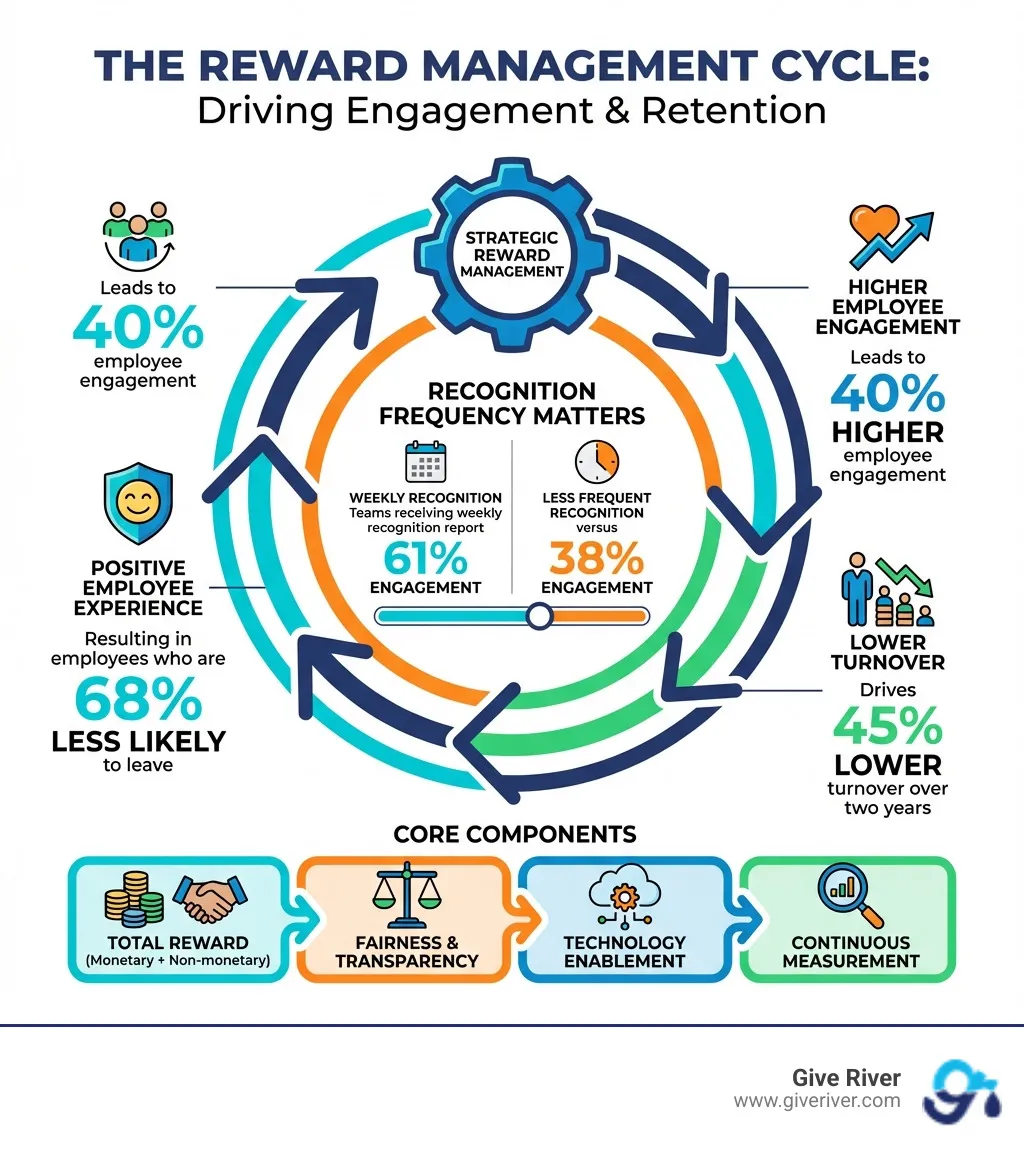
Key Takeaways
- Define Clear Objectives: Align your reward system with business goals like retention, performance, and culture.
- Adopt a Total Reward Approach: Combine monetary rewards with non-monetary recognition and growth opportunities.
- Ensure Fairness and Transparency: Use clear criteria, conduct job evaluations, and maintain open communication.
- Leverage Technology: Use platforms for scalability, real-time recognition, and data-driven insights.
- Measure and Adapt: Track engagement, retention, and employee feedback to refine your strategy.
- Avoid Common Pitfalls: Steer clear of one-size-fits-all programs and infrequent recognition.
For background on how rewards influence motivation, explore concepts like employee engagement, which HR leaders use as a benchmark for reward effectiveness.
Designing an Effective Reward Management System
An effective reward management in hrm system creates an environment where employees feel valued and committed. This requires strategic alignment between rewards and both business goals and human psychology.
The Core Objectives of Reward Management
Every reward system should achieve specific organizational goals:
- Talent Acquisition and Retention: Competitive rewards packages are crucial for attracting and keeping top talent.
- Motivation and Performance: Rewards reinforce desired behaviors and drive sustainable performance.
- Reinforcing Company Culture: Your reward system reflects company values, embedding them into everyday behavior.
- Enhancing Employee Experience: Positive reward experiences contribute significantly to job satisfaction.
Total Reward vs. Traditional Pay
Modern reward management has evolved beyond traditional compensation to a Total Reward strategy combining tangible and intangible benefits:
- Transactional (Monetary) Rewards: Base pay, bonuses, profit-sharing, and benefits like health insurance.
- Relational (Non-Monetary) Rewards: Recognition, development opportunities, work-life balance, and positive work environment.
Research shows that while financial rewards matter, intrinsic drivers like recognition and purpose powerfully contribute to long-term performance. A Total Reward approach meets diverse employee needs rather than relying solely on pay adjustments.
Ensuring Fairness and Transparency
For effectiveness, reward systems must be perceived as fair. Build trust through:
- Clear Criteria: Define and communicate reward standards plainly.
- Job Evaluations: Ensure internal equity and external competitiveness.
- Open Communication: Be transparent about your reward philosophy.
Research on organizational justice shows how equity perceptions strongly influence engagement and performance.
From Strategy to Action: Implementation and Optimization
Designing a great reward system is only half the battle. Successful implementation drives results.
A 5-Step Implementation Guide
- Define Objectives and Budget: Clarify goals and set realistic budgets.
- Design a Diverse Reward Mix: Create balanced monetary and non-monetary rewards. Platforms like Give River offer points-based rewards alongside meaningful acts of generosity.
- Communicate Transparently: Launch with clear explanations of purpose and process.
- Train Your Managers: Equip them with tools for meaningful recognition.
- Launch, Measure, and Iterate: Track metrics like engagement and retention, using data for ongoing adjustments.

Technology in Modern Reward Management
Technology platforms transform reward management into dynamic experiences. While Bonusly and Kudos focus primarily on recognition, Give River provides a more holistic solution by also incorporating wellness, growth, and community impact. Key benefits include:
- Scalability: Manage recognition across locations.
- Real-Time Recognition: Instant feedback is more impactful than annual reviews.
- Data and Analytics: Track metrics for data-driven improvements.
- Gamification: Use leaderboards and points to encourage participation.
Avoiding Common Pitfalls
Avoid these mistakes:
- One-Size-Fits-All Approach: Offer variety for diverse preferences.
- Rewarding Wrong Things: Align rewards with strategic goals.
- Lack of Transparency: Clear communication is essential.
- Forgetting Non-Monetary Rewards: Simple thanks often have lasting impact.
Learn more about Give River's employee rewards solutions.
Types of Rewards and Diverse Employee Needs
Effective reward management in hrm recognizes that different people are motivated differently. A comprehensive system offers diverse rewards addressing distinct needs.
Monetary Rewards: The Foundation
Tangible financial incentives addressing security and value:
- Base Pay: Fundamental compensation that must be competitive.
- Variable Pay: Performance-based bonuses, commissions, and profit-sharing.
- Merit Increases: Periodic adjustments based on performance.
- Stock Options: Ownership aligning long-term interests.
- Benefits: Health insurance, retirement plans, and paid time off.
Non-Monetary Rewards: Engagement Drivers
Intangible rewards tapping into psychological needs:
- Recognition: Verbal praise, public acknowledgment, peer-to-peer recognition, spot awards.
- Development: Training, mentorship, career progression, challenging assignments.
- Work-Life Balance: Flexible arrangements, wellness programs, extra time off.
- Positive Environment: Autonomy, trust, meaningful work, team-building.
Appealing to Diverse Needs
Different employees prioritize differently:
- Early Career: Seek learning, mentorship, and career paths.
- Mid-Career: Value work-life balance and leadership opportunities.
- Seasoned Professionals: Want autonomy and robust retirement benefits.
- Parents/Caregivers: Prioritize flexibility and health benefits.
- Impact-Driven: Seek meaningful work and social responsibility.
Platforms like Bonusly and Kudos focus on recognition, while Give River combines recognition with wellness, growth content, gamification, and community impact, covering the full spectrum of employee needs.
Management Implementation and Oversight
Effective reward management in hrm requires active leadership and daily management. Key practices ensure your system thrives:
Lead by Example
- Senior leaders should visibly participate in the reward system.
- Clearly articulate purpose, objectives, and alignment with values.
Empower and Train Managers
- Invest in training for effective recognition and fair appraisal practices.
- Provide technology platforms, budget guidelines, and clear policies.
Foster Continuous Feedback
- Encourage frequent check-ins beyond formal appraisals.
- Promote peer-to-peer recognition from all directions.
- Emphasize timely recognition for maximum impact.
Ensure Consistency and Fairness
- Standardize evaluation processes across teams.
- Use objective, measurable criteria.
- Conduct regular audits to ensure compliance.
Monitor and Adapt
- Analyze data from reward platforms and HR systems.
- Collect feedback through surveys and conversations.
- Refresh your approach as needs evolve.
Competitors like Bonusly and Kudos provide recognition features; Give River builds on this by combining recognition with wellness, growth content, gamification, and community impact, giving managers a richer toolkit.
Common Pitfalls and How to Avoid Them
Even well-intentioned reward management in hrm strategies can fail. Recognize these pitfalls to build sustainable systems:
The One-Size-Fits-All Trap
- Pitfall: Assuming all employees want the same rewards.
- Solution: Use surveys and data to understand preferences. Implement flexible total reward approaches.
Infrequent Recognition
- Pitfall: Limiting recognition to annual reviews.
- Solution: Foster continuous, real-time recognition through technology platforms.
Rewarding Wrong Behaviors
- Pitfall: Rewarding activity over outcomes or individual heroics over collaboration.
- Solution: Define desired behaviors clearly and link rewards directly to them.
Lack of Transparency
- Pitfall: Unclear reward determination processes.
- Solution: Establish documented policies and train managers to explain decisions.
Over-Reliance on Money
- Pitfall: Assuming higher pay solves all motivation challenges.
- Solution: Balance financial rewards with recognition, growth, and well-being initiatives.
Poor Management Capability
- Pitfall: Managers uncomfortable with feedback or inconsistent in recognition.
- Solution: Provide practical training and easy-to-use tools.
Failure to Measure
- Pitfall: Launching systems without tracking or adapting.
- Solution: Track engagement, retention, and participation metrics. Iterate based on data.
By addressing these pitfalls early, you can design fair, motivating systems aligned with long-term success.
How Does Reward Management Influence and Shape Organizational Culture?
A well-designed reward management in hrm system goes far beyond compensation; it is one of the most powerful levers you have for shaping and reinforcing organizational culture. Every reward and recognition moment sends a signal about what your company truly values.
Here are some of the main ways reward management influences culture:
- Reinforcing Values and Desired Behaviors: When you consistently recognize behaviors that reflect your core values—such as innovation, collaboration, or customer focus—employees quickly understand what matters most and adjust their actions accordingly.
- Driving a Performance Culture: Linking rewards to clear, achievable goals helps create a culture where strong performance is expected and celebrated. Done well, this encourages healthy ambition without creating a cutthroat environment.
- Fostering a Culture of Appreciation: Frequent, authentic recognition builds a climate where people feel seen and valued. While peer-to-peer tools like Bonusly and Kudos excel at making appreciation a visible, everyday habit, Give River extends this by linking recognition to personal growth and community impact, reinforcing a culture that values the whole person.
- Building Trust and Transparency: A reward system that is perceived as fair and transparent strengthens trust between employees and leadership. When criteria are clear and consistently applied, people are more likely to believe that effort leads to opportunity.
- Elevating Engagement and Morale: Recognition and meaningful rewards boost motivation and morale. Over time, this translates into higher energy, stronger commitment, and a more positive atmosphere across teams.
- Shaping the End-to-End Employee Experience: How you structure pay, benefits, development opportunities, and recognition moments collectively forms a large part of the employee experience. A thoughtful total reward strategy makes your organization a place where people want to stay and grow.
When you connect reward decisions to the culture you aspire to build, your reward management in hrm system becomes a practical roadmap for how people show up, collaborate, and succeed together.
What Is the Concept of "Total Reward," and How Does It Differ from Traditional Compensation?
The concept of Total Reward represents a significant evolution in reward management in hrm, moving beyond the narrow scope of traditional compensation. It is a holistic approach that acknowledges the many ways an organization can attract, motivate, and retain its people.
What Is Total Reward?
Total Reward is the comprehensive package of financial and non-financial benefits, opportunities, and experiences that an employee receives from their employment relationship. It treats these elements as an integrated whole, designed to maximize their combined impact on motivation, commitment, and engagement.
In addition to base pay and bonuses, a Total Reward strategy typically considers:
- Compensation: Base salary, variable pay (bonuses, commissions), and long-term incentives.
- Benefits: Health and welfare programs, retirement plans, paid time off, and protection benefits.
- Work-Life Effectiveness: Flexible work arrangements, wellness programs, and resources that help employees manage personal and professional demands.
- Recognition: Formal and informal programs that acknowledge effort, progress, and impact.
- Performance and Growth: Goal setting, feedback, coaching, and learning opportunities that support development.
By acknowledging everything employees value in the employment relationship, Total Reward recognizes that people are motivated by much more than pay alone.
How Does It Differ from Traditional Compensation?
Traditional compensation tends to focus primarily on pay and core benefits with the main goal of attracting talent and meeting market benchmarks. Total Reward, by contrast, focuses on the overall employee experience and aims to drive engagement, performance, and retention.
A simplified comparison looks like this:
Traditional Compensation:
- Primary focus on salary, bonuses, and basic benefits.
- Often transactional and reactive (for example, adjusting pay to match competitors).
- Limited emphasis on non-monetary elements such as recognition or development.
Total Reward:
- Integrates pay, benefits, development, recognition, well-being, and work environment.
- Proactive and strategic, designed to support culture and long-term goals.
- Emphasizes both extrinsic (financial) and intrinsic (psychological) motivators.
Recognition-focused competitors like Bonusly and Kudos contribute important pieces of the Total Reward picture by making appreciation more visible. Give River extends this further through its 5G Method, combining recognition with guidance, wellness and growth content, gamification, and community impact, helping organizations deliver a richer, more complete Total Reward experience.
When you shift from a traditional compensation mindset to a Total Reward strategy, your reward management in hrm efforts become a central driver of employee fulfillment, culture, and performance.
More from this category.

The Impact of Employee Recognition on Workplace Success
Ever notice how a simple "thank you" can transform your entire day? Now imagine that feeling multiplied across your entire organization. That's the power behind the best employee recognition programs – they're not just nice-to-have perks,…

Why Recognition Feels Broken in Today's Workplace
Picture this: your whole department gets the same canned "thank-you" email. It lands with a thud. Connected recognition exists to replace that hollow gesture with a system that consistently spotlights real contributions.

From "Nice-to-Have" to Non-Negotiable: Why Your Business Needs Recognition Software
The business case for corporate recognition software goes far beyond warm feelings. When employees feel genuinely valued, every corner of your organization benefits\u0014from productivity metrics that impress the CFO to…
See the platform in action.
30-day free trial. No credit card. River Guide included on Core and Growth.