Defining Corporate Purpose Statements and Their Strategic Value
Corporate purpose statements are concise declarations that define why a company exists beyond generating profit - and they've become one of the most powerful tools leaders have for driving employee engagement, retention, and long-term…

Defining Corporate Purpose Statements and Their Strategic Value
Corporate purpose statements are concise declarations that define why a company exists beyond generating profit - and they've become one of the most powerful tools leaders have for driving employee engagement, retention, and long-term business performance.
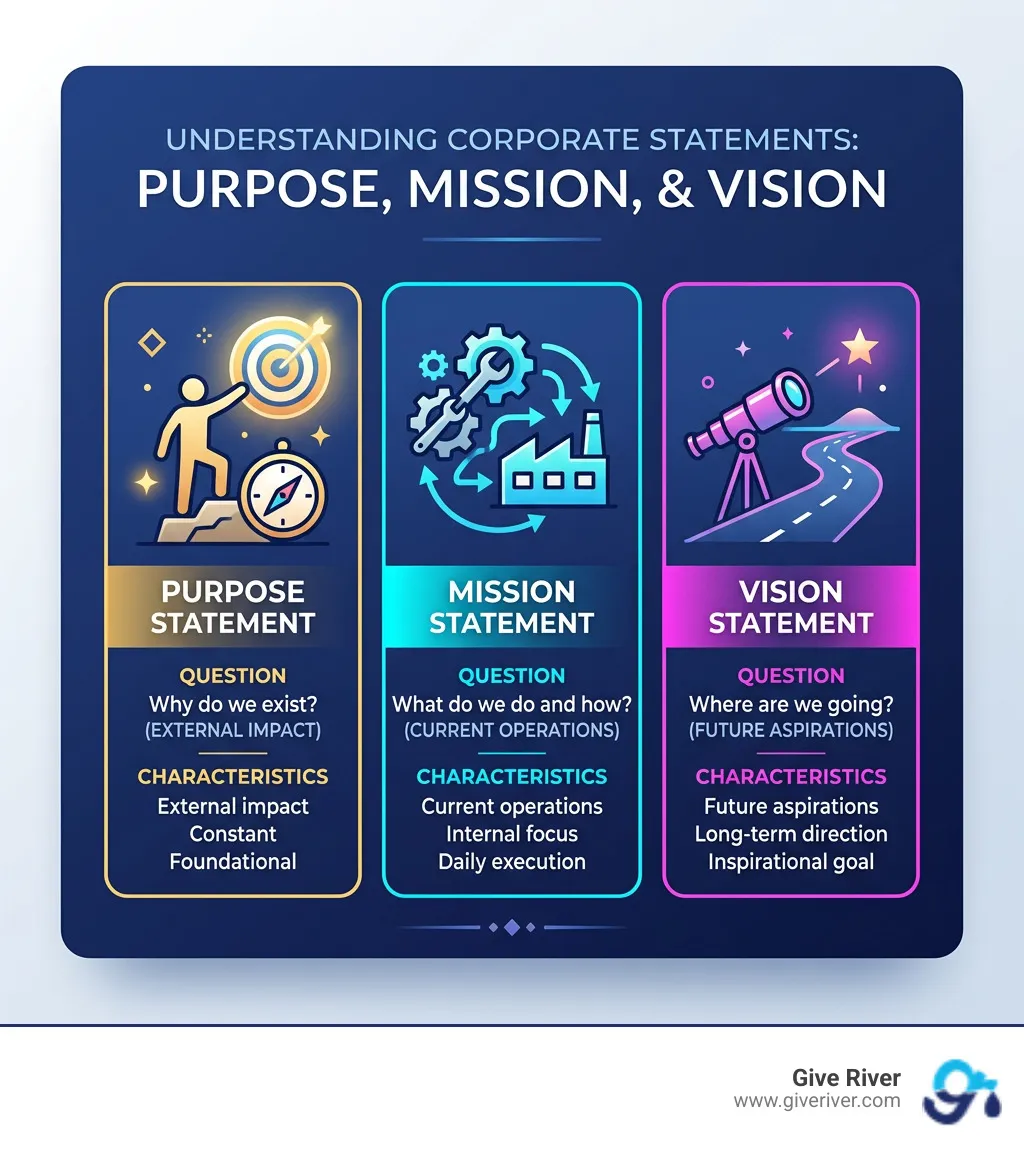
Here's a quick overview of what you need to know:
| Concept | What It Answers | Focus |
|---|---|---|
| Purpose Statement | Why do we exist? | External impact, constant, foundational |
| Mission Statement | What do we do and how? | Current operations, internal focus |
| Vision Statement | Where are we going? | Future aspirations, long-term direction |
Top corporate purpose statement examples from Fortune 500 companies:
- Nike - "To move the world forward through the power of sport."
- Pfizer - "Breakthroughs that change patients' lives."
- Ford - "To help build a better world, where every person is free to move and pursue their dreams."
- Kroger - "To feed the human spirit."
- McDonald's - "To feed and foster communities."
These aren't just polished marketing lines. When lived authentically, a strong purpose statement shapes every decision a company makes - from hiring to strategy to how leaders show up in a crisis.
Nearly 70% of employees have been reflecting on their sense of purpose since the pandemic, according to McKinsey research. And 4 in 5 people believe a company should stand for something beyond making money. Yet only 1 in 3 Fortune 500 companies currently uses a corporate purpose statement to build their brand around customers.
That gap represents both a challenge and a significant opportunity for leaders willing to do the work.
I'm Meghan Calhoun, Co-Founder of Give River and a workplace culture strategist with over two decades of experience helping organizations build high-performing, fulfilling teams - including work with Fortune 100 companies where I saw how corporate purpose statements can transform engagement when they're more than words on a wall. That experience is exactly what shaped Give River's approach to connecting employees to purpose every single day.
Handy Corporate purpose statements terms:
In the modern business landscape, a company is more than its balance sheet. It is a living entity with an "organizational DNA" that dictates how it breathes, grows, and interacts with the world. At the core of this DNA lies the corporate purpose statement. While traditional models focused almost exclusively on "shareholder primacy"-the idea that a company's only job is to maximize profits for owners-we have seen a massive shift toward stakeholder capitalism.
This evolution was famously signaled by the Business Roundtable's 2019 "Statement on the Purpose of a Corporation", where 181 CEOs committed to leading their companies for the benefit of all stakeholders: customers, employees, suppliers, communities, and shareholders. This isn't just "nice to have" fluff; it's a strategy for long-term growth. When a company understands its broader role in society, it can navigate market shifts with greater agility.
To truly understand this, we need to look at how purpose fits into the wider framework of What is Corporate Social Responsibility? Purpose provides the "why" that makes CSR initiatives feel like a natural extension of the business rather than a disconnected charity project.
What is a Corporate Purpose Statement?
A corporate purpose statement is a single, concise, declarative sentence that identifies why a company exists. Unlike a mission statement, which focuses on the "what" and the "how" of daily operations, a purpose statement is customer-centric and person-first. It answers the fundamental question: What would the world lose if this company ceased to exist tomorrow?
It serves as a North Star, guiding the company toward a positive impact on the world. This is deeply connected to What is the Purpose of Corporate Social Responsibility?, as both concepts aim to align business success with societal progress. A great purpose statement is aspirational yet believable, specific enough to be meaningful, and memorable enough for every employee to recite it from heart.
Why Corporate Purpose Statements Drive Performance
The data is clear: purpose pays off. Since the pandemic, 83% of employees have rated "meaning in day-to-day work" as a top priority. When employees feel that their work contributes to a larger goal, the business results are staggering.
According to McKinsey research, employees who say they are "living their purpose" at work are:
- 6.5 times more likely to report higher resilience.
- 4 times more likely to report better health.
- 6 times more likely to want to stay at the company.
- 1.5 times more likely to go above and beyond for the organization.
This shift from shareholder primacy to stakeholder value isn't just a trend; it's a survival mechanism. Companies that fail to articulate their "why" struggle with retention and engagement, while purpose-driven organizations build a "fortress" culture that can withstand economic turbulence.
How to Create and Activate an Authentic Purpose
Creating a purpose statement isn't a job for a lone copywriter in a dark room. It requires a co-creation process that involves voices from every level of the organization. If the purpose doesn't resonate with the person on the front lines, it won't drive the culture forward.

Activation is where many companies stumble. A purpose statement only becomes "real" when it is embedded into the strategic roadmap and used to filter every major business decision. This is the foundation of a Purpose-Driven Workplace.
Standout Examples from the Fortune 500
Let’s look at some of the heavy hitters who have mastered the art of the "rally cry":
- Nike: "To move the world forward through the power of sport." This statement has guided Nike for over 50 years, driving everything from their support of Olympic athletes to their "moonshot" goals for sustainable products.
- Pfizer: "Breakthroughs that change patients' lives." Every word here is deliberate. "Breakthroughs" refers to both scientific and commercial innovation, while "patients' lives" encompasses a holistic view of the patient, their family, and their caregivers.
- Coca-Cola: "To craft the brands and choice of drinks that refresh the world in body, mind, and spirit. And done in ways that create a more sustainable business and better shared future." This links their core product to a global impact.
- Ford Motor Company: "To help build a better world, where every person is free to move and pursue their dreams." It’s not about selling cars; it’s about the human right to mobility and opportunity.
- Amazon: "To be Earth’s most customer-centric company, Earth’s best employer, and Earth’s safest place to work." This reflects their massive scale and their commitment to multiple stakeholder groups.
A Step-by-Step Guide to Refining Your Purpose
If your current statement feels dusty or disconnected, it might be time for a "purpose audit." This often happens during major update triggers like a merger, new leadership, or a significant strategic shift.
- Intake and Listening: Conduct stakeholder listening sessions. What do your employees think you stand for? What do your customers value most?
- Identify Themes: Look for the common threads. What is the unique "DNA" that sets you apart from competitors?
- Co-Creation: Hold interactive sessions with a diverse group of employees—including the skeptics! Involving skeptics often turns them into your strongest advocates.
- Draft and Test: Create a few versions and test them with employee groups. Is it memorable? Does it feel "honest"?
- Refine and Finalize: Ensure the language is clear and uses active verbs. Avoid vague terms like "excellence" or "quality" that don't specify the impact.
Avoiding Pitfalls and Embedding Purpose into Culture
The biggest danger in this process is "purpose-washing"—creating a beautiful statement that has zero connection to how the company actually operates. If your purpose is "environmental stewardship" but you have no sustainability metrics, your employees will see right through it.
Common pitfalls to avoid:
- Vague language: If a statement could apply to any company in any industry, it’s too broad.
- Lack of leadership alignment: If the C-suite doesn't live the purpose, no one else will.
- Shortcuts: Don't rush the process. "Go slow to go fast" is the best mantra here.
While platforms like Bonusly or Kudos are effective for peer-to-peer recognition and transactional rewards, they often lack the deep strategic integration needed to tie daily actions back to a specific corporate purpose. Unlike these general recognition tools, Give River focuses on aligning individual growth with the organization's "why," ensuring that every act of gratitude or generosity reinforces the core purpose statement rather than just providing a temporary morale boost. To truly embed purpose, you need a decision-making framework where leaders ask, "Does this action align with our purpose?" before moving forward.
Measuring Success and the Give River Approach
How do you know if your purpose is working? You measure it through authenticity metrics: employee engagement scores, retention rates, and community impact data.
At Give River, we use our unique 5G Method to help companies turn their purpose into a daily reality:
- Guided: Providing the content and roadmap for personal and professional growth.
- Gamified: Making the journey toward purpose engaging and rewarding.
- Gratitude: Using recognition to highlight when employees live the company's values.
- Growth: Focusing on the long-term development of every team member.
- Generosity: Connecting the company's success to making a lasting impact through community support.
By integrating these five pillars, we help you move beyond "words on a wall" to create a culture where every employee feels they are part of something bigger. When your team sees that their daily efforts contribute to a meaningful goal, you don't just get a more productive workforce—you get a more fulfilled one.
Ready to transform your workplace culture? Make a lasting impact with Give River and start living your purpose today.
More from this category.
Why Most Work Meetings Start on the Wrong Foot (And How to Fix It)
The best 2 truths and a lie ideas for work can transform an awkward, silent meeting opener into a moment your team actually looks forward to. Whether you're onboarding new hires, kicking off a remote all-hands, or just trying to shake off…

The Trust Deficit in Remote Work
Building trust in a virtual team is a critical challenge for modern organizations. While remote work offers flexibility, it can erode team cohesion if not managed intentionally.

Why Connection Building Activities Are the Secret to High-Performing Teams
Connection building activities are structured exercises that help teams develop trust, improve communication, and foster genuine relationships at work — and they're one of the most overlooked drivers of team performance.
See the platform in action.
Free for up to 25 members, or try Core or Growth free for 30 days. A card is required; Free is never charged, and a trial bills when it ends unless you cancel.