The Strategic Value of an Integrated Performance Appraisal and Reward System
A performance appraisal and reward system is the integrated process organizations use to evaluate employee performance against defined goals and then recognize or compensate that performance in ways that reinforce desired behaviors — and…

The Strategic Value of an Integrated Performance Appraisal and Reward System
A performance appraisal and reward system is the integrated process organizations use to evaluate employee performance against defined goals and then recognize or compensate that performance in ways that reinforce desired behaviors — and when it works well, it's one of the most powerful levers you have for building a high-performing team.
Here's a quick overview of how the two components work together:
| Component | What It Does | Example |
|---|---|---|
| Performance Appraisal | Measures individual or team performance against set goals and standards | Annual review, 360-degree feedback, MBO check-ins |
| Reward System | Provides incentives tied to appraisal outcomes to reinforce performance | Bonuses, promotions, recognition, stretch assignments |
| Integration | Links the two so rewards directly reflect evaluated performance | Salary increase tied to performance rating |
| Continuous Cycle | Moves beyond one-time reviews to ongoing feedback and recognition | Real-time spot awards, quarterly check-ins |
Despite widespread adoption, most organizations aren't getting the full value from these systems. Gallup research shows that companies with high employee engagement report 21% higher productivity — yet the majority of employees still feel disengaged at work. The gap isn't usually a lack of appraisal processes or reward budgets. It's a failure to connect the two in a way that feels fair, meaningful, and motivating to the people it's designed for.
This disconnect is expensive. Low engagement fuels turnover, erodes morale, and quietly drains productivity quarter after quarter. And for HR managers and CEOs at mid-sized companies, that translates directly into replacement costs, lost institutional knowledge, and a culture that struggles to attract top talent.
The good news? It doesn't have to be that way. When performance appraisals are thoughtfully linked to a well-structured reward system — and supported by continuous feedback and genuine recognition — the results are measurable and significant.
I'm Meghan Calhoun, co-founder of Give River and a workplace culture strategist with over two decades of experience building high-performing teams across high-pressure industries, where I've seen how a well-designed performance appraisal and reward system can transform not just productivity, but the entire human experience of work. In this guide, I'll walk you through everything you need to know to build one that actually works.
Glossary for performance appraisal and reward system:
In our experience at Give River, we’ve seen that the most successful organizations don't view appraisals as a "once-a-year HR headache." Instead, they treat the performance appraisal and reward system as a strategic heartbeat. When you align individual contributions with organizational goals, you create a roadmap for success that everyone can follow.
This alignment does more than just organize tasks; it creates a sense of employee fulfillment. When people know exactly what is expected of them and see a direct line between their hard work and the rewards they receive, accountability flourishes. You aren't just measuring output; you're building a culture where excellence is the standard because it is consistently recognized and valued.
Productivity gains and retention rates are the natural byproducts of this synergy. If your team feels that their growth is being monitored and their wins are being celebrated, they are far less likely to look for the exit. By integrating these two systems, you move from a reactive management style to a proactive, growth-oriented culture. For more on this symbiotic relationship, check out our guide on performance appraisal and rewards.
Defining Performance Appraisal and Reward System Components
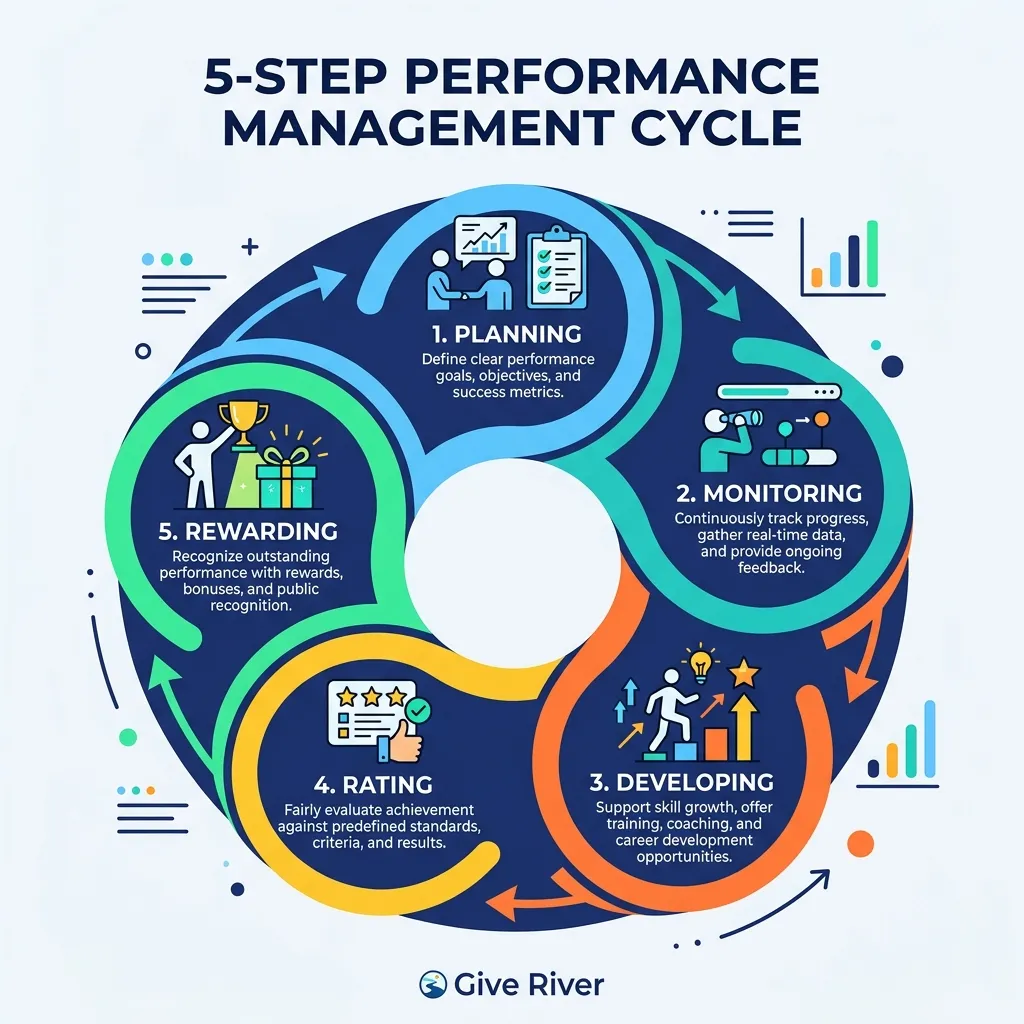
To build a great system, we first need to understand the terminology. While often used interchangeably, "performance management" and "performance appraisal" are different. Performance management is the holistic, ongoing process of planning, monitoring, and developing employees. The appraisal is the specific "rating" event within that cycle.
An effective performance appraisal and reward system relies on what we call the "3 P's":
- Purpose: Why are we doing this? (e.g., development, pay raises, or mission alignment).
- People: Who is involved? (e.g., managers, peers, and the employees themselves).
- Process: How do we measure it? (e.g., the tools, frequency, and criteria used).
When designing your system, you must define specific parameters such as the appraisal cycle length (often one year), the minimum period before a rating can be given (typically 90-120 days), and the summary rating patterns (e.g., a 5-level scale). Understanding these fundamentals is key to effective reward management in hrm.
Why Linking Performance to Rewards Drives Organizational Success
The data is clear: engagement is a profit engine. Beyond the Gallup statistic of 21% higher productivity, research shows that companies prioritizing employee wellness and recognition report a 34% higher profit rate than their peers. But why does linking rewards to performance work so well? It comes down to psychological theories that we use as the foundation for our 5G Method:
- Expectancy Theory: Employees are motivated when they believe that effort leads to performance, and performance leads to a desired reward.
- Equity Theory: Fairness is paramount. If an employee perceives that their "input-to-output" ratio is lower than their peers, motivation plummets.
- Reinforcement: Positive consequences (rewards) increase the likelihood that a behavior will be repeated.
By creating a transparent compensation reward system, you ensure that your team isn't guessing what success looks like. They see the evidence of it in their paychecks, their career paths, and the public recognition they receive.
Navigating Appraisal Methods: From MBO to 360-Degree Feedback
There isn't a "one-size-fits-all" method for evaluating performance. Depending on your culture, you might choose:
- Management by Objectives (MBO): Focuses on aligning individual goals with company goals. It’s highly collaborative and results-oriented.
- 360-Degree Feedback: Gathers input from supervisors, peers, and subordinates to provide a holistic view of an employee’s impact.
- Behaviorally Anchored Rating Scales (BARS): Uses specific examples of "good" or "bad" behavior to make ratings more objective.
- Forced Distribution: Popularized by GE, this method ranks employees into categories (e.g., top 20%, middle 70%, bottom 10%).
While forced distribution can drive high performance in some contexts, academic research warns that it can also foster unhealthy competition and legal risks. In fact, studies on reward practices and PMS effectiveness suggest that systems tying appraisals to salary increases and even terminations are more effective than those that merely rank employees against each other without clear developmental paths.
Implementing a Modern Performance Appraisal and Reward System

Modern systems have moved away from the "annual review" toward a model of continuous feedback. We believe that feedback should be like a GPS—helping employees stay on track in real-time rather than telling them they took a wrong turn six months ago. This approach fosters a true meritocracy where hard work is visible and rewards are timely.
Building this culture requires a balance. You need the structure of a formal performance appraisal and reward system, but you also need the "human touch" of spontaneous recognition. This is where the distinction between intrinsic and extrinsic rewards becomes vital.
| Reward Type | Focus | Examples |
|---|---|---|
| Extrinsic | External, tangible benefits | Bonuses, salary raises, profit sharing, stock options |
| Intrinsic | Internal, psychological satisfaction | Sense of achievement, meaningful work, autonomy |
| Non-Financial | Tangible but not cash-based | Extra PTO, flexible hours, public "shout-outs" |
| Developmental | Future-oriented growth | Stretch assignments, mentorship, professional courses |
Balancing Intrinsic and Extrinsic Rewards for Maximum Motivation
If you only focus on the "extrinsic" (money), you might actually reduce motivation over time. Research shows that while financial rewards are necessary for baseline satisfaction, they don't always drive long-term engagement. To truly inspire your team, you need to tap into intrinsic motivators.
Stretch assignments—giving a high performer a project that pushes their boundaries—can be more rewarding than a small bonus. Career development opportunities and flexibility in where or when someone works are also high-value rewards that cost the company very little but mean the world to the employee. For a deeper dive into these strategies, see our employee reward and recognition guide.
Overcoming Biases in Your Performance Appraisal and Reward System
Even the best-intentioned managers are susceptible to bias. To ensure your system is fair and transparent, you must actively guard against:
- The Halo/Horn Effect: Letting one great (or poor) trait color the entire evaluation.
- Recency Bias: Focusing only on what the employee did in the last month rather than the whole year.
- Central Tendency: Rating everyone as "average" to avoid difficult conversations or paperwork.
While platforms like Bonusly or Kudos offer great tools for peer-to-peer "micro-recognition," they often operate in a silo from the formal appraisal process. Give River is different because our 5G Method specifically links these daily wins to long-term performance data, providing a more holistic view of employee impact than simple peer-to-peer apps. We also emphasize the human element through manager training and calibration meetings—where managers discuss their ratings with each other—to ensure consistency across departments. Fairness isn't just a "nice-to-have"; it's the foundation of trust in any reward system.
Actionable Steps to Build a Culture of Recognition
Ready to transform your workplace? Here is our actionable framework for building a culture of recognition through the Give River 5G Method:
- Set SMART Goals: Ensure every employee has goals that are Specific, Measurable, Achievable, Relevant, and Time-bound.
- Implement Real-Time Feedback: Don't wait for the annual review. Use weekly check-ins to provide coaching and course correction.
- Encourage Peer-to-Peer Rewards: Allow team members to recognize each other. This builds community and ensures that small wins don't go unnoticed.
- Diversify Your Rewards: Offer a mix of cash, time-off, and growth opportunities. Use our employee rewards platform to automate and personalize these incentives.
- Train Your Leaders: Recognition is a skill. Train your managers to give specific, behavior-based praise that reinforces company values.
By following modern recognition best practices, you aren't just "managing" people; you're empowering them. You're moving from a system of oversight to a system of support, where every employee feels like a valued part of a winning team.
Conclusion: The Future of Performance and Fulfillment
A robust performance appraisal and reward system is more than just a set of HR policies—it is the backbone of your organizational culture. By integrating clear evaluations with meaningful, diverse rewards, you create a feedback loop that drives both business results and human fulfillment.
We’ve seen that when organizations move away from outdated, bureaucratic ranking systems and toward continuous, gratitude-based models, the transformation is staggering. You get more than just 21% higher productivity; you get a team that is energized, loyal, and deeply connected to your mission.
At Give River, we are dedicated to helping you build these high-performing teams through our 5G Method. Whether you are looking to refine your current appraisal process or launch a brand-new recognition program, the most powerful reward you can give is the knowledge that someone's work truly matters.
Ready to see how gamified recognition can transform your culture? Explore our employee performance awards guide or reach out to us today to start your journey toward a happier, healthier workplace.
More from this category.

The Impact of Employee Recognition on Workplace Success
Ever notice how a simple "thank you" can transform your entire day? Now imagine that feeling multiplied across your entire organization. That's the power behind the best employee recognition programs – they're not just nice-to-have perks,…

Why Recognition Feels Broken in Today's Workplace
Picture this: your whole department gets the same canned "thank-you" email. It lands with a thud. Connected recognition exists to replace that hollow gesture with a system that consistently spotlights real contributions.

From "Nice-to-Have" to Non-Negotiable: Why Your Business Needs Recognition Software
The business case for corporate recognition software goes far beyond warm feelings. When employees feel genuinely valued, every corner of your organization benefits\u0014from productivity metrics that impress the CFO to…
See the platform in action.
30-day free trial. No credit card. River Guide included on Core and Growth.