What Is a Good eNPS Score? How to Calculate It, Read It and Follow Up
Any eNPS above 0 means your promoters outnumber your detractors. Published benchmarks disagree on what counts as good, so here's how to calculate eNPS, read it against your own trend, and the follow-up questions that explain it.

An eNPS (employee Net Promoter Score) is the percentage of employees who answer 9 or 10 when asked how likely they are to recommend your company as a place to work, minus the percentage who answer 0 to 6. Any score above 0 means you have more promoters than detractors, but published benchmarks disagree on what counts as "good", so the most reliable test is whether your own score is rising from one round to the next. In Give River, eNPS runs as an always-anonymous recurring survey on the Core plan, and the Insights dashboard shows the score, the breakdown and the change since the last round.
eNPS at a glance
| Part | Detail |
|---|---|
| The question | "On a scale of 0 to 10, how likely are you to recommend [company] as a place to work?" |
| Promoters | Answer 9 or 10 |
| Passives | Answer 7 or 8 |
| Detractors | Answer 0 to 6 |
| The formula | % promoters − % detractors |
| The range | −100 to +100. It's a number, not a percentage |
| A good sign | Above 0, and rising from round to round |
How to calculate eNPS
Net Promoter was created by Fred Reichheld and a team at Bain & Company to measure customer loyalty with a single question. For employees, Bain says most eNPS adopters have settled on one central question: how likely people would be to recommend the company as a place to work. Scoring follows Bain's Net Promoter method:
- Ask one question on a 0–10 scale: "How likely are you to recommend [company] as a place to work?"
- Group the answers. 9 or 10 are promoters, 7 or 8 are passives, and 0 to 6 are detractors.
- Subtract. eNPS = the percentage of promoters minus the percentage of detractors.
Passives count toward the number of responses but not toward the score. That means moving someone from a 6 to a 7 raises your eNPS by exactly as much as moving someone from an 8 to a 9. The result runs from −100 (everyone is a detractor) to +100 (everyone is a promoter). Write it as a plain number: an eNPS of 20 doesn't mean "20% of people are happy".
A worked example
A hypothetical team gets 50 responses:
| Group | Answers | People | Share |
|---|---|---|---|
| Promoters | 9–10 | 20 | 40% |
| Passives | 7–8 | 20 | 40% |
| Detractors | 0–6 | 10 | 20% |
| Total | 50 | 100% |
eNPS = 40 − 20 = +20. In a spreadsheet with one answer per row in column B (rows 2 to 51), this formula gives the same result: =(COUNTIF(B2:B51,">=9")-COUNTIF(B2:B51,"<=6"))/COUNT(B2:B51)*100.
What is a good eNPS score?
Start with what the scale itself tells you, because that part doesn't depend on anyone's benchmark:
| Your score | What it means |
|---|---|
| Below 0 | More of the people who answered are unlikely to recommend you (0–6) than are keen to (9–10) |
| 0 | Promoters and detractors cancel out |
| Above 0 | Promoters outnumber detractors |
| Rising round to round | Whatever the starting point, sentiment is moving the right way |
Published benchmarks disagree
Different sources give different answers, sometimes from the same publisher. These are the figures we could confirm on each publisher's own page:
| Source | What it says | Basis |
|---|---|---|
| SHRM employee experience toolkit | Above 10 is good; above 50 is excellent | A rule of thumb, with no data or date given |
| Einav Lavi (CHRO, Qualitest) on SHRM Executive Network, June 2022 | "Depending on the industry, a good rating is around 30"; over 50 is exceptional | A rule of thumb, with no data cited |
| Culture Amp benchmark, all industries (global), July 2026 | Median eNPS of 17 | About 5,000 organizations, data collected July 2025 to June 2026 |
| Culture Amp benchmark, United States, July 2026 | Median eNPS of 19 | About 2,000 organizations, same period |
The thresholds are rules of thumb that don't agree with each other. The medians come from one survey vendor's dataset and sit well below the "around 30" in a 2022 SHRM Executive Network article: about half the organizations in a benchmark with a median of 17 score 17 or lower. Benchmarks shift by country too, and the same vendor's industry pages differ again. Bain adds a caution: employee scores "can be substantially lower than customer scores", because employees often hold their company to higher standards than customers do. So don't compare your eNPS with your customer NPS, and treat any single benchmark as a rough reference, not a target.
So what counts as good for your team?
- Rising beats high. A move from −5 to +10 over a year says more about your team than a one-off +30.
- Compare like with like: the same wording, scale and group of people, ideally at the same point in the year.
- Read it next to the response rate. A score from a fraction of the team only describes the people who answered.
Why your own trend matters more than a benchmark
On a small team, a few people move the score a long way. With 20 responses, each person is 5% of the total, so one person going from a 6 to a 9 lifts eNPS by 10 points. Before reacting, ask whether one or two people could explain a change.
A trend also needs a steady rhythm. Bain says companies most commonly request eNPS feedback monthly, with surveys of only a few questions, much shorter than a typical annual employee survey. Quarterly works too if you need more time to act between rounds. Whichever you choose, stick with it: changing the cadence, the wording or the audience breaks the comparison. For a year-long plan, see our guide to pulse survey questions and cadence.
Follow-up questions to ask with eNPS
The score tells you where you stand, not why. Bain's history of Net Promoter calls "Why?" the other critical question for customers, and the same goes for employees: asking people to explain their score in their own words shows you what to act on. Keep each round short, with the score question plus two or three of these:
| Question | Format | What it tells you |
|---|---|---|
| What's the main reason for your score? | Open text | The why behind the number. Ask it every round |
| "My job inspires me." | Agree–disagree scale | Bain's suggested second question, which Bain says best predicts energy, enthusiasm and creativity |
| What's one thing we could change that would make you more likely to recommend us as a place to work? | Open text | A concrete fix, not just a complaint |
| I've been recognized for good work in the past month. | 1–5 agree | Whether everyday recognition is reaching people |
| My manager helps me do my best work. | 1–5 agree | Manager support |
| I can see a future for myself here. | 1–5 agree | Growth, and an early read on retention risk |
| My workload has been sustainable this month. | 1–5 agree | Burnout risk |
| I feel part of my team. | 1–5 agree | Belonging and connection |
Rotate the 1–5 questions, and keep the wording identical when one comes back so rounds compare. Skip demographic questions on small teams: if two people from one department answered, "anonymous" isn't. For longer lists by topic, see our employee survey questions.
What to do after each eNPS round

Bain's eNPS approach stresses sharing disguised feedback with supervisors and leaders as quickly and fully as possible. In practice:
- Share the result quickly. Tell the team the score, the change since last time, and the two or three themes from the comments.
- Pick one or two actions. Choose themes you can change before the next round, name an owner, and say what you'll do.
- Listen to passives as well as detractors. People who answer 7 or 8 are close to promoting you, and their comments can point to the small fixes that would tip them over.
- Ask the same question next round to see whether the action worked.
If comments keep saying people don't feel valued, start with recognition: our guide to types of employee recognition covers the options, and these thank-you messages for coworkers make it easy to begin. For turning a pile of survey data into a plan, see engagement survey analysis.
How eNPS works in Give River
When an admin creates a survey from Give River's eNPS template, it pre-fills the 0–10 recommend question with an open-ended follow-up and sets up a recurring series:
- A cadence you choose. Monthly, Quarterly or Custom (any interval in days). Weekly isn't offered, so sentiment has time to shift between rounds, and each round schedules itself.
- Always anonymous. Admins never see who gave which answer, and a round isn't scored until at least 5 people have answered.
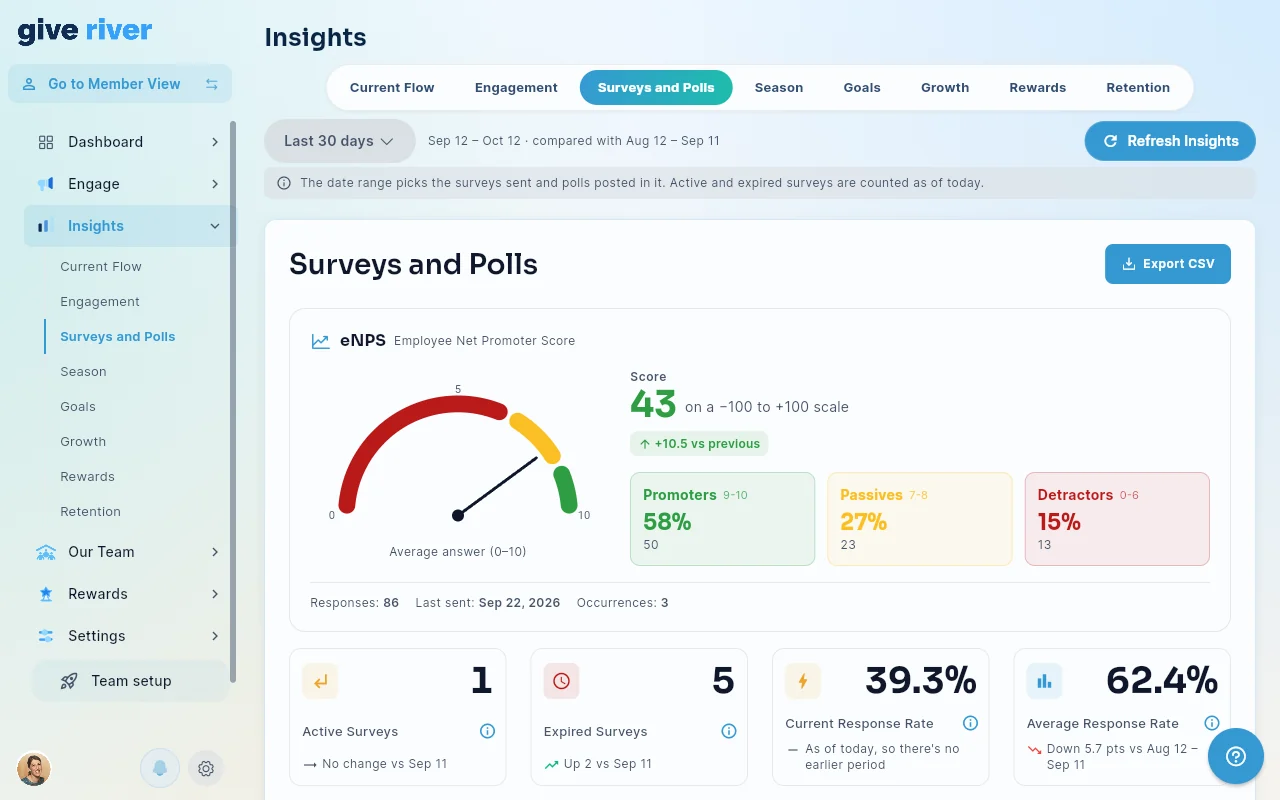
- The score in Insights. The eNPS panel shows a gauge, the score on a −100 to +100 scale, the counts and percentages of promoters, passives and detractors, and how many points the score moved since the previous round.
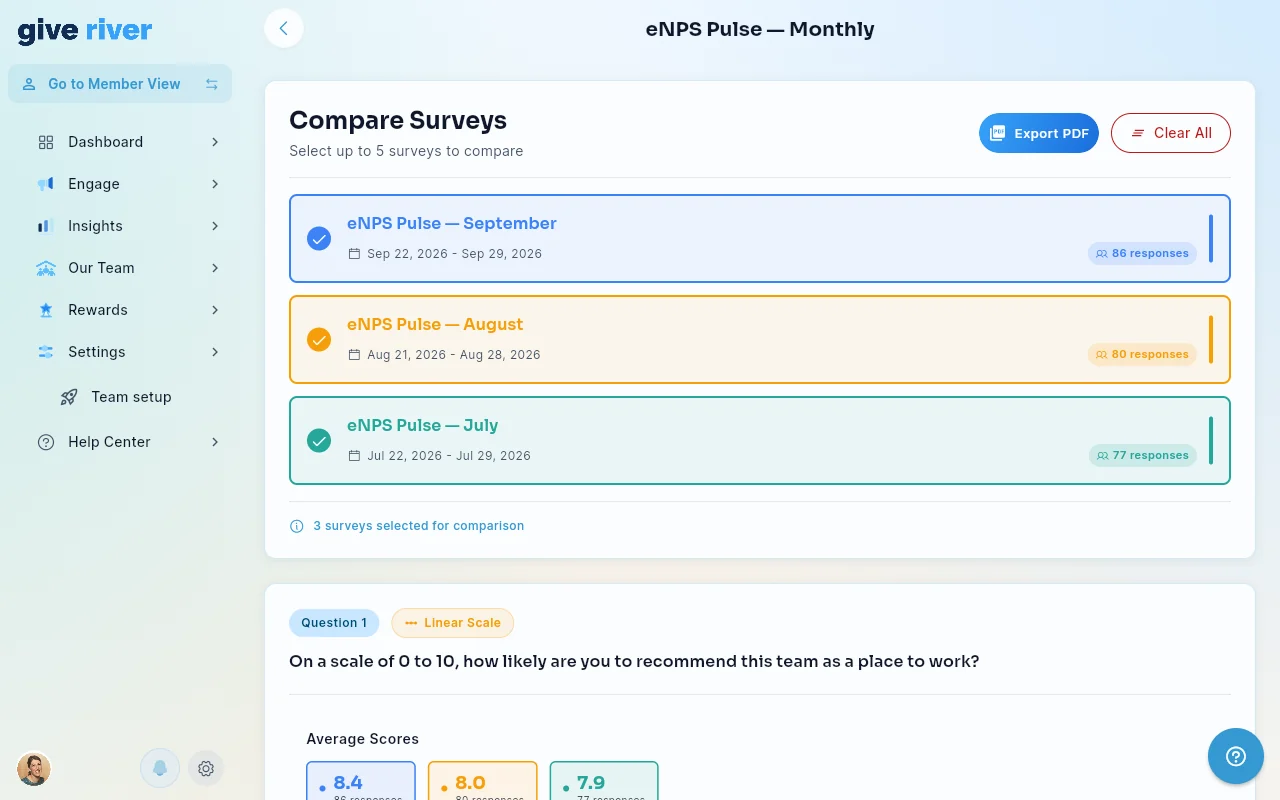
- Every round side by side. Compare rounds lines up the same questions across runs, so you can see which answers moved.
- Bring an existing survey. Any survey whose first question is a 0–10 scale can be converted into an eNPS series.
Surveys (including eNPS series) and the Insights dashboard are on Core, at $4.99 per user per month. eNPS is part of Guidance in Give River's 5G Method, which also covers peer recognition and gamified Seasons, so the platform that measures sentiment also gives you ways to act on it.
Frequently asked questions
How do you calculate eNPS?
Ask employees how likely they are to recommend your company as a place to work, on a 0–10 scale. Subtract the percentage who answer 0 to 6 (detractors) from the percentage who answer 9 or 10 (promoters); 7s and 8s (passives) count in the total but not the score.
What is a good eNPS score?
Any score above 0 means promoters outnumber detractors. Published guidance disagrees beyond that: one SHRM page calls anything above 10 good and a 2022 article by a company CHRO on SHRM's Executive Network says around 30, while Culture Amp's July 2026 benchmark puts the global median at 17. A score that rises from round to round is the most reliable sign.
Can eNPS be negative?
Yes. eNPS runs from −100 to +100, and it's negative whenever detractors outnumber promoters: a starting point to track, not a verdict.
How often should you run an eNPS survey?
Bain says companies most commonly ask monthly; quarterly works if you need more time to act between rounds. Give River offers monthly, quarterly or a custom interval, but not weekly.
Should eNPS surveys be anonymous?
Yes. Bain says employee feedback must be kept confidential to encourage honest answers. In Give River, eNPS surveys are always anonymous, and results stay hidden until at least 5 people have answered.
What's the difference between eNPS and NPS?
NPS asks customers how likely they are to recommend you to a friend or colleague; eNPS asks employees about recommending you as a place to work. The arithmetic is the same, but Bain warns employee scores can be substantially lower than customer scores, so don't compare the two.
Sources
Outside sources checked November 23, 2026. Give River features are described from our Help Center: Surveys (including eNPS), Survey Series Comparison and Admin Insights and Analytics. Net Promoter® and NPS® are registered trademarks, and Net Promoter Score℠ a service mark, of Bain & Company, Inc., NICE Systems, Inc., and Fred Reichheld.
- Bain & Company: Measuring Your Net Promoter Score, The Employee Net Promoter System, The History of Net Promoter
- SHRM: Employee Experience: A Comprehensive Guide (toolkit, undated), Four Diversity and Inclusion Initiatives That You Can Start Immediately (Einav Lavi, June 1, 2022)
- Culture Amp benchmarks, July 2026: All Industries (Global), United States, Publishing
More from this category.
Pulse Survey Questions and Cadence: How Often, How Many and What to Ask
A good starting point is a monthly pulse of three to five questions: the same anchor questions every time, plus a theme that rotates. Here's a sample 12-month cadence, a question bank by theme, and how to act on the results.

The 5 Best Employee Engagement Platforms in 2026, Compared
Give River, Culture Amp, WorkTango, Engagedly, and Kudos compared from each vendor's own site: pricing, gamification, learning, surveys, and who each one fits.

Employee Engagement Software for Companies With 50–200 Employees (2026)
What a 50–200 person company needs from engagement software, what six platforms cost at that size, who each fits, and how fast you can launch.
See the platform in action.
Free for up to 25 members, or try Core or Growth free for 30 days. A card is required; Free is never charged, and a trial bills when it ends unless you cancel.