Why **Modern Management Practices Such as Employee Management Recognition Programs** Are Reshaping the Workplace
Modern management practices such as employee management recognition programs are structured approaches that go beyond a simple "good job" to systematically acknowledge, reward, and develop employees in ways that drive real business…

Why Modern Management Practices Such as Employee Management Recognition Programs Are Reshaping the Workplace
Modern management practices such as employee management recognition programs are structured approaches that go beyond a simple "good job" to systematically acknowledge, reward, and develop employees in ways that drive real business outcomes. Here is a quick overview of what these practices look like today:
| Practice | What It Means |
|---|---|
| Real-time recognition | Acknowledging contributions immediately, not just at annual reviews |
| Peer-to-peer programs | Enabling colleagues to recognize each other, not just top-down praise |
| Values-based recognition | Tying appreciation directly to company culture and core behaviors |
| Personalized rewards | Offering non-cash, experience-based, or wellness incentives employees actually want |
| Technology integration | Using digital platforms, mobile apps, and analytics to scale recognition |
| Gamification | Applying sports-inspired mechanics like challenges and leaderboards to drive engagement |
The numbers behind these practices are hard to ignore. Organizations with formal recognition programs report employees who are 82% happier and 14% more engaged than those without. Meanwhile, 79% of employees who quit a job cite a lack of appreciation as a primary reason for leaving — a costly reality when replacing a single employee can run anywhere from 40% to 200% of their annual salary.
Yet despite the evidence, nearly a quarter of employees still feel underappreciated at work. The gap between what leaders think they are doing and what employees actually experience is where modern management practices step in to make a measurable difference.
The workplace has fundamentally changed. Remote and hybrid teams, generational shifts, and the aftermath of the Great Resignation have made the old playbook — annual bonuses, pizza parties, employee of the month plaques — feel hollow to today's workforce. What employees want now is recognition that feels genuine, frequent, and connected to something bigger than a paycheck.
I'm Meghan Calhoun, Co-Founder of Give River and a two-edge veteran of high-performance sales environments where I witnessed how the absence of meaningful recognition quietly erodes even the most talented teams. My experience navigating burnout, studying the science of human fulfillment, and building a recognition-first platform gives me a grounded perspective on exactly why modern management practices such as employee management recognition programs are no longer optional — they are a strategic imperative for any leader serious about retention and culture.
Discover more about modern management practices such as employee management recognition programs:
The Evolution of Modern Management Practices Such as Employee Management Recognition Programs
In the past, management was often synonymous with "supervision." It was a top-down, transactional relationship where feedback was reserved for the annual performance review and recognition was a gold watch after 25 years of service. Today, the shift toward modern management practices such as employee management recognition programs reflects a deeper understanding of human psychology and the digital-first nature of work.
Traditional programs were often "one-size-fits-all" and highly manual. Modern practices, however, prioritize real-time feedback. Instead of waiting months to praise a successful project, managers and peers use digital tools to offer immediate acknowledgment. This frequency is vital; Gallup research suggests that for recognition to be effective, it should happen at least once every seven days.
A cornerstone of this evolution is the move toward a values-based culture. Modern programs don't just reward "hitting the numbers"; they celebrate behaviors that align with the company’s core mission. Whether it's innovation, integrity, or teamwork, tying appreciation to values ensures that the culture remains cohesive even as teams grow. To dive deeper into these shifts, check out our guide on modern-employee-recognition-programs-best-practices.
Furthermore, the rise of peer-to-peer acknowledgment has decentralized the power of praise. When colleagues recognize one another, it builds a sense of belonging that top-down directives simply cannot match. This is especially crucial in our current era of remote work dynamics, where digital transformation allows us to stay connected to company culture regardless of physical location.
Why Modern Management Practices Such as Employee Management Recognition Programs Drive Retention
The business case for appreciation is backed by hard science. When we receive recognition, our brains activate reward systems that increase intrinsic motivation. According to the SCARF model (Status, Certainty, Autonomy, Relatedness, Fairness), recognition enhances an individual's sense of "status" and "relatedness," making them more committed to the group.
The impact on the bottom line is staggering:
- Engagement: Employees who receive regular recognition are 14% more engaged.
- Happiness: Recognition programs lead to employees who are 82% happier at work.
- Retention: Effective programs can decrease voluntary turnover rates by 31%.
- Productivity: 78% of workers admit they work harder when their efforts are rewarded.
Research shows that well-recognized employees are 45% less likely to leave a company after two years. In contrast, the "recognition gap"—where 55% of workers receive no recognition or sub-standard praise—is a primary driver of the $300 billion annual cost of burnout in the U.S.
| Outcome | Traditional Recognition | Modern Recognition |
|---|---|---|
| Frequency | Annual or Quarterly | Weekly or Real-Time |
| Source | Manager only | Peers and Leadership |
| Focus | Tenure/Years of Service | Values and Achievements |
| Impact | Low engagement (static) | 31% lower turnover |
| Delivery | Manual/Paper-based | Digital/Mobile/Integrated |
Key Trends Shaping Modern Management Practices Such as Employee Management Recognition Programs
As we look toward the future, several trends are defining how we appreciate our teams. Personalization is at the forefront. A generic gift card no longer cuts it; employees want rewards tailored to their lives, whether that’s a wellness app subscription or a donation to a cause they care about.
AI integration is also making waves, helping managers identify "unsung heroes" by analyzing collaboration patterns and suggesting timely moments for a shoutout. We are also seeing a massive shift toward wellness and well-being focus. Recognition today often includes mental health days, ergonomic home-office stipends, or "recharge" rewards.
While platforms like Bonusly and Kudos have popularized social recognition walls where everyone can see wins in real-time, Give River distinguishes itself by moving beyond transactional points to focus on holistic employee fulfillment. The market is moving toward these more comprehensive solutions. Modern organizations are also prioritizing sustainability and inclusivity, ensuring that rewards are eco-friendly and that recognition reaches "deskless" or frontline workers just as easily as those in the head office. For a broader look at the landscape, explore our employee-recognition-platforms resource.
Implementing a High-Impact Recognition Strategy
Building a successful program doesn't happen by accident. It requires an intentional 8-step implementation framework to ensure the program sticks and actually moves the needle on culture.
- Define the "Why": Start by setting clear objectives. Are you trying to reduce turnover, improve safety, or boost innovation?
- Secure Leadership Buy-In: Recognition isn't just an HR "perk"; it's a retention strategy. Show executives the ROI—spending just 1% of payroll on recognition can lead to an 85% positive impact on engagement.
- Identify Key Metrics: Decide how you will measure success (e.g., eNPS, participation rates, or turnover).
- Involve Your Employees: Ask them how they want to be recognized. 50% prefer public praise, while 43% prefer private acknowledgment.
- Train Your Managers: Recognition is a skill. Train leaders to be specific, timely, and genuine in their praise.
- Choose the Right Tools: Implement a system that makes it easy to give and receive "kudos" in the flow of work.
- Launch with Excitement: Brand your program and launch it with a "hero team" of internal champions.
- Measure and Iterate: Regularly review the data and adjust the program to keep it fresh.
For a deep dive into the planning phase, read our employee-recognition-action-plan-complete-guide.
Leveraging Technology for Scalable Appreciation
In a global or hybrid workforce, manual "Employee of the Month" photos on a breakroom wall are obsolete. Modern management practices such as employee management recognition programs rely on technology to scale. Digital platforms provide mobile accessibility, allowing field workers or remote staff to stay in the loop.
Automated milestones ensure that no work anniversary or birthday goes unnoticed, while real-time analytics allow HR to see which departments are thriving and which might be suffering from "recognition deserts." Gamification takes this a step further by using points, badges, and leaderboards to make the process interactive and fun.
Integration is key. By connecting your recognition software to tools like Slack and Teams, appreciation becomes a natural part of the daily workflow rather than another task to complete. Check out our list of employee-recognition-software-companies to see how these tools are transforming the modern office.
Designing Rewards That Employees Actually Want
What constitutes a "reward" has changed. While cash is always appreciated, 65% of employees prefer non-cash incentives. They value experiences, flexibility, and personal growth.
- Experience-Based Rewards: Tickets to a show, a cooking class, or a weekend getaway create lasting memories that a bonus check often doesn't.
- Professional Development: Offering to pay for a certification or a conference shows you are invested in their future.
- Wellness Incentives: Gym memberships, mental health days, or ergonomic equipment.
- Flexibility and Autonomy: Sometimes the best reward is a "Friday off" or the ability to choose their own project.
The secret to success is variety. By offering a points-based system where employees can "shop" for their own rewards, you ensure that the appreciation feels personal and meaningful. For more ideas, see our employee-reward-recognition-complete-guide.
Measuring Success and Sustaining Long-Term Engagement
A common pitfall is "launch and forget" syndrome. To avoid this, organizations must track KPIs like participation rates (how many people are giving recognition?) and recognition frequency. If the average employee isn't being recognized at least once a month, the program may be losing steam.
We recommend quarterly program reviews where you gather feedback via pulse surveys and look at the correlation between recognition and your Employee Net Promoter Score (eNPS). The ROI of recognition is found in the turnover you avoid. If your turnover drops by even a small percentage, the program has likely paid for itself many times over.
To keep the momentum going, leadership must lead by example. When a CEO takes the time to publicly thank a junior staffer for a specific contribution, it sends a powerful message that everyone’s work matters. Explore more employee-recognition-strategies to keep your team engaged for the long haul.
Conclusion: Building a Culture of Fulfillment with Give River
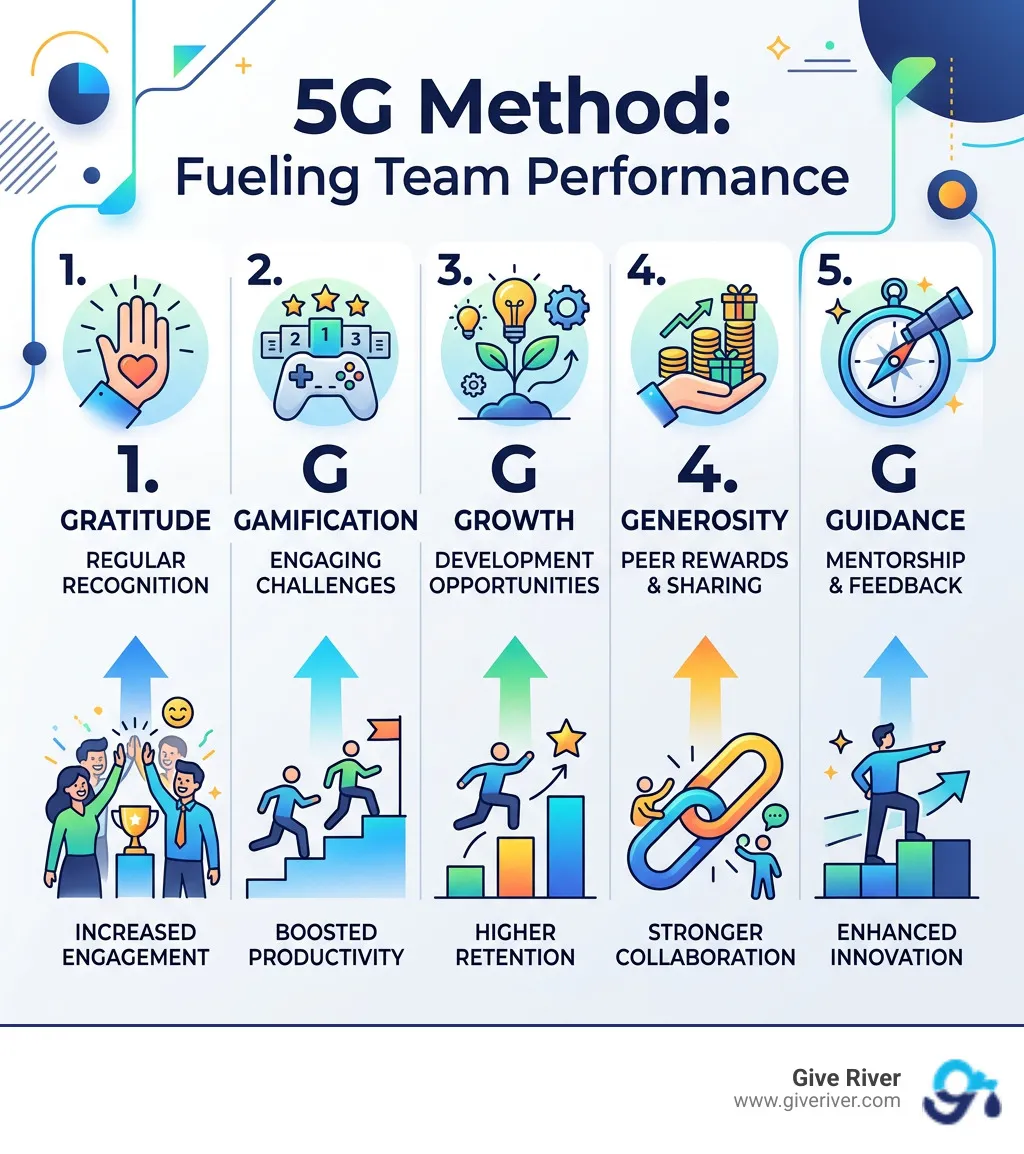
At Give River, we believe that work should be a source of fulfillment, not just a means to an end. While platforms like Bonusly and Kudos excel at social recognition, Give River provides a more integrated experience by focusing on the whole human. Our platform is built on the 5G Method, a holistic approach designed to transform workplace culture:
- Guided: We provide the content and structure to help employees grow.
- Gamified: We make performance and recognition fun and interactive.
- Gratitude: We center everything around the power of appreciation.
- Growth: We focus on both personal wellness and professional development.
- Generosity: We empower teams to make a community impact through their wins.
By moving beyond simple "engagement" and focusing on true fulfillment, we help you build high-performing teams that are healthier, happier, and more loyal. Modern management practices such as employee management recognition programs are the engine that drives this transformation.
Ready to see how gratitude can change your business? Transform your culture with the Give River recognition platform today and start building the team of tomorrow.
Quick Links for Further Reading:
More from this category.
Best Employee Recognition Software for Nonprofits (2026)
What nonprofits need from recognition software, what six platforms charge mission-driven teams, and how to get a grant-funded Season of Give River for free.
Employee Recognition Software Pricing in 2026: What 6 Platforms Charge
What Give River, Bonusly, Motivosity, Nectar, Awardco, and Workhuman charge in 2026, from their own sites: pricing models, minimums, fees, and contract terms.

How to Improve Employee Recognition Across Multiple Locations
Six practical ways to make recognition reach every site and shift, what to look for in a platform, and how a 25-location nonprofit did it.
See the platform in action.
30-day free trial. No credit card. River Guide included on Core and Growth.