Why Your Employee Engagement Experience Is the Foundation of Business Success
The employee engagement experience is the complete journey an employee has with your organization — from the moment they first encounter your employer brand to the day they leave and beyond. It shapes how motivated, connected, and…

Why Your Employee Engagement Experience Is the Foundation of Business Success
The employee engagement experience is the complete journey an employee has with your organization — from the moment they first encounter your employer brand to the day they leave and beyond. It shapes how motivated, connected, and committed your people feel at every stage of their career with you.
Here's a quick snapshot of what it means and why it matters:
| Employee Engagement | Employee Experience | |
|---|---|---|
| What it measures | Emotional connection, motivation, and commitment | The full journey: relationships, environment, resources, and growth |
| Role | An outcome of experience | The driver of engagement |
| Scope | How engaged someone feels | Everything that shapes how they feel |
| Measured by | Surveys, eNPS, productivity | Lifecycle touchpoints, culture, technology, workspace |
To improve your employee engagement experience, start here:
- Understand the difference between engagement (the outcome) and experience (the driver)
- Map your employee lifecycle to identify the moments that matter most
- Collect continuous feedback through pulse surveys and stay interviews — not just annual reviews
- Act on what you hear — unacted feedback actively lowers engagement
- Measure the right KPIs: eNPS, retention rate, inclusion, and well-being alongside traditional engagement scores
- Build a culture of recognition and growth that makes people feel valued as whole humans, not just headcounts
The stakes are high. Research shows that employees who report a positive employee experience have 16 times the engagement level of those with a negative one — and companies with strong employee experience generate 23% higher profits than those that don't prioritize it. Yet most organizations are still running outdated annual engagement surveys and wondering why the needle isn't moving.
The problem isn't that your people don't want to be engaged. It's that engagement alone is the wrong target. As one key insight from Perceptyx's research puts it, treating engagement in isolation is like treating a fever without finding the cause. You need to address the full experience that drives engagement in the first place.
That's exactly what this guide is about.
I'm Meghan Calhoun, Co-Founder of Give River and a workplace wellness advocate with over two decades of experience leading high-pressure teams — from Fortune 100 sales floors to emotionally demanding environments — where I learned how the employee engagement experience can make or break both people and performance. After nearly burning out myself, I rebuilt my approach around the science of human fulfillment, which became the foundation of Give River's 5G Method: Gratitude, Gamification, Growth, Generosity, and Guidance.
In this guide, we'll walk you through a practical, gamified framework for transforming your employee engagement experience — one that drives measurable results in retention, productivity, and culture.
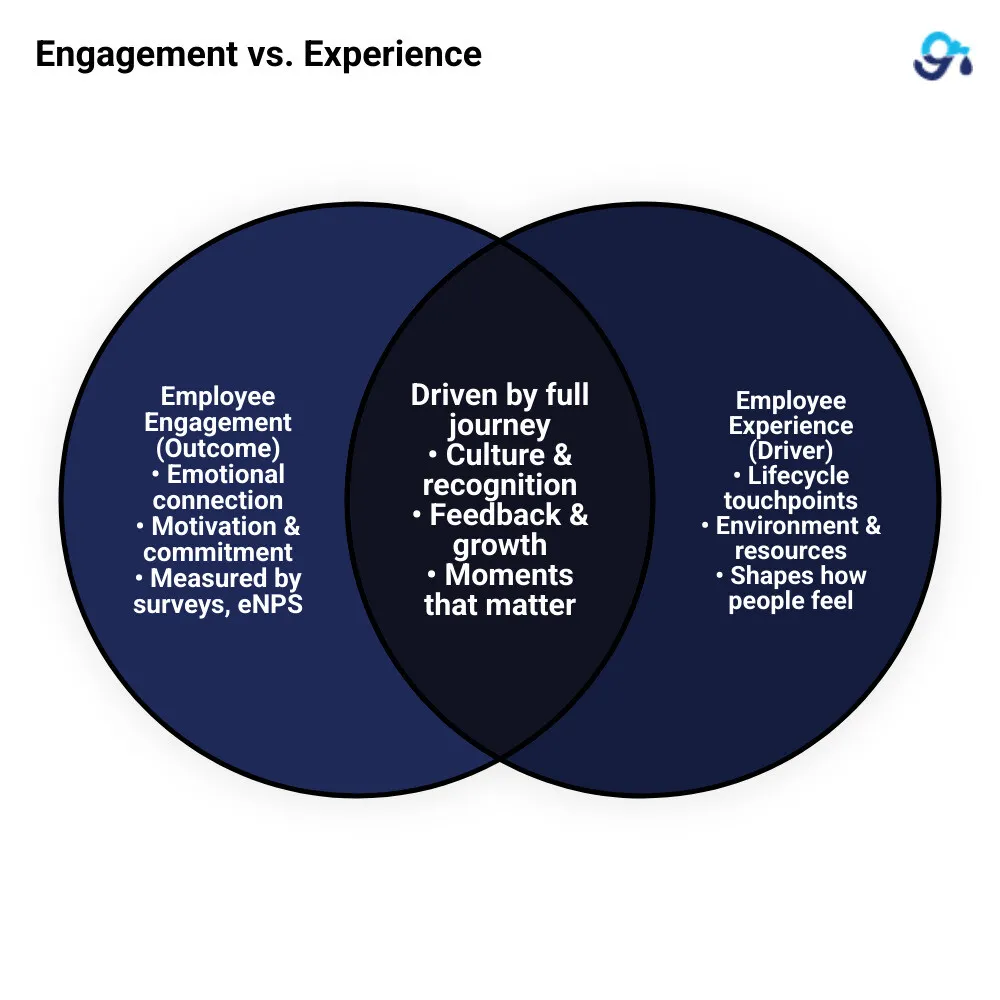
Employee engagement experience definitions:
Understanding the employee engagement experience: From Lifecycle to ROI
When we talk about the employee engagement experience, we are moving past the era of the "once-a-year" pulse check. In today’s competitive talent market, prioritizing the experience your people have every day isn't just a nice-to-have HR initiative—it is a critical business imperative.
Organizations that excel in this area don't just attract talent; they create an environment where talent thrives. According to Scientific research on EX impact, a positive experience leads to workers who are significantly more likely to go above and beyond. This isn't magic; it’s the result of intentionally designing every touchpoint of the professional journey.

Defining the employee engagement experience vs. traditional engagement
It is easy to use these terms interchangeably, but distinguishing them is the first step toward a winning culture. Think of employee engagement as the what—the level of enthusiasm, pride, and commitment an employee feels toward their work.
The employee engagement experience (EX), however, is the how and the why. It encompasses every interaction, from the software they use to the relationship they have with their manager. While traditional engagement programs might focus on "boosting morale" through a pizza party, an EX-focused strategy looks at the physical workspace, the digital tools provided, and the cultural environment.
By focusing on the experience, you address the root causes of employee-engagement-and-motivation. If the experience is seamless and supportive, high engagement follows naturally as an outcome.
Mapping Lifecycle Touchpoints to the employee engagement experience
To improve the employee engagement experience, we must look at the "moments that matter" across the seven stages of the employee lifecycle:
- Attract: Your employer brand and the first impression you make on candidates.
- Onboard: The critical first weeks where a new hire decides if they made the right choice.
- Engage: The day-to-day interactions and sense of belonging.
- Perform: Having the resources and clear expectations to succeed.
- Develop: Opportunities for growth and career progression.
- Exit: A respectful transition that turns departing staff into brand advocates.
- Alumni: Maintaining a network of former employees who can still offer referrals or insights.
Understanding these stages allows you to use data-driven insights, such as those found in an hr-employee-survey-complete-guide, to pinpoint exactly where the experience might be breaking down.
The Business Case: Profitability and Retention
If you need to convince your leadership team that the employee engagement experience is worth the investment, let the numbers speak for themselves. Research consistently shows that companies in the top quartile for engagement are 23% more profitable than those in the bottom quartile.
Furthermore, employees who enjoy a positive experience are 68% less likely to consider leaving their current role. When you consider that replacing a staff member can cost 50% to 60% of their annual salary, the ROI of retention becomes undeniable. Highly engaged teams also see a 41% reduction in absenteeism and a 10% increase in customer ratings. In short, when your people feel good about their work, your customers feel good about your business.
Strategies to Gamify and Measure Your Workplace Culture
In the modern world of work—where hybrid and remote setups are the norm—we can no longer rely on watercooler chats to build culture. We need digital-first strategies that bring people together, regardless of their zip code.
Gamification is one of the most powerful tools in our arsenal. By introducing elements like points, badges, and leaderboards, we tap into the natural human desire for achievement and recognition. This doesn't mean turning work into a video game; it means using game mechanics to make the employee engagement experience more interactive and rewarding.
Best Practices for Improving the Modern Employee Experience
Improving the experience requires a multi-pronged approach that addresses the "whole person." Here are our top strategies:
- Prioritize Recognition: Don't wait for the annual review. Use rewards-and-recognition platforms to provide real-time "shout-outs" for great work.
- Invest in Wellness: Burnout is the enemy of engagement. Offer wellness resources that support mental, physical, and financial health.
- Enable Growth: Career opportunities are a top driver of engagement in 2024. Provide clear pathways for advancement and continuous learning.
- Embrace Flexible Work: Hybrid workers often report higher productivity and better work-life balance. Trust your team to manage their time.
- Foster DEI: An inclusive environment where everyone feels they belong is foundational to a positive employee engagement experience.
While platforms like Bonusly or Kudos offer great peer-to-peer recognition, they often focus primarily on the 'Gratitude' aspect of the experience. Give River is different because we integrate recognition into a broader growth framework. Our 5G Method goes beyond simple shout-outs by combining gamification with holistic wellness, professional guidance, and community generosity, ensuring that the employee engagement experience supports the whole person, not just their output.
Measuring Success with KPIs and Continuous Feedback
You cannot manage what you do not measure. However, the old way of measuring—the massive 100-question annual survey—is dying. It often leads to "survey fatigue" and, worse, "inaction fatigue" when employees feel their feedback goes into a black hole.
Instead, we recommend a "continuous listening" model. This includes:
- eNPS (Employee Net Promoter Score): A simple metric asking how likely employees are to recommend your company as a place to work.
- Pulse Surveys: Short, frequent surveys (often 5-10 questions) that track sentiment in real-time.
- Stay Interviews: Proactive conversations to understand why people stay and what might make them leave.
- Retention and Absenteeism Rates: Hard data that reflects the health of your culture.
Following employee-engagement-survey-best-practices ensures that you are asking the right questions at the right time. Most importantly, you must act on the data. Even small, visible changes based on feedback build more trust than a dozen unread reports.
Transforming Culture with Give River’s 5G Method
At Give River, we’ve distilled the science of fulfillment into our 5G Method. We believe that a truly exceptional employee engagement experience is built on five pillars:
- Guided: Providing the mentorship and clarity employees need to navigate their roles.
- Gamified: Using interactive tools and rewards to keep work engaging and fun.
- Gratitude: Making rewards-and-recognition a daily habit, not a rare event.
- Growth: Focusing on both personal wellness and professional development content.
- Generosity: Connecting employees to a larger purpose through community impact and social responsibility.
By focusing on these five areas, we help organizations move beyond "satisfaction" and toward genuine fulfillment. When your team members feel like they are growing, being recognized, and contributing to something bigger than themselves, they don't just work harder—they work better.
Ready to see how gamification can transform your team? We invite you to explore our digital-engagement-platforms and discover how Give River can help you build a happier, healthier, and high-performing workplace culture. Let's move beyond the survey and start building an experience that truly matters.
More from this category.

The 5 Best Employee Engagement Platforms in 2026, Compared
Give River, Culture Amp, WorkTango, Engagedly, and Kudos compared from each vendor's own site: pricing, gamification, learning, surveys, and who each one fits.

Employee Engagement Software for Companies With 50–200 Employees (2026)
What a 50–200 person company needs from engagement software, what six platforms cost at that size, who each fits, and how fast you can launch.
What Is a Digital Engagement Platform? (And Why It Matters Right Now)
Understanding the digital engagement platform definition starts with a simple idea: it's a technology framework that centralizes how an organization communicates with, supports, and motivates its people — employees or customers — across…
See the platform in action.
30-day free trial. No credit card. River Guide included on Core and Growth.