Why Strategies for Corporate Social Responsibility Are Reshaping How Businesses Win
Strategies for corporate social responsibility have moved far beyond writing a check to a local charity once a year. Today, they represent a fundamental shift in how businesses define success — measuring not just profit, but impact on…

Why Strategies for Corporate Social Responsibility Are Reshaping How Businesses Win
Strategies for corporate social responsibility have moved far beyond writing a check to a local charity once a year. Today, they represent a fundamental shift in how businesses define success — measuring not just profit, but impact on people and the planet too.
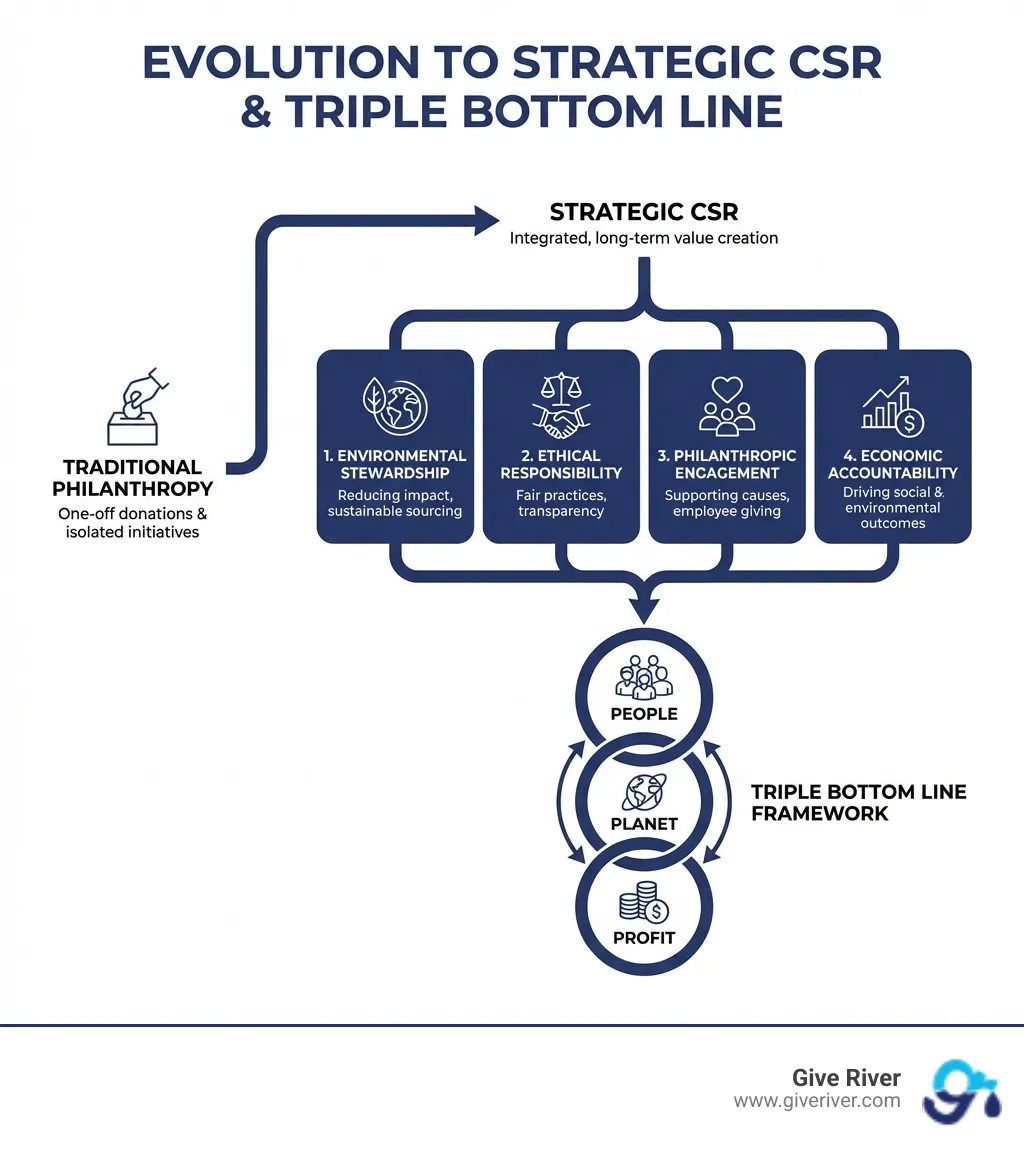
Here's a quick overview of the four core CSR strategies modern businesses use:
- Environmental stewardship - Reducing emissions, cutting waste, and sourcing sustainably
- Ethical responsibility - Fair wages, transparent supply chains, and inclusive governance
- Philanthropic engagement - Donating to causes, supporting communities, and enabling employee giving
- Economic accountability - Investing financial resources in programs that drive social and environmental outcomes
These aren't isolated initiatives. The most effective CSR programs weave all four into the core of how a business operates — creating what researchers call a triple bottom line: people, planet, and profit.
The data backs this up. According to Boston Consulting Group, companies recognized as leaders in environmental, social, and governance (ESG) matters carry an 11% valuation premium over their competitors. And yet, a striking 47% of executives strongly agree their CSR initiatives are creating real impact — which means the other half still has significant ground to cover.
The gap between intention and execution is exactly where most companies get stuck.
I'm Meghan Calhoun, co-founder of Give River and a workplace culture strategist with over two decades of experience helping organizations build teams that perform and thrive — and developing strategies for corporate social responsibility that actually stick has become one of the most powerful levers I've seen leaders pull to improve both retention and purpose at work. In the sections ahead, we'll break down a practical framework so you can move from good intentions to measurable impact.
Similar topics to strategies for corporate social responsibility:
- types of csr initiatives
- impact of csr initiatives on a company's bottom line
- csr and esg initiatives
The Framework of Modern Strategies for Corporate Social Responsibility
In the past, many companies viewed social responsibility meaning and definition as a side project—something the marketing department handled to look good in the local paper. Today, it has evolved into a self-regulating business model where a company remains socially accountable to itself, its stakeholders, and the public.
We see this shift reflected in international standards like ISO 26000. Unlike other ISO certifications, this isn't a requirement you "pass"; it’s a voluntary set of guidance to help organizations translate principles into effective actions. It covers everything from human rights to environmental protection, ensuring that what is corporate social responsibility is treated as a core business function rather than an afterthought.
Modern strategies for corporate social responsibility are also increasingly intertwined with CSR and ESG initiatives. While CSR is the internal philosophy and culture of a company, ESG (Environmental, Social, and Governance) provides the data-driven metrics that investors use to evaluate a company's sustainability. Scientific research from the Boston Consulting Group confirms that ESG leaders enjoy an 11% valuation premium, proving that doing good is, quite literally, good for business.

The Triple Bottom Line and Four CSR Components
To truly understand CSR definition, we must look at the "Triple Bottom Line"—a framework that encourages us to measure success through three lenses: Profit, People, and Planet. Within this framework, we categorize types of CSR initiatives into four main components:
- Environmental Stewardship: This involves reducing a company's carbon footprint. For example, McDonald’s reduced its solid waste by 30% by changing its packaging materials.
- Ethical Responsibility: This ensures fair treatment for all stakeholders. It means sourcing products according to fair trade standards and ensuring a diverse, inclusive workplace.
- Philanthropic Ventures: This goes beyond ethical operations to active giving. Whether it’s company matching gift programs or sponsoring local nonprofits, this is about being a good corporate citizen.
- Financial Commitments: This is the "Economic" pillar. It ensures that a company backs its social goals with real capital, investing in sustainable R&D or community development.
Why Modern Strategies for Corporate Social Responsibility Matter
Why should your organization care about these strategies? Beyond the moral obligation, the advantages of corporate social responsibility are tangible and far-reaching.
First, there is the undeniable boost to brand reputation. Consumers—especially Millennials and Gen-Z—are increasingly voting with their wallets for brands that align with their values. Secondly, there is the impact of CSR initiatives on a company's bottom line. Efficiency gains, such as DuPont saving over $2 billion in energy costs since 1990, show that sustainability often leads to direct cost savings.
Finally, we cannot ignore employee retention. People want to work for a company that has a soul. When employees feel their work contributes to a greater good, CSR and employee satisfaction skyrocket, leading to higher productivity and lower turnover.
B-Corporations vs Benefit Corporations
When exploring ethical business models, you’ll likely encounter two similar-sounding terms: B-Corps and Benefit Corporations. They are related but distinct.
A B-Corporation is a certification issued by the nonprofit B Lab. To earn it, a company must achieve a high score on the B Impact Assessment, which measures impact on workers, community, customers, and the environment. This certification requires public transparency of their scores.
A Benefit Corporation, on the other hand, is a legal status recognized by state law. It changes the legal obligations of the company, requiring directors to consider the impact of their decisions on all stakeholders (people and planet), not just shareholders (profit). Adopting sustainable business practices through these structures provides a permanent "north star" for the organization.
4 Game-Changing Strategies for Corporate Social Responsibility Success
To move from a basic program to a "game-changing" one, we need to shift from Responsive CSR to Strategic CSR. This distinction, pioneered by Michael Porter and Mark Kramer in Harvard Business Review, is the difference between doing "nice things" and doing things that create "shared value."
| Feature | Responsive CSR | Strategic CSR |
|---|---|---|
| Primary Goal | Mitigate harm & act as a good citizen | Create unique competitive advantage |
| Focus | Generic social issues | Issues tied to the core value chain |
| Integration | Siloed in PR or Marketing | Embedded in core operations |
| Outcome | Improved reputation | Shared value for business & society |
Here are the four strategies to help you make that transition:
1. Purpose Alignment and "Inside-Out" Mapping
The most effective strategies for corporate social responsibility start by looking at your company’s value chain. What are the social impacts of your day-to-day operations? If you are a logistics company, your biggest impact is carbon emissions. If you are a tech firm, it might be data privacy or the "digital divide." By aligning your CSR with your core purpose, you ensure the initiatives feel authentic rather than performative.
2. Deep Stakeholder Engagement
Don't guess what your community needs—ask them. This includes your employees. Research shows that 87% of leaders view Employee Resource Groups (ERGs) as a trusted source of information for CSR activities. When you engage employees in best CSR initiatives employees, you aren't just doing a project; you're building a culture. While platforms like Bonusly or Kudos are effective for peer recognition, Give River differentiates itself by tying that recognition directly to a larger community purpose. This ensures that employee engagement isn't just an internal loop, but a driver for external social impact.
3. Value Chain Integration
Instead of just donating to a random charity, look for strategic CSR examples where the social initiative actually improves your business environment. For instance, Nestlé didn't just give money to farmers; they built refrigerated dairies and provided veterinary services. This improved the farmers' lives and ensured Nestlé had a high-quality, reliable milk supply. That is shared value.
4. Radical Transparency and Reporting
In an age of skepticism, "trust me" doesn't work. You need to show your work. This means moving beyond "feel-good" stories to hard data. Use recognized frameworks like GRI or SASB to report your progress. When you are transparent about both your successes and your challenges, you build a level of trust with consumers and investors that a flashy ad campaign could never buy.
Avoiding Common CSR Pitfalls and "Purpose-Washing"
We have all seen it: a company changes its logo to a pride flag or a green leaf for a month while their internal practices remain unchanged. This is "purpose-washing" or "greenwashing," and it is one of the quickest ways to destroy brand trust.
To avoid this, we must ensure that our CSR initiatives meaning is rooted in action. Common mistakes include:
- Lacking Executive Support: If the CEO doesn't buy in, the program will eventually be cut during the first lean quarter.
- Siloed Initiatives: CSR shouldn't live in its own bubble; it needs to be integrated into HR, Procurement, and Operations.
- Using CSR Only as a Marketing Tool: If the budget for the ad about the charity is bigger than the donation to the charity, you have a problem.
Understanding what is the purpose of corporate social responsibility means recognizing it as a long-term commitment to a better way of doing business, not a short-term PR fix. A clear CSR programme meaning is one that is felt by the employees and the community every day, not just during an annual report.
Measuring and Reporting Social Impact
If you can’t measure it, you can’t manage it. This is why what is corporate social responsibility reporting has become the fastest-growing budget line item for impact professionals. In 2019, 90% of S&P 500 companies published sustainability reports.
To do this effectively, we recommend:
- Setting SMART Goals: Specific, Measurable, Achievable, Relevant, and Time-bound. Instead of saying "we want to help the environment," say "we will reduce water consumption by 20% by 2026."
- Using Global Standards: Frameworks like the Global Reporting Initiative (GRI) or the Sustainability Accounting Standards Board (SASB) provide a common language for impact.
- Tracking Participation and Outcomes: Don't just track how many hours employees volunteered; track the result of that work. Did it improve graduation rates? Did it reduce local waste?
As highlighted in the Harvard Business Review research, the goal is to move beyond "stakeholder satisfaction" to actual social impact.
Conclusion: Building a Culture of Generosity
Developing effective strategies for corporate social responsibility is a journey, not a destination. It requires a fundamental shift in mindset—from seeing social impact as a cost to seeing it as an investment in the future of your company and the world.
At Give River, we believe that the most powerful CSR starts from within. Unlike standard recognition tools like Bonusly or Kudos that focus on transactional rewards, our unique 5G Method—Guided, Gamified, Gratitude, Growth, and Generosity—helps companies integrate social values into the very fabric of their workplace culture. By combining employee recognition with charitable impact, we create a virtuous cycle where doing good work leads to doing good in the world.
When employees feel fulfilled and empowered to make a difference, they don't just work harder; they work with more heart. And in today's competitive landscape, a company with heart is the ultimate competitive advantage.
Ready to transform your workplace culture and amplify your impact? Let's build a culture of generosity together. Explore how our tools for charitable impact can help your team turn purpose into performance.
More from this category.

Why Community Involvement Grants Matter for Your Organization's Impact
Community involvement grants provide essential funding to help organizations—from nonprofits and schools to businesses—create meaningful change. These grants can feel overwhelming to steer, but they offer a powerful way to address critical…

Why Getting Involved Matters: More Than Just Giving Back
Community involvement ideas span from food drives and tutoring to charity runs and park clean-ups. Whether you prefer hands-on projects, skill-based opportunities, donation drives, or corporate volunteer programs, there are countless ways…

Why Community Involvement Programs in Schools Matter
Community involvement programs in schools are collaborative relationships between educational institutions and local stakeholders like families, businesses, and non-profits. They are crucial for creating a supportive ecosystem that…
See the platform in action.
30-day free trial. No credit card. River Guide included on Core and Growth.