Why Your Employees' Voice is Your Greatest Asset
An hr employee survey is a structured questionnaire designed to capture feedback on everything from job satisfaction and company culture to leadership effectiveness. These surveys provide HR leaders with actionable data to improve…

Why Your Employees' Voice is Your Greatest Asset
An hr employee survey is a structured questionnaire designed to capture feedback on everything from job satisfaction and company culture to leadership effectiveness. These surveys provide HR leaders with actionable data to improve engagement, reduce turnover, and build healthier workplace cultures.
Here's a sobering reality: low employee engagement costs the global economy approximately $8.9 trillion, or 9% of global GDP, according to Gallup's latest State of the Global Workplace report. Yet many organizations are missing the single most powerful tool they have to address it—their employees' voices.
The disconnect is alarming. While 78% of HR professionals claim they are proactive, only 42% of employees agree. Worse, only 25% of workers believe their company acts on survey feedback. This gap isn't just about communication—it's about trust, culture, and your bottom line. When employees feel heard, engagement soars, productivity increases by 12.5%, and they become 3.4 times less likely to seek new jobs.
An hr employee survey isn't just a questionnaire—it's a conversation. But most organizations do them wrong, letting valuable insights get buried in spreadsheets. This guide will show you how to design surveys people want to complete, analyze the results, and turn insights into actions that build happier, high-performing teams.
I'm Meghan Calhoun, Co-Founder of Give River. I've spent two decades learning what drives sustainable employee engagement. While platforms like Bonusly and Kudos excel at peer-to-peer recognition, they often treat surveys as a separate function. Give River takes a more comprehensive approach. We integrate surveys directly with our unique 5G Method—Gratitude, Gamification, Growth, Generosity, and Guidance—to transform feedback into a continuous cycle of recognition and improvement.
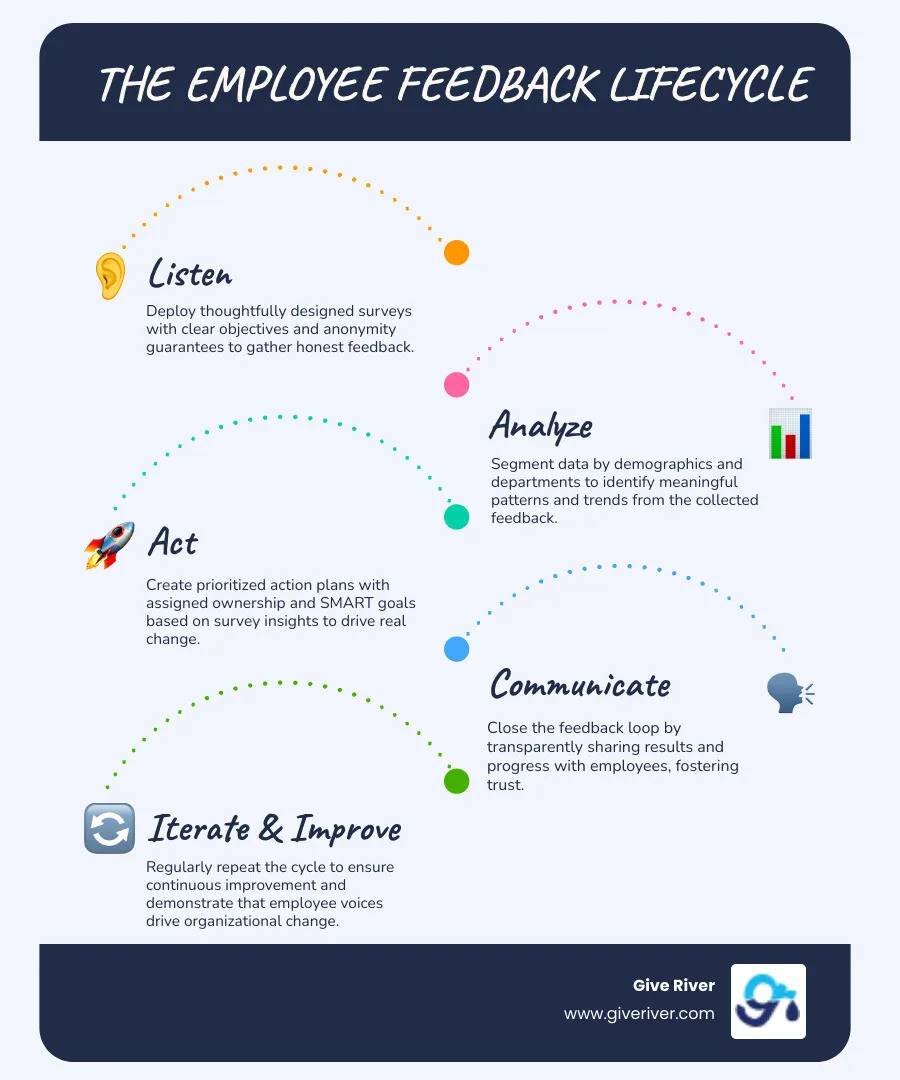
The Employee Feedback Lifecycle: A successful hr employee survey program follows a continuous cycle: (1) Listen - Deploy thoughtfully designed surveys. (2) Analyze - Segment data to identify meaningful patterns. (3) Act - Create prioritized action plans based on insights. (4) Communicate - Close the feedback loop by sharing results and progress. This cycle repeats to maintain continuous improvement.
The Ultimate Guide to Your HR Employee Survey Strategy
Think of your hr employee survey program as the heartbeat of your organization—a continuous pulse that tells you what's working and what's not. It's about creating a living conversation that drives real change.
Understanding the Types and Benefits of Employee Surveys
Different challenges require different survey approaches. Here’s a quick rundown:
- Employee Satisfaction Surveys: Your annual health check-up, covering basics like compensation, benefits, and work-life balance. An Employee Satisfaction Platform can help track these metrics consistently.
- Employee Engagement Surveys: These go deeper, measuring emotional commitment, motivation, and pride in the company—the factors that truly drive performance.
- Pulse Surveys: Short, frequent check-ins (weekly or monthly) that track sentiment in real-time and help you catch issues before they escalate. An Employee Pulse Survey Platform can maximize their effectiveness.
- Deep-Dive Surveys: Comprehensive investigations into specific topics like remote work effectiveness or a new HR initiative.
- Onboarding and Exit Surveys: These bookend the employee journey, helping you refine the new hire experience and capture honest feedback from departing employees.
The payoff for this effort is substantial. Companies with strong feedback mechanisms see a 12.5% increase in productivity and find that engaged employees are 3.4 times less likely to be job hunting. Surveys also foster a culture of transparency and trust, moving your organization from guesswork to data-driven decisions. When you act on feedback, you prove that employee voices matter, strengthening the employer-employee relationship and boosting Employee Engagement and Retention.
While platforms like Bonusly and Kudos offer valuable recognition features, Give River’s approach is different. We integrate your hr employee survey program directly into our 5G Method, ensuring feedback doesn't just sit in a report but actively drives growth, recognition, and meaningful change.

Designing and Conducting an Effective HR Employee Survey
An effective hr employee survey starts with a solid design. Follow these best practices:
- Define Clear Objectives: Know what you need to learn before you write a single question.
- Guarantee Anonymity: Employees must feel safe providing honest feedback. Communicate how you'll protect their identity and stick to it.
- Ask Unbiased, Clear Questions: Avoid leading questions. Instead of “Don’t you agree our new policy is great?” ask, “How would you rate your satisfaction with our new policy?”
- Keep it Concise: Respect people's time. Aim for 5-10 minutes for pulse surveys and 15-20 minutes for comprehensive annual surveys.
- Use a Mix of Question Types: Use rating scales for quantitative data, but include open-ended questions to uncover the “why” behind the numbers.
A comprehensive survey should cover key areas like job satisfaction, feedback and recognition, Company Culture Engagement, leadership, and professional development. Since 74% of employees say a lack of development opportunities holds them back, this is a critical area to explore.
If you're just starting, use these five powerful questions:
- “How likely are you to recommend this company as a great place to work?” (Your eNPS)
- “Do you feel you have the resources and support needed to do your job effectively?”
- “Do you feel recognized for your contributions at work?”
- “Do you believe there are opportunities for you to learn and grow professionally here?”
- “Is there anything else you would like to share?”
For timing, use annual surveys for benchmarking and supplement with quarterly or monthly pulse surveys. When choosing tools, you can use standalone platforms like SurveyMonkey or integrated HR systems. Give River’s Employee Engagement Technology stands apart by connecting survey feedback directly to our 5G Method for recognition, growth, and community impact, ensuring data drives action.
Finally, communicate the survey’s purpose and timeline clearly before launch. Emphasize anonymity and send reminders strategically to boost participation.

From Data to Action: Analyzing Results and Creating Change
Collecting data is just the start. The real work is turning that data into action. Start by analyzing both quantitative (the numbers) and qualitative (the comments) data. The numbers tell you what is happening, while the comments tell you why.
Don't just look at company-wide averages. Segment your data by department, tenure, location, and manager to uncover hidden patterns. Are new hires struggling? Is one team less engaged than others? These are the insights that point to specific solutions. Compare results to previous surveys to identify trends and use our Employee Engagement Insights tools to uncover critical patterns.
Once you have your insights, it's time to build an action plan:
- Prioritize Issues: You can't fix everything. Focus on 2-3 key areas that will have the biggest impact.
- Assign Ownership: Make someone accountable for each priority.
- Set SMART Goals: Define specific, measurable, achievable, relevant, and time-bound goals.
- Communicate the Plan: This is the trust-building moment. Share the results, explain what you plan to do, and follow up on progress. This transparency proves that you're listening and closes the feedback loop.

Measuring Success and Avoiding Common Pitfalls
An effective hr employee survey program requires avoiding common traps and measuring real impact. The cardinal sin is ignoring feedback. When employees see no action, they lose trust. Only 25% of workers believe their company acts on feedback—be the exception.
Other pitfalls to avoid include:
- Poor Communication: Failing to explain the survey's purpose or share results.
- Survey Fatigue: Bombarding your team with too many long, repetitive questionnaires.
- Lack of Anonymity: This kills honest feedback and is non-negotiable.
- Asking Irrelevant Questions: Every question should serve a clear purpose.
So, how do you measure success? Look beyond scores. Track response rates to gauge trust in the process. Monitor key HR metrics like employee engagement scores, retention rates, and your eNPS (Employee Net Promoter Score) over time. The ultimate measure is seeing tangible improvements in these areas.
Leading companies prove this works. Patagonia ties survey results to leadership bonuses, contributing to an impressive 90% employee retention rate. Zappos embeds feedback into its core values, resulting in significantly lower turnover. These organizations don't just ask questions—they build accountability and demonstrate that feedback drives change. You can explore more examples in our Case Studies.
Conclusion: Changing Feedback into a Thriving Culture

We've covered the lifecycle of an effective hr employee survey program, and one truth remains constant: your employees' voices are the compass that guides your organization toward success. Surveys aren't a checkbox exercise; they are a continuous conversation of listening, understanding, acting, and communicating that builds trust with every cycle.
The real power lies in what you do with the answers. When employees see their feedback lead to real change, they feel valued and become more engaged. This is how you build a culture where people genuinely want to do their best work. By sharing results and action plans, you demonstrate that every voice matters.
This journey from feedback to fulfillment creates a truly Purpose-Driven Workplace, where employees contribute to something meaningful and leaders empower their teams.
At Give River, we've designed our platform around this holistic vision. While platforms like Bonusly and Kudos offer great recognition tools, they often operate separately from your core feedback strategy. Give River’s unique 5G Method fully integrates hr employee survey insights with recognition, wellness, growth, and community impact. This means your survey data doesn't just generate reports—it feeds a comprehensive system designed to build happier, healthier, high-performing teams.
The disconnect where 78% of HR leaders feel proactive but only 42% of employees agree doesn't have to be your reality. With the right approach and a commitment to action, you can create a workplace where listening is part of your DNA.
Ready to transform your workplace culture? See how Give River can help you turn employee feedback into actionable Data Driven Insights that drive real engagement and fulfillment. When you truly listen and act, everyone wins.
More from this category.
What Is a Digital Engagement Platform? (And Why It Matters Right Now)
Understanding the digital engagement platform definition starts with a simple idea: it's a technology framework that centralizes how an organization communicates with, supports, and motivates its people — employees or customers — across…

Understanding Gamification in the Workplace
Employee disengagement is a significant concern for many organizations today, impacting productivity and morale. Employee engagement through gamification offers an innovative solution by changing mundane tasks into exciting experiences. By…

Why Most Managers Are Flying Blind on Team Engagement
The best employee engagement tools for managers in 2025 include:
See the platform in action.
30-day free trial. No credit card. River Guide included on Core and Growth.