Why Employee Engagement Strategies 2026 Still Define Your Bottom Line
The most effective employee engagement strategies 2026 leaders are implementing right now share a common thread: they treat engagement as a core business priority, not an HR checkbox. Here's a quick-reference breakdown of what actually…

Why Employee Engagement Strategies 2026 Still Define Your Bottom Line
The most effective employee engagement strategies 2026 leaders are implementing right now share a common thread: they treat engagement as a core business priority, not an HR checkbox. Here's a quick-reference breakdown of what actually works:
Top Employee Engagement Strategies for 2026:
- Leverage AI and data analytics - Use pulse surveys and predictive tools to spot disengagement before it becomes turnover
- Build personalized growth paths - Align individual development goals with company objectives through upskilling and internal mobility
- Prioritize holistic wellness - Address mental health, burnout prevention, and flexible scheduling proactively
- Recognize and reward meaningfully - Implement peer-to-peer recognition tied to company values, not just generic incentives
- Embrace hybrid flexibility - Support both remote and in-person employees with equitable tools and experiences
- Create purpose-driven culture - Connect employees to a mission beyond their daily tasks through CSR and shared values
- Measure continuously - Replace annual surveys with real-time feedback loops and act on what you learn
- Secure leadership buy-in - Treat engagement as a shared business responsibility, not an isolated HR program
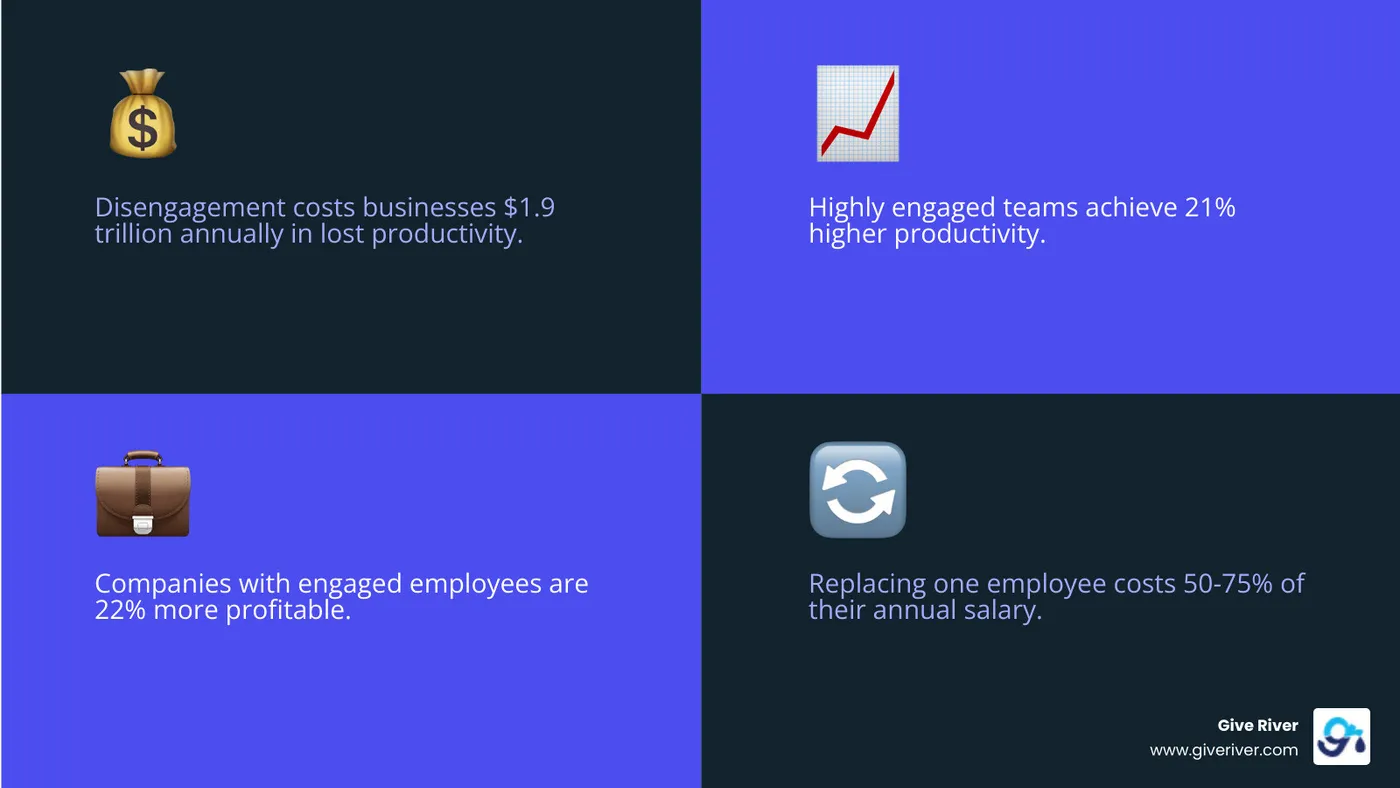
If your organization is quietly bleeding talent and productivity, you're not alone. Nearly 80% of employees worldwide are either not engaged or actively disengaged at work - and that disengagement carries a staggering price tag. Gallup estimates it costs businesses $1.9 trillion in lost productivity annually, while disengaged teams can drag profitability down by as much as 23%.
The stakes are real. For a single employee earning $60,000 per year, replacing them costs your company anywhere from $30,000 to $45,000 - before you factor in lost institutional knowledge, team morale, and the time your managers spend onboarding someone new.
Yet the flip side is equally compelling. Companies with highly engaged teams are 21% more productive and 22% more profitable than their less-engaged counterparts. Gallup's 2022 Exceptional Workplace Award winners maintained 70% engagement even through significant disruption - proof that sustainable, high engagement is achievable with the right approach.
The challenge most mid-sized organizations face isn't a lack of caring. It's a lack of strategy. Ping-pong tables and pizza Fridays don't move the needle. What does? Intentional, data-informed, human-centered systems that meet employees where they are - whether that's at a standing desk in the office or a home office three time zones away.
I'm Meghan Calhoun, Co-Founder of Give River and a workplace wellness advocate with over two decades of experience building high-performing teams across high-pressure industries - experience that shaped my understanding of what employee engagement strategies 2026 actually demands from leadership. The insights ahead draw from that journey, the science of human fulfillment, and the real results we've seen transform teams from burned out to genuinely thriving.
Basic employee engagement strategies 2026 terms:
Top Employee Engagement Strategies 2026 for High-Performing Teams
In the current landscape, the "Great Resignation" has matured into the "Great Realignment." Employees aren't just looking for jobs; they are looking for meaning, autonomy, and a sense of belonging. As we navigate employee engagement strategies 2026, we must move beyond the surface level. At Give River, we believe true fulfillment comes from a holistic approach we call the 5G Method: Guided, Gamified, Gratitude, Growth, and Generosity.
Modern engagement is no longer about "managing" people - it is about empowering them. This starts with autonomy. When you give your team the freedom to decide how they work, you aren't just being "nice"; you're following scientific evidence. Research shows that happy employees are up to 20% more productive. This productivity isn't forced; it's a natural byproduct of a supportive environment.
Hybrid work has become the standard, with nearly 80% of companies adopting this model. However, the shift requires more than just a Zoom link. It requires Top Strategies to Enhance Employee Engagement that bridge the gap between physical and digital spaces. Whether your team is in a skyscraper or a home office, they need to feel like they are part of the same mission.

Leveraging Technology and AI for Employee Engagement Strategies 2026
Technology is the backbone of the modern workplace, but in 2026, we are seeing a shift from "tools that help us work" to "tools that help us connect." Artificial Intelligence (AI) and data analytics are no longer just for the IT department; they are essential for HR and leadership.
By using Employee Engagement Technology, we can now move from reactive fixes to proactive support. Imagine an AI-driven platform that notices a drop in interaction levels or a change in sentiment during pulse surveys. Instead of waiting for an exit interview, leaders can intervene early, offering support before burnout sets in.
Real-time sentiment analysis allows us to take the "temperature" of the organization daily. This isn't about surveillance; it's about listening at scale. When you use a Talent Engagement Software Complete Guide, you gain the ability to spot trends - like a specific department feeling overwhelmed after a project launch - and address them immediately.
Cultivating Growth and Recognition as Core Employee Engagement Strategies 2026
If you want your best people to stay, you have to show them a future within your walls. Stagnation is the enemy of retention. In 2026, personalized development plans are a non-negotiable part of Employee Engagement and Motivation.
Employees, particularly Gen Z, crave a "line of sight" between their daily tasks and their career goals. This means:
- Upskilling: Providing the tools for them to learn new technologies (like AI).
- Internal Mobility: Making it easy for a marketing coordinator to transition into product management if that's where their passion lies.
- Peer-to-Peer Praise: Moving beyond the "top-down" recognition model. While platforms like Bonusly or Kudos focus primarily on peer-to-peer recognition, Give River differentiates itself by integrating these moments into our "Gratitude" pillar, linking appreciation directly to social impact and our holistic 5G framework. When recognition is tied to company values and shared publicly, it reinforces the culture you want to build. For more depth, check out our Boosting Employee Engagement Ultimate Guide.
Prioritizing Holistic Wellness and Hybrid Flexibility
We have to stop treating "wellness" as an optional perk. In 2026, mental health and work-life balance are primary drivers of Employee Engagement and Retention. The cost of burnout is too high to ignore - not just in health, but in the 23% profitability loss associated with disengaged staff.
True wellness includes:
- Psychological Safety: Creating an environment where people can admit mistakes without fear.
- Flexible Scheduling: Moving away from the rigid 9-to-5 to focus on outcomes rather than "hours in seat."
- Mental Health Support: Offering more than just an EAP - think dedicated mental health days and stress management workshops.
For those managing distributed teams, our Remote Team Engagement Tips offer practical ways to keep the "virtual watercooler" alive without the "forced fun" that often leads to Zoom fatigue.
Implementing and Measuring Your 2026 Engagement Framework
Strategy without execution is just a wishlist. To make employee engagement strategies 2026 stick, you need leadership buy-in. If the C-suite doesn't live the values, the rest of the team won't either. Engagement isn't an "HR thing" - it's a "business thing."
Cultural transformation happens when two-way communication becomes the norm. This means leaders must be willing to hear the "bad news" just as much as the good. When employees see that their feedback leads to actual change, trust is built. And trust is the ultimate retention tool.
Aligning Purpose with Community Impact and Generosity
Why do we do what we do? In 2026, the answer "for a paycheck" isn't enough for the modern workforce. People want to work for organizations that stand for something. This is where the "Generosity" pillar of our 5G Method shines.
By integrating Corporate Social Responsibility (CSR) into the daily workflow, you give employees a sense of purpose. Whether it's through company matching gift programs or organized volunteer days, these initiatives foster a Company Culture Engagement that transcends the office.
Diversity, Equity, and Inclusion (DEI) are also critical here. An inclusive culture isn't just about quotas; it's about ensuring every voice has a seat at the table. When employees feel they can bring their whole selves to work, engagement levels naturally rise. For more on this, see our Employee Engagement Insights and Strategies for Employee Engagement.
Avoiding Common Pitfalls in Engagement Initiatives
Even the best-intentioned employee engagement strategies 2026 can fail if they fall into these common traps:
- The Action Gap: Collecting feedback via surveys but never doing anything with the results. This is the fastest way to create "survey fatigue."
- Overcomplicated Metrics: Focusing on "percent favorable" scores that look good on a slide deck but don't reflect the reality of the shop floor.
- Micromanagement: Hiring talented people and then telling them exactly how to do their jobs. Autonomy is a key driver of engagement.
- Lack of Transparency: Keeping employees in the dark about company challenges. Transparency builds "in-group" loyalty.
To avoid these, follow our Employee Engagement Survey Best Practices and use these Top 30 Team Member Engagement Survey Questions to Boost Engagement to get the data that actually matters.
Tracking Success Through Data-Driven Metrics
You cannot manage what you do not measure. In 2026, we must move beyond the annual review. We need a constant pulse on the organization. Key metrics to track include:
- eNPS (Employee Net Promoter Score): Would your team recommend you as a place to work?
- Voluntary Turnover Rates: Are your "stars" leaving?
- Internal Fill Rate: Are you growing your own leaders?
At Give River, we use a gamified performance platform to make this tracking seamless. Unlike single-feature tools like Bonusly or Kudos that focus primarily on rewards, Give River provides a comprehensive ecosystem that blends performance metrics with charitable giving to create a deeper sense of purpose. By using an Employee Engagement Tracker, you can see real-time progress on goals and engagement levels. Our Employee Engagement Platform Features are designed to make engagement fun, not a chore.
When you Boost Employee Engagement through a structured framework, you aren't just improving morale - you're securing the future of your business. If you're ready to see how your team can drive charitable impact through engagement, we're here to help you build a culture that wins.
The landscape of work is changing, but the human need for connection, growth, and purpose remains the same. By focusing on these employee engagement strategies 2026, you can turn your workplace into a high-performing community where everyone thrives.
More from this category.
The 5 Best Employee Engagement Platforms in 2026, Compared
Give River, Culture Amp, WorkTango, Engagedly, and Kudos compared from each vendor's own site: pricing, gamification, learning, surveys, and who each one fits.

Employee Engagement Software for Companies With 50–200 Employees (2026)
What a 50–200 person company needs from engagement software, what six platforms cost at that size, who each fits, and how fast you can launch.
What Is a Digital Engagement Platform? (And Why It Matters Right Now)
Understanding the digital engagement platform definition starts with a simple idea: it's a technology framework that centralizes how an organization communicates with, supports, and motivates its people — employees or customers — across…
See the platform in action.
30-day free trial. No credit card. River Guide included on Core and Growth.