Why Investing in Career Development is a Win-Win
A career development program sample gives HR leaders and CEOs a concrete starting point for building structured, meaningful growth pathways for their teams — without having to reinvent the wheel. Here are seven proven program types you can…

Why Investing in Career Development is a Win-Win
A career development program sample gives HR leaders and CEOs a concrete starting point for building structured, meaningful growth pathways for their teams — without having to reinvent the wheel. Here are seven proven program types you can adapt to your organization:
| Career Development Program Type | Best For |
|---|---|
| Individual Development Plans (IDPs) | Personalized employee growth and goal-setting |
| Mentorship & Coaching Programs | Knowledge transfer and leadership pipelines |
| Upskilling & Training Initiatives | Closing skill gaps with targeted learning |
| Job Rotation & Cross-Functional Projects | Broadening experience across departments |
| Gamified Growth & Recognition Programs | Boosting engagement through fun, daily development |
| Leadership Development & Wellbeing Tracks | Preparing high-potentials and supporting whole-person health |
| Community Impact & Purpose-Driven Initiatives | Connecting personal values to company mission |
The numbers behind career development tell a clear story. According to research from Gartner, proactively supporting employee career growth can have up to a 45% positive impact on how supported employees feel — compared to just 8% when you only try to meet their expectations. Meanwhile, teams with access to development opportunities show 34% higher retention rates.
Yet most organizations are still under-investing. A 2022 Workplace Intelligence study found that 78% of workers feel they lack critical skills, and 70% feel unprepared for the evolving workplace. That's not a people problem — it's a systems problem.
The gap between what employees need and what employers currently offer represents both a challenge and a significant opportunity. For mid-sized companies struggling with turnover and disengagement, a well-designed career development program isn't a nice-to-have — it's one of the highest-ROI investments you can make in your workforce.
I'm Meghan Calhoun, Co-Founder of Give River and a workplace performance strategist with over two decades of experience building high-performing teams across industries — experience that directly shaped how I think about career development program samples and what actually moves the needle on employee growth. I've seen how the right development structure can transform a burned-out, disengaged team into one that shows up energized and purposeful, and I'm excited to walk you through seven real-world program models that can do exactly that.
Must-know career development program sample terms:
- advantages of career development programs
- boost employee productivity
- career development mentoring programs
The Modern Workforce's Demand for Growth
The "standard" job description is no longer enough to keep top talent. Today’s workers are acutely aware of the rapidly shifting landscape of work. In fact, 71% of workers worry that their current education level might hold them back from advancing. This isn't just anxiety; it's a call for help. When 87% of workers believe employers should be investing in continued education, they are looking for a partner in their professional journey, not just a paycheck.
We’ve found that the most successful companies treat professional development for employees as a core business strategy rather than a HR "perk." When you provide these opportunities, the loyalty you earn is immense: 76% of employees say they are more likely to stay with a company that offers continuous training.
What is a Career Development Program?
At its heart, a career development program is a strategic, intentional framework designed to support employee upskilling and career management. It isn’t just a one-time workshop or a dusty handbook; it’s a living ecosystem of resources, support, and professional growth programs that align an individual’s personal aspirations with the organization’s long-term needs.
By implementing a structured learning and development solution, we bridge the gap between where an employee is today and where they—and the company—need to be tomorrow. It’s about creating a "win-win" where the employee gains purpose and higher earning potential, while the organization builds a resilient, high-performing talent pipeline.
7 Career Development Program Sample Ideas to Inspire Your Strategy
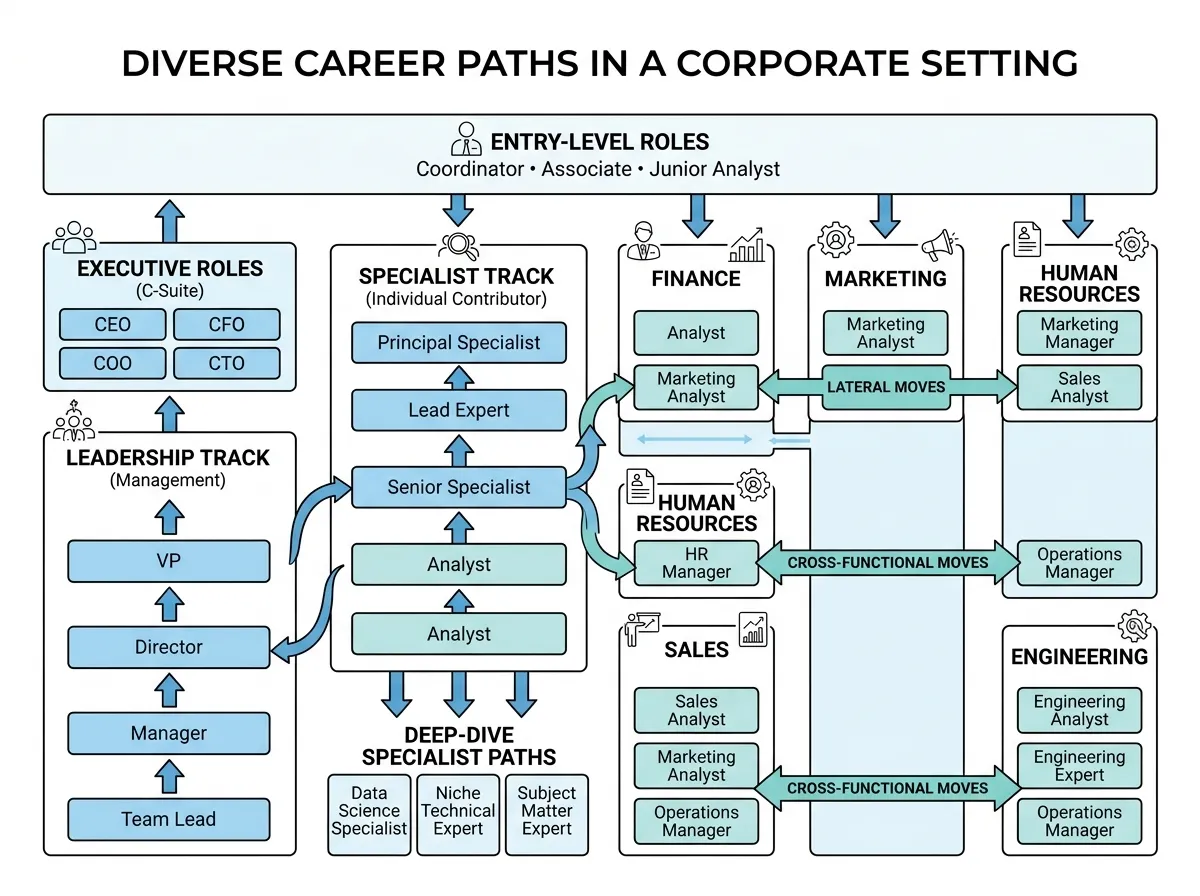
Creating a program doesn't mean you have to do everything at once. The key is to choose the career development program sample that best fits your current culture and business goals. Whether you are a small startup or a large enterprise, these seven models offer a roadmap to a more engaged workforce.
1. The Foundational Individual Development Plan (IDP)
The Individual Development Plan (IDP) is the cornerstone of any great employee development plan. Think of it as a personalized roadmap. Instead of a generic "corporate ladder," an IDP focuses on the individual’s unique strengths and career vision.
An effective IDP involves a collaborative process between the employee and their supervisor. It starts with identifying the top three strengths—perhaps networking, research, or active listening—and then setting SMART (Specific, Measurable, Achievable, Relevant, Time-bound) goals. For example, an employee might set a goal to "acquire advanced data visualization skills within six months to lead the quarterly reporting project."
By encouraging personal growth in workplace settings through IDPs, you empower employees to take ownership of their trajectory while ensuring their growth serves the company mission.
2. Structured Mentorship and Coaching Programs
Mentorship is one of the most cost-effective ways to facilitate knowledge transfer. By pairing a seasoned professional with a junior employee, you create a natural environment for guidance and leadership development.
While platforms like Bonusly or Kudos focus heavily on peer-to-peer recognition—which is vital—career development mentoring programs add a layer of deep, personalized guidance that recognition alone can't provide. Give River differentiates itself by embedding these mentorship connections within a broader growth ecosystem, ensuring that guidance leads to measurable skill development rather than just social interaction. Mentorship can be formal (assigned pairs with specific milestones) or informal (encouraged coffee chats and "shadowing" days). Either way, it builds a culture of "paying it forward" that is essential for long-term succession planning.
3. A Skill-Based Career Development Program Sample: The Upskilling Initiative
With technology evolving at breakneck speed, a skill-based career development program sample is often the most urgent for modern businesses. This involves a rigorous skill gap analysis: What skills do we have, and what will we need in two years?
This program might include:
- Technical Training: Using ai tools for learning and development to personalize the learning experience.
- Soft Skills Workshops: Focusing on emotional intelligence, conflict resolution, and empathetic communication.
- Financial Support: Offering tuition reimbursement or learning stipends for certifications and career development courses online.
Investing in professional development in business ensures your workforce doesn't just survive digital transformation—they lead it.
4. Job Rotation & Cross-Functional Projects
Sometimes, the best way to grow isn't "up"—it's "over." Job rotation programs allow employees to spend time in different departments, breaking down silos and fostering a more interconnected workforce.
A marketing specialist might spend three months working with the product team to understand the technical roadmap, or a customer service rep might assist HR with onboarding. This "job crafting" approach helps employees align their daily work with their evolving interests. Using professional growth tools to track these rotations can help you see which employees are developing the "T-shaped" skills (deep expertise in one area, broad knowledge in others) that are so valuable in leadership. You can find more career development programs examples that focus on lateral growth to keep your team's perspective fresh.
5. A Modern Career Development Program Sample: Gamified Growth & Recognition
We live in a world of instant feedback. Why should professional growth be any different? A modern career development program sample leverages gamified personal growth to make learning a daily habit rather than an annual chore.
At Give River, we believe in the power of micro-learning—breaking down complex training into 5-10 minute "bites" that employees can complete during their day. When you combine this with peer recognition and community impact, you create a "Growth Loop."
While platforms like Kudos and Bonusly offer great ways to say "thank you" through peer recognition, Give River's 5G Method is different because it integrates that gratitude directly with professional milestones. Unlike traditional recognition tools that focus primarily on social appreciation, Give River connects rewards to actual skill acquisition. When an employee completes a micro learning for training employees module, they don't just get a certificate; they earn points that can be used for rewards or donated to a charity of their choice. This turns "training" into a rewarding, community-building experience that bridges the gap between simple recognition and tangible career growth.
7. Leadership Development Tracks & Wellbeing Programs
You can't have high performance without high-level health. A comprehensive professional growth programs must include both leadership tracks and wellbeing initiatives.
Leadership development isn't just for executives; it's about training your first-time managers in emotional intelligence and performance management. Simultaneously, integrating workplace mental health resources into your development program recognizes the "whole person." A manager who is burned out cannot effectively develop their team. Wellbeing programs—ranging from mindfulness workshops to "focus time" policies—provide the foundation upon which all other career growth is built.
7. Community Impact and Purpose-Driven Initiatives
Modern employees—especially Gen Z and Millennials—crave purpose. They want to know that their work matters beyond the bottom line. Integrating community impact at work into your career development strategy is a powerful way to build leadership and team cohesion.
For example, you might allow employees to lead a volunteer campaign as a "stretch assignment" to develop project management skills. This creates a purpose-driven workplace culture where personal values and company missions are aligned. When employees see their professional growth resulting in a positive impact on the world, their engagement skyrockets.
Build Your Future-Ready Workforce Today
Implementing a career development program sample isn't a "set it and forget it" task. It requires ongoing commitment and a willingness to measure what matters. If you're ready to start, we recommend beginning with a small pilot program and scaling up based on feedback.
Implementing and Measuring Your Program
To ensure your program is more than just a line item in the budget, you need to track its ROI. Here is how we recommend approaching it:
- Align with Goals: Ensure every training activity serves a business need, such as reducing "time-to-hire" for internal roles.
- Involve Stakeholders: Don't just leave it to HR. Get department heads involved in defining what "success" looks like for their specific teams.
- Use Key Metrics: Track retention rates of program participants versus non-participants. Use 360-degree feedback to see if managers are actually improving after their training.
- Listen to the Team: Use engagement scores to measure how supported employees feel. Proactively working on growth has a 45% positive impact on their sense of support.
By constantly reviewing and adjusting, you ensure you are offering the best career development programs possible for your unique workforce.
Conclusion: The Path to Continuous Growth
The companies that win in the next decade won't be the ones with the biggest offices; they'll be the ones with the most developed people. By moving beyond traditional, rigid structures and embracing a career development program sample that is personalized, gamified, and purpose-driven, you create an environment where talent wants to stay.
At Give River, our 5G Method—Guided, Gamified, Gratitude, Growth, and Generosity—is designed to make this transition seamless. We don't just provide a platform; we provide a culture-building engine that integrates recognition with real, measurable professional growth.
Ready to build a culture of continuous growth? Explore Give River's learning and development solution to see how we can help you unlock the full potential of your team. Let's build a future where every employee feels empowered to grow, give back, and succeed.
More from this category.

Why Choosing the Right Learning and Development Platforms Matters in 2026
Learning and development platforms have become one of the most critical investments a company can make — yet with over 800 competing systems on the market, finding the right fit feels overwhelming.

Why Your L&D Toolkit Defines Your 2026 Workforce
Learning and development (L&D) tools are digital platforms that help organizations create, deliver, and optimize employee training. Companies with strong training programs see 218% higher income per employee and can reduce turnover by 40%…

Why Applied AI for Learning and Development Matters Now
Applied AI for learning and development: tools and agents are reshaping how organizations train and support employees. But with every vendor slapping "AI-powered" on their products, cutting through the hype to find what's truly useful is a…
See the platform in action.
30-day free trial. No credit card. River Guide included on Core and Growth.