Why Corporate Social Responsibility Is Reshaping How Businesses Operate
What is corporate social responsibility in business? Here's the short answer:

Why Corporate Social Responsibility Is Reshaping How Businesses Operate
What is corporate social responsibility in business? Here's the short answer:
Corporate Social Responsibility (CSR) is a self-regulating business model in which a company takes accountability for its impact on society, the environment, and its stakeholders — going beyond legal obligations and profit-making to actively contribute to the public good.
The four core dimensions of CSR are:
| Dimension | What It Means |
|---|---|
| Economic | Making financially sound decisions that also benefit society |
| Legal | Complying with laws and regulations as a baseline standard |
| Ethical | Acting fairly and transparently with all stakeholders |
| Philanthropic | Giving back through donations, community programs, and charitable initiatives |
For decades, most businesses operated with a single goal in mind: maximize profits. That thinking is rapidly changing. Today, companies are expected to be responsible corporate citizens — accountable not just to shareholders, but to employees, communities, and the planet.
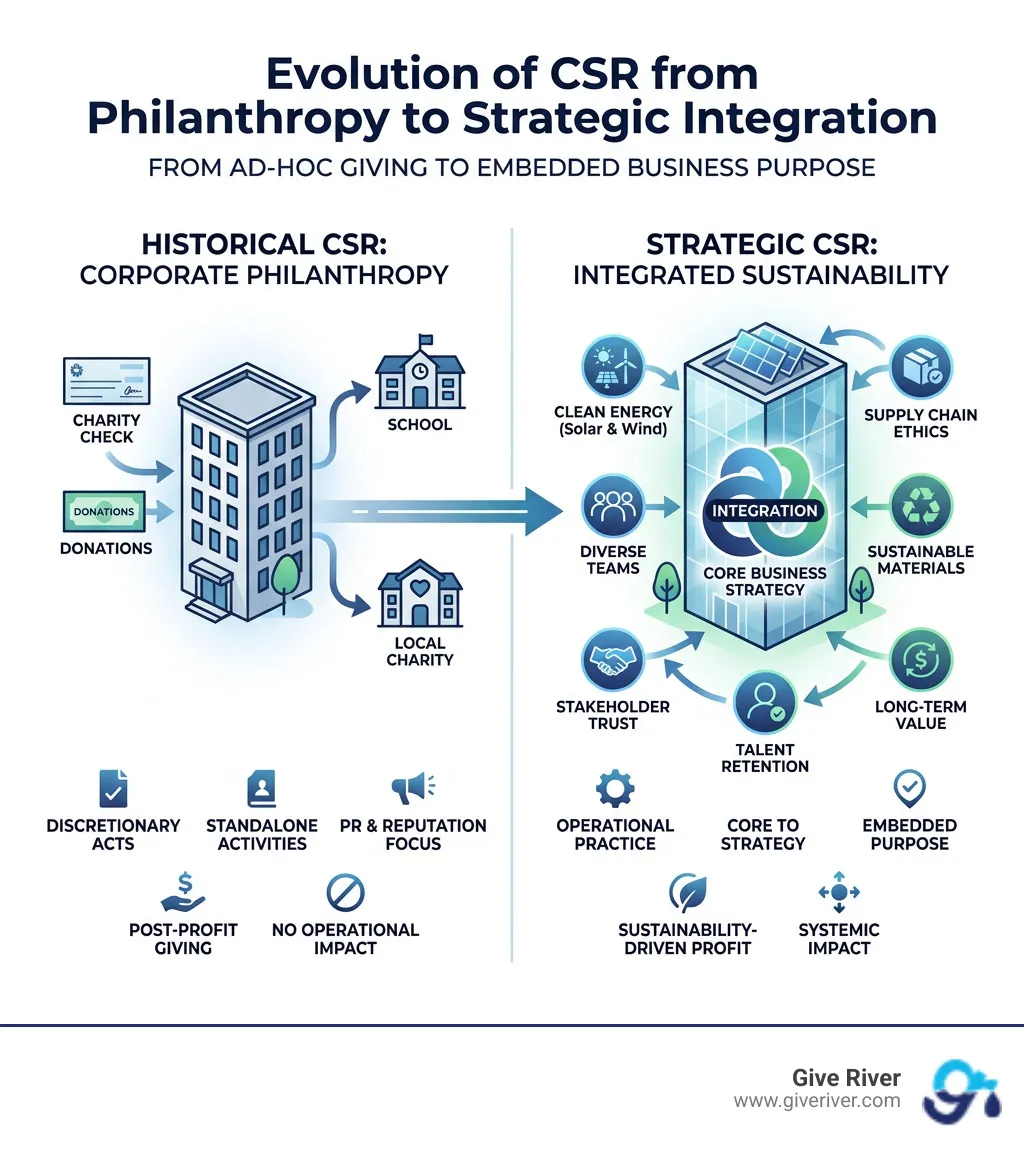
The shift isn't just idealistic. It's strategic. Research from Boston Consulting Group found that companies leading in environmental, social, and governance (ESG) matters carried an 11% valuation premium over their competitors. CSR has evolved from writing charity checks to embedding social and environmental purpose into the core of how businesses operate.
For CEOs and HR leaders navigating high turnover and low engagement, CSR offers something powerful: a way to align your organization around shared values that retain talent, strengthen culture, and build lasting trust — from the inside out.
I'm Meghan Calhoun, Co-Founder of Give River and a workplace wellness advocate with over two decades of experience driving performance in high-pressure environments — experience that taught me how understanding what is corporate social responsibility in business can transform not just a company's reputation, but its people and culture from the ground up. In this guide, I'll walk you through everything you need to know to turn CSR from a buzzword into a genuine business advantage.
What is corporate social responsibility in business word guide:
- advantages of corporate social responsibility
- csr examples
- what is corporate social responsibility reporting
What is Corporate Social Responsibility in Business?
When we ask what is corporate social responsibility in business, we are looking at a framework of self-regulation. It is the idea that a company shouldn't just exist to make money; it should exist to make the world a slightly better place. This concept, often referred to as corporate citizenship, means a business acts as a member of society with rights and, more importantly, responsibilities.
At its heart, csr-definition involves moving toward a "Triple Bottom Line." Instead of just looking at Profit, companies measure their success through three lenses: Profit, People, and Planet. This shift ensures that stakeholder engagement—listening to employees, customers, and local communities—is just as important as reporting to shareholders.
The Four Pillars of CSR Initiatives
To make CSR actionable, we generally break it down into four main types of csr initiatives. Think of these as the pillars that support a responsible business structure:
- Environmental Responsibility: This is perhaps the most visible pillar. It involves reducing a company’s carbon footprint, limiting waste, and preserving natural resources. Whether it’s transitioning to renewable energy or eliminating single-use plastics, csr environmental sustainability initiatives are now a baseline expectation for modern consumers.
- Ethical Labor Practices: This pillar focuses on how a company treats its people. It goes beyond paying a minimum wage to ensuring fair trade standards, promoting workplace diversity, and maintaining a safe, inclusive environment.
- Philanthropic Giving: This is the traditional "charity" side of CSR. It includes donating a portion of earnings to nonprofits, sponsoring community events, or creating charitable trusts to solve specific social issues.
- Financial Responsibility: Often overlooked, this means a company ensures its financial decisions align with its values. It’s about investing in sustainable R&D, avoiding "shady" tax loopholes, and ensuring that the pursuit of profit doesn't come at the expense of the other three pillars.
How CSR Differs from ESG and Sustainability
It’s easy to get lost in the alphabet soup of corporate jargon. While they are related, csr and esg initiatives serve different purposes:
- CSR (Corporate Social Responsibility): This is the internal "why" and "how." it is the culture and the initiatives a company chooses to adopt to be more responsible. It is often more qualitative.
- ESG (Environmental, Social, and Governance): This is the external "scorecard." Investors use ESG metrics to assess a company’s risk and health. While CSR is about a company’s desire to do good, ESG is about the data that proves they are doing it.
- Sustainability: This is the long-term goal. It refers to a business model that can be maintained indefinitely without depleting resources or harming society.
According to scientific research on ESG valuation premiums, companies that excel in these areas don't just feel better—they perform better financially, often seeing a significant boost in market value compared to "laggards" in their industry.

The Strategic Impact and Implementation of CSR
Implementing CSR isn't just about a one-off donation or a "green" logo. True CSR requires a strategic transformation. It means looking at your operations and asking: "How can we do this more efficiently and more ethically?"
When done right, the impact of csr initiatives on a company's bottom line is profound. It drives operational efficiency (like reducing energy costs), fosters innovation, and creates a powerful brand differentiation. In a crowded market, being the "good" company is a massive competitive edge.
Real-World Examples of Corporate Social Responsibility in Business
We don't have to look far to see what is corporate social responsibility in business in action. Several global giants have set the standard for strategic csr examples:
- Starbucks: The coffee giant has set ambitious 2030 goals, aiming for a 50% reduction in greenhouse gas emissions, water consumption, and food waste. They aren't just selling coffee; they are trying to sustain the planet that grows it.
- Home Depot: Focusing on the "Social" aspect, Home Depot has invested over one million hours per year in training for frontline employees. This helps workers advance their careers, proving that CSR starts with your own team.
- General Motors: In 2024, GM provided nearly $4 million in grants to nonprofits to support car- and ride-sharing programs, helping over 16,000 people access better transportation.
These csr examples show that impact happens when a company aligns its unique resources with a specific social need.
The Business Case: Why CSR Matters for Growth
If you are a business leader, you might be wondering about the ROI. The data is clear: what is the purpose of corporate social responsibility if not to build a more resilient business?
Beyond the 11% valuation premium mentioned earlier, CSR is a talent magnet. In an era where employees are looking for purpose, csr and employee satisfaction are inextricably linked. People want to work for companies that share their values. When employees feel their work contributes to a greater good, retention rates skyrocket and talent attraction becomes much easier.
Navigating Global Mandates and Challenges
While many companies engage in CSR voluntarily, it is becoming a legal requirement in some parts of the world.
- India: The Companies Act of 2013 mandates that qualifying companies spend 2% of their average net profits on CSR activities.
- Mauritius: Businesses are required to pay a 2% CSR tax on chargeable income for government-approved initiatives.
- Indonesia: Companies in the natural resources sector are legally required to allocate funds for social and environmental development.
However, with increased pressure comes the risk of greenwashing—where a company spends more time marketing its "good deeds" than actually doing them. To avoid this, companies must align their efforts with scientific research on UN Sustainable Development Goals and ensure their government csr initiatives are transparent and verifiable.
Measuring Success and Reporting Impact
You can't manage what you don't measure. Measuring csr impact has moved from "gut feelings" to standardized frameworks.
The GRI (Global Reporting Initiative) and ISO 26000 provide the gold standards for what is corporate social responsibility reporting. Additionally, many companies now use the B Impact Assessment to see how they stack up against the rigorous standards of B Corp certification. Reporting isn't just about showing off; it's about providing transparency to stakeholders who demand accountability.
Building a Culture of Generosity: What is Corporate Social Responsibility in Business?
At Give River, we believe that the most effective CSR isn't just a corporate policy—it's a culture. We use our 5G Method (Guided, Gamified, Gratitude, Growth, and Generosity) to help businesses integrate these values into the daily lives of their employees.
How Give River Differs from Traditional Platforms While platforms like Bonusly or Kudos focus primarily on peer-to-peer recognition and internal rewards like gift cards, Give River goes a step further by connecting that recognition directly to community impact. Unlike these competitors that often limit engagement to internal perks, Give River integrates CSR into the recognition process. We help you build a "Culture of Generosity" where doing good is part of the job description, ensuring that every act of appreciation also contributes to a greater social cause.
Actionable CSR Steps for Small Businesses:
- Start Small: You don't need a million-dollar budget. Start by matching employee donations or offering "VTO" (Volunteer Time Off).
- Audit Your Supply Chain: Look for local or minority-owned vendors to support.
- Listen to Your Team: Ask your employees what causes they care about. CSR is most effective when it is bottom-up, not just top-down.
- Define Your "Why": Align your CSR with your business mission. If you're a tech company, maybe you support STEM education. If you're a restaurant, focus on food waste.
- Be Transparent: Even if you're just starting, share your goals and your progress with your customers.
For more information on how to weave these values into your team's DNA, check out our recognition platform services.
Conclusion: The Future is Purpose-Driven
Understanding what is corporate social responsibility in business is no longer optional—it's a prerequisite for long-term success. The companies that will thrive in the coming decades are those that realize their responsibility extends far beyond the quarterly earnings report.
By embracing the four pillars of CSR, measuring your impact, and fostering a genuine culture of generosity, you do more than just "do good." You build a brand that people trust, a workplace where people want to stay, and a business that is built to last.
Ready to transform your workplace culture through the power of generosity? Let's build something meaningful together.
Call to Action: Want to see how your company can boost engagement while making a real-world impact? Explore the Give River Recognition Platform and discover how our 5G Method can turn your CSR goals into a daily reality for your team.
More from this category.

Recognition Software With Charitable Giving (2026): 6 Platforms Compared
Most recognition platforms let employees donate their rewards. Six compared on donations, company match, causes, and volunteering, from each vendor's own site.

Why Community Involvement Grants Matter for Your Organization's Impact
Community involvement grants provide essential funding to help organizations—from nonprofits and schools to businesses—create meaningful change. These grants can feel overwhelming to steer, but they offer a powerful way to address critical…

Why Getting Involved Matters: More Than Just Giving Back
Community involvement ideas span from food drives and tutoring to charity runs and park clean-ups. Whether you prefer hands-on projects, skill-based opportunities, donation drives, or corporate volunteer programs, there are countless ways…
See the platform in action.
Free for up to 25 members, or try Core or Growth free for 30 days. A card is required; Free is never charged, and a trial bills when it ends unless you cancel.