Why Employee Recognition Matters More Than You Think
Employee recognition in the workplace is the practice of openly acknowledging and appreciating employees' contributions, achievements, and behaviors that align with company values. Here's what defines a strong workplace recognition culture:

Why Employee Recognition Matters More Than You Think
Employee recognition in the workplace is the practice of openly acknowledging and appreciating employees' contributions, achievements, and behaviors that align with company values. Here's what defines a strong workplace recognition culture:
- Frequent & Timely: Recognition happens at least every seven days, delivered close to the achievement
- Multi-Directional: Comes from managers, peers, leaders, and even customers
- Varied Forms: Includes public praise, private notes, promotions, monetary rewards, and milestone celebrations
- Values-Aligned: Reinforces specific behaviors that support organizational goals
- Inclusive & Equitable: Everyone has equal opportunity to be recognized, not just top performers
The numbers tell a sobering story. Only one in three U.S. workers strongly agree they received recognition or praise for doing good work in the past seven days. Meanwhile, organizations with formal recognition programs experience 31% lower voluntary turnover and are 12 times more likely to achieve strong business outcomes.
Think about the last time you put your heart into a project, nailed the execution, and felt genuinely proud of the result. That feeling of accomplishment multiplies exponentially when others take notice. Yet most organizations are still treating recognition as an afterthought-occasional praise, generic thank-you emails, or annual awards ceremonies that feel more obligatory than meaningful.
The disconnect between what employees need and what they're receiving represents one of the most overlooked opportunities in today's war for talent. When companies spend just 1% or more of payroll on recognition, 85% notice a positive impact on engagement. Even more compelling: employees recognized weekly are 2.6 times more likely to be their most productive selves.
I'm Meghan Calhoun, co-founder of Give River, and I've spent over two decades driving results in high-pressure environments-from television hosting to advertising sales to working with grieving families. Through these varied experiences, I've learned that employee recognition in the workplace isn't just about making people feel good; it's about creating sustainable high performance through meaningful connection, growth, and purpose. This guide will show you how to build a recognition strategy that drives real business results while creating a workplace culture where people genuinely want to show up.
Quick look at employee recognition in the workplace:
The Strategic Impact of employee recognition in the workplace
When we talk about employee recognition in the workplace, we aren't just talking about "warm fuzzies." We are talking about a fundamental business lever. Research shows that organizations with sophisticated recognition programs are 12 times more likely to have strong business outcomes. This isn't a coincidence; it's the result of aligning human psychology with corporate objectives.
Recognition acts as a signaling mechanism. It tells the rest of the team what "great" looks like. When you celebrate a specific behavior, you aren't just rewarding one person; you are setting a standard for everyone else. This clarity reduces frustration-in fact, organizations with recognition programs experience 28.6% lower frustration levels than those without.

Comparing Recognition Types
To build a truly effective strategy, we need to understand the difference between the two primary "gears" of recognition:
| Feature | Formal Recognition | Informal Recognition |
|---|---|---|
| Frequency | Scheduled (Monthly/Annual) | Spontaneous (Daily/Weekly) |
| Structure | Defined criteria and awards | Fluid and conversational |
| Examples | service-award, Years of Service | Slack shout-outs, high-fives |
| Impact | Long-term milestone marking | Immediate behavioral reinforcement |
| Cost | Usually budgeted (Awards/Gifts) | Low to no cost (Praise/Notes) |
Why employee recognition in the workplace Drives Retention
In today’s competitive market, the "war for talent" is won by those who can keep their people. The data is clear: well-recognized employees are 45% less likely to leave. When an employee receives high-quality recognition, they are 65% less likely to be actively looking or watching for another job opportunity.
Why? Because recognition creates psychological safety and a sense of belonging. It validates that an individual's work has meaning and purpose. When we ignore these needs, the cost is staggering. Replacing a leader or manager can cost up to 200% of their annual salary. By implementing robust recognition-programs-for-employees, we aren't just spending money; we are protecting our most valuable assets.
Building a Culture of employee recognition in the workplace
A true culture of recognition isn't top-down; it's 360 degrees. While 52.5% of employees want more recognition from their immediate manager, peer-to-peer recognition is equally vital. It democratizes the process, ensuring that the "quiet winners" who keep the wheels turning are seen.
When employees believe that everyone has a fair chance to be recognized, they are 56% more likely to give extra effort. This is why peer-to-peer-recognition-software-complete-guide has become so essential. It allows for social recognition in the "flow of work"-tools like Slack or Microsoft Teams-making gratitude a daily habit rather than a monthly event.
Designing and Measuring a Modern Recognition Strategy
Building a program that actually works requires more than just picking out some gift cards. At Give River, we advocate for a strategic approach that integrates into the very fabric of your company. A great rule of thumb is to spend 1% or more of your payroll on recognition. When companies hit this threshold, 85% report a significant positive impact on engagement.
The 5 Pillars of Strategic Recognition
According to longitudinal research, high-quality recognition is built on five pillars:
- Fulfillment: Does the recognition meet a human need?
- Authenticity: Is it sincere or just a checkbox?
- Personalization: Does it reflect the individual's preferences?
- Equity: Is it fair and accessible to all?
- Alignment: Does it connect back to your core values?
When recognition meets at least four of these pillars, employees are nine times more likely to be engaged. You can find more modern-employee-recognition-programs-best-practices to help you structure these pillars effectively.
Best Practices for Meaningful and Timely Recognition
If recognition is delayed, it loses its power. To make employee recognition in the workplace truly effective, follow these best practices:
- Be Specific: Instead of saying "Good job," say "Thank you for staying late to fix that bug; your attention to detail saved the client launch."
- Be Timely: The "7-day rule" is vital. Employees who receive recognition every seven days are significantly more productive.
- Make it Personal: Some people love a public shout-out, while others prefer a handwritten note. Know your people.
- Tie to Values: Use employee-recognition-strategies that remind the team why their work matters to the company's mission.
Overcoming Common Challenges and Favoritism
The biggest "culture killer" in recognition is the perception of favoritism. If the same three people win "Employee of the Month" every time, the rest of the team will check out. This turns your program into a "popularity contest."
To overcome this, you need transparency and inclusion. Use a employee-recognition-action-plan-complete-guide to set clear, objective criteria for awards. Ensure that frontline workers, remote staff, and "behind-the-scenes" roles have the same visibility as your sales superstars.
Real-World Ideas and Recognition Examples
Looking for inspiration? Here are a few ways organizations are bringing gratitude to life:
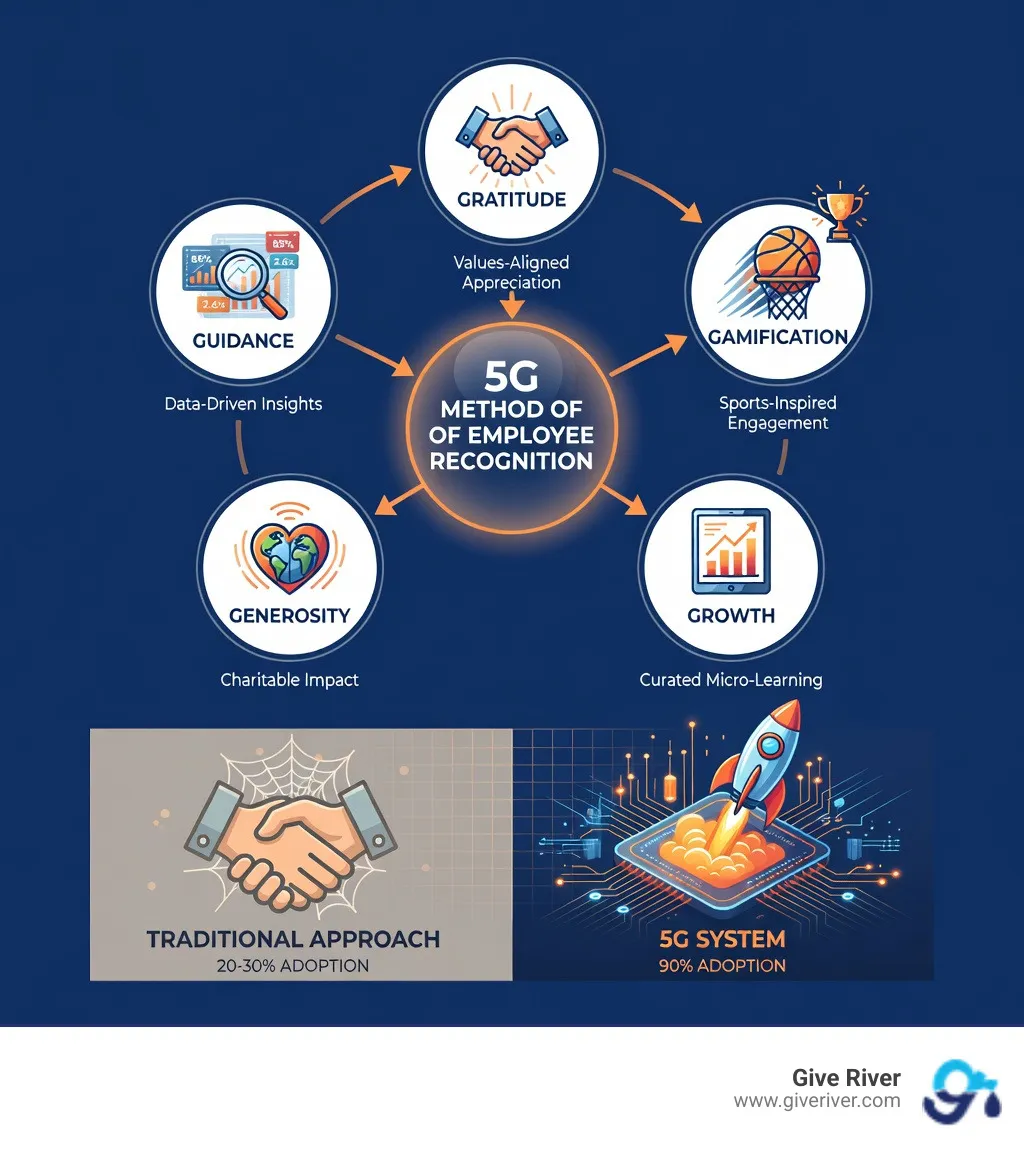
- Social Shout-outs: While platforms like Bonusly or Kudos focus primarily on peer-to-peer micro-bonuses, Give River differentiates itself by integrating these social interactions with a holistic '5G Method'—combining gratitude with professional growth, wellness, and charitable generosity to drive deeper fulfillment.
- Milestone Yearbooks: Creating personalized digital or physical yearbooks for work anniversaries that include notes from colleagues.
- The 365-Day Calendar: Giving managers a prompt every day to recognize someone new on their team.
- Generosity Awards: Allowing recognized employees to choose a charity where the company will make a donation in their name (a core part of our Give River philosophy).
Check out more employee-recognition-examples to see what fits your brand.
Measuring Success and Proving ROI
You can't manage what you don't measure. To prove the value of your employee recognition in the workplace, track these key metrics:
- Participation Rates: What percentage of your team is giving and receiving recognition?
- Recognition Index: How often is the average employee recognized? (Aim for at least once a month).
- Turnover Trends: Is voluntary turnover decreasing in departments with high recognition activity?
- Engagement Scores: Use surveys to see if employees feel more valued over time.
A robust staff-recognition-system should provide these analytics out of the box, allowing you to link culture directly to your bottom line.
Conclusion: Beyond the High Five
Recognition isn't just a "nice to have"—it is the fuel that powers high-performing teams. When we move beyond the casual high-five and build a system of genuine gratitude, we transform the workplace from a place where people have to be into a place where they want to be.
At Give River, we believe that when you combine recognition with growth, wellness, and generosity, you create a culture that is impossible to replicate. Are you ready to stop guessing and start growing?
Ready to transform your culture? Explore the Give River Recognition Platform and see how our 5G Method can boost your team's fulfillment and productivity today.
More from this category.

The Impact of Employee Recognition on Workplace Success
Ever notice how a simple "thank you" can transform your entire day? Now imagine that feeling multiplied across your entire organization. That's the power behind the best employee recognition programs – they're not just nice-to-have perks,…

Why Recognition Feels Broken in Today's Workplace
Picture this: your whole department gets the same canned "thank-you" email. It lands with a thud. Connected recognition exists to replace that hollow gesture with a system that consistently spotlights real contributions.

From "Nice-to-Have" to Non-Negotiable: Why Your Business Needs Recognition Software
The business case for corporate recognition software goes far beyond warm feelings. When employees feel genuinely valued, every corner of your organization benefits\u0014from productivity metrics that impress the CFO to…
See the platform in action.
30-day free trial. No credit card. River Guide included on Core and Growth.