Why Team Bonding is Your Ultimate Culture-Building Tool
Good team bonding exercises are structured activities designed to strengthen relationships, improve communication, and build trust among team members—whether they're working in-person, remotely, or in hybrid environments.

Why Team Bonding is Your Ultimate Culture-Building Tool
Good team bonding exercises are structured activities designed to strengthen relationships, improve communication, and build trust among team members—whether they're working in-person, remotely, or in hybrid environments.
Quick Answer: Top Good Team Bonding Exercises
| Category | Activity | Best For | Time Required |
|---|---|---|---|
| Icebreakers | Two Truths and a Lie | New teams, breaking down barriers | 10-15 min |
| Collaboration | Human Knot | Communication skills, problem-solving | 15-20 min |
| Creativity | Marshmallow Challenge | Innovation, strategic thinking | 20-30 min |
| Problem-Solving | Escape Room | Critical thinking, teamwork | 45-60 min |
| Remote Teams | Virtual Trivia | Engagement, fun competition | 20-30 min |
| Trust-Building | Minefield | Partnership, clear communication | 15-20 min |
When you mention "team-building activities," you might brace for eye rolls. But in the era of remote and hybrid work, fostering genuine connections is a key challenge for managers. Without intentional effort, remote employees can feel disconnected and disengaged. Traditional pizza parties and forced trust falls often miss the mark.
What actually works? Good team bonding exercises that treat your employees like championship athletes. Professional sports teams know that winning requires caring for the whole person with skill development, mental health support, and team connection. The most effective activities create opportunities for gratitude, growth, and shared purpose, helping teams develop the 7 C's of high performance: Communication, Collaboration, Commitment, Competence, Confidence, Creativity, and Cohesion.
Research consistently backs this up. For example, scientists have found that strong social connections are one of the most reliable predictors of happiness and long-term health outcomes, reinforcing the idea that team bonding is not just "nice to have" but core to well-being and performance. You can explore some of this science in resources like the Greater Good Science Center's overview of how social connections keep us healthy.
The good news? You don't need elaborate off-site retreats. You need thoughtful activities that address real human needs—connection, recognition, and meaning.
I'm Meghan Calhoun, Co-Founder of Give River, and I've spent over two decades learning that good team bonding exercises are essential infrastructure for building teams that thrive for years.
Good team bonding exercises basics:
- activities that build teamwork
- fun games to play when hosting an event
- peer to peer recognition activities
The Core Benefits: Beyond Just Having Fun
Good team bonding exercises are strategic investments in your people. When done right, they yield a cascade of benefits:
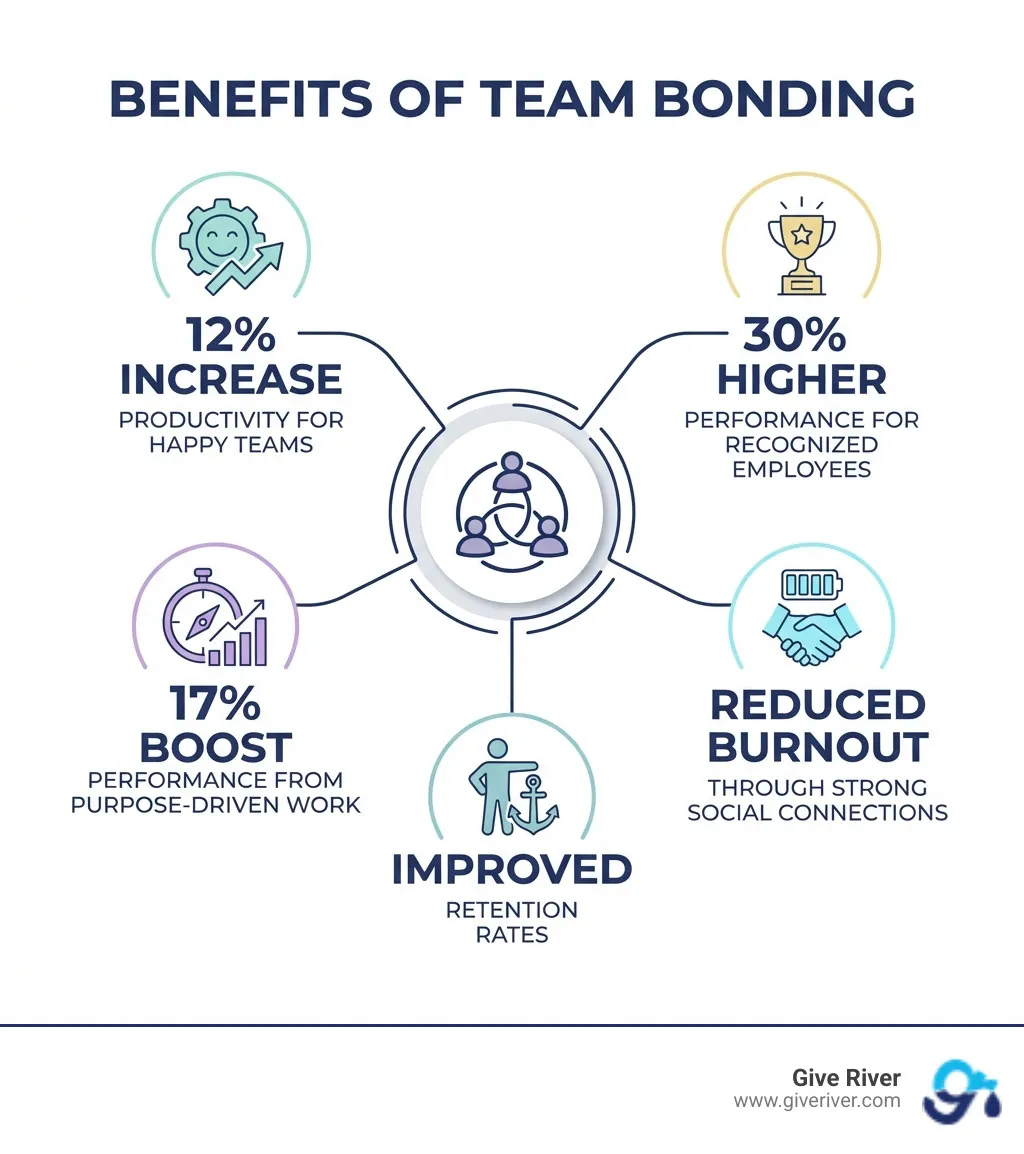
- Increased Productivity & Morale: Happy, connected employees are more productive and enthusiastic. This boosts job satisfaction and overall output. A well-known study by economist Andrew Oswald and colleagues found that happier employees can be up to 12% more productive, underscoring why investing in team bonding pays off.
- Employee Retention: A strong sense of community makes employees less likely to leave. They feel a deeper bond with their colleagues and the company.
- Building Trust & Fostering Connections: Informal interactions help colleagues connect as people, not just job titles. This human connection is vital. Scientific research shows that social connections are fundamental to our well-being. These bonds create psychological safety, making it easier to share ideas and take risks.
- Improved Collaboration & Onboarding: Teamwork activities naturally improve communication and highlight individual strengths. For new hires, these exercises streamline onboarding, helping them integrate quickly and feel part of the team from day one.
The 7 C's: A Framework for High-Performing Teams
At Give River, we use the "7 C's of Team Building" to design effective exercises. This framework helps build strong teams aligned with shared goals.
- Communication: Creating opportunities for open, honest dialogue.
- Collaboration: Actively contributing to a shared goal and leveraging diverse skills.
- Commitment: Dedication to the team's objectives and the organization's mission.
- Competence: Identifying and growing the team's collective skills and knowledge.
- Confidence: Building trust in the team's abilities through celebrating wins.
- Creativity: Encouraging innovative thinking and unique problem-solving.
- Cohesion: Fostering a strong sense of unity, mutual support, and shared identity.
Focusing on these 7 C's helps build psychological safety and team alignment. For more on building a strong culture in distributed teams, explore our guide on organizational culture in virtual teams.
The Ultimate List of Good Team Bonding Exercises
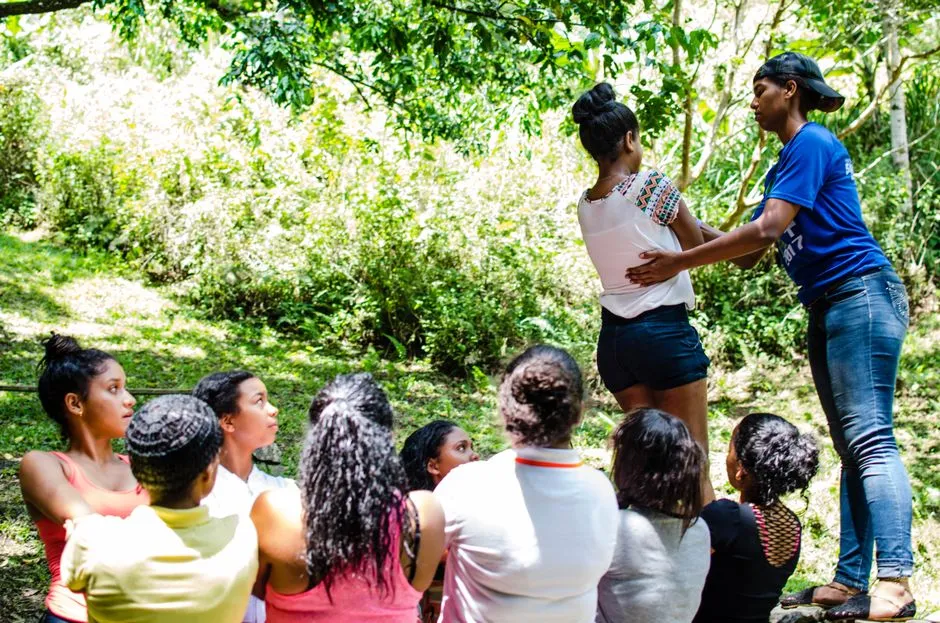
Now that we understand the "why," let's dive into the "how." The beauty of good team bonding exercises is their adaptability. Whether your team is fully in-person, entirely remote, or navigating a hybrid model, there's an activity perfectly suited to foster connection and collaboration. We've curated a list of our favorite categorized activities, designed to be engaging, effective, and free of cringe-worthy moments.
Quick Icebreakers to Spark Connection
Icebreakers are fantastic for setting a positive tone, especially at the start of a meeting or for integrating new team members. They help clear the way for learning and collaboration by making everyone more comfortable.
- Two Truths and a Lie: A classic for a reason! Each person shares three "facts" about themselves—two true, one a lie. The team guesses the lie. It’s a fun way to uncover surprising details about colleagues and break down false perceptions. Giving advance notice can make the "lies" even more creative.
- One-Word Icebreaker: Ask each team member to describe their current mood, a recent project, or their thoughts on a specific topic using just one word. This offers quick insights and encourages concise communication.
- Office Trivia: Create questions about your company's history, fun facts about colleagues, or even inside jokes. This is a great way to reinforce company knowledge for tenured staff and aid in onboarding new employees.
- Personal Passion Presentations: Ask team members to share a quick 1-2 minute presentation on a non-work passion or hobby. This showcases personality and helps colleagues connect on a deeper, personal level.
- Rose-and-Thorn: A low-effort, high-impact activity. Each person shares a "rose" (something positive or a small win) and a "thorn" (a challenge or something negative) from their week. It helps teams stay connected and in tune with each other's experiences.
Here are 10 engaging icebreaker questions you can use right away:
- What's one thing on your bucket list?
- If you could have any superpower, what would it be?
- What's your favorite way to unwind after a long day?
- What's a skill you'd love to learn?
- If you were a color, what color would you be and why?
- What's the most unusual food you've ever tried?
- What's your go-to karaoke song?
- If you could travel anywhere in the world right now, where would you go?
- What's one small thing that made you smile today?
- What's your favorite season and why?
For more ideas, especially for distributed teams, check out our resources on virtual ice breakers and team building questions for remote workers.
Good team bonding exercises for Unstoppable Collaboration
Collaboration is the engine of productivity. These exercises challenge teams to work together, communicate effectively, and leverage each other's strengths to achieve a common goal.
- Human Knot: This classic activity requires teams to untangle themselves from a "knot" of intertwined arms without letting go. It's excellent for improving communication, careful instruction-taking, and problem-solving under pressure. It also pushes comfort zones in a fun, physical way.
- Back-to-Back Drawing: Pair up team members. One person describes an image (without showing it) to their partner, who tries to draw it. This highlights the importance of clear verbal communication, active listening, and the challenges of interpreting instructions.
- Perfect Square: A group of blindfolded participants must form a perfect square using a single rope. This exercise emphasizes non-verbal communication, trust, and the need for a shared vision and coordinated effort, often revealing natural leaders.
- Blind Drawing: Similar to back-to-back, but one person is blindfolded while the other gives instructions to draw a specific object. This further stresses the importance of precise language and the listener's interpretation.
These activities are fantastic for developing crucial workplace skills such as active listening, verbal and non-verbal communication, and the ability to coordinate complex tasks. For additional activities that build teamwork, visit our dedicated page on activities that build teamwork.

More good team bonding exercises to Boost Creativity & Problem-Solving
Innovation thrives in environments where creativity is encouraged and problem-solving is a collective effort. These good team bonding exercises are designed to spark ingenuity, strategic thinking, and resourcefulness.
- Marshmallow Challenge: Teams are given a limited set of materials (spaghetti, tape, string, one marshmallow) and challenged to build the tallest freestanding structure that can support the marshmallow on top. It's a fantastic exercise in creative problem-solving, rapid prototyping, and collaborative innovation, often demonstrating that success comes from testing assumptions early.
- Egg Drop: Another classic, teams must design and build a device to protect an egg from breaking when dropped from a specified height. This activity fosters engineering skills, resource management under constraints, and the ability to think critically about design and protection. It also emphasizes the importance of presentation and justifying solutions.
- Scavenger Hunt: Whether in-person or virtual, scavenger hunts are excellent for encouraging teamwork, strategic planning, and creative thinking. Teams follow clues, solve riddles, and complete tasks to find a hidden item or reach a destination. It's also a great way for new and seasoned workers to explore the company or a new environment. For exciting variations, check out amazing race challenges for team building.
- Escape Room (Virtual or In-Person): Teams work together to solve a series of puzzles, riddles, and challenges to "escape" a themed room within a time limit. This is a highly engaging activity that boosts critical thinking, communication under pressure, and collaborative problem-solving. Virtual escape rooms can be adapted using video conferencing and collaboration tools, making them perfect for remote or hybrid teams.
These exercises not only provide a fun challenge but also highlight the importance of diverse perspectives in finding innovative solutions. They encourage teams to think outside the box and apply strategic planning to overcome obstacles. Integrating elements of play and challenge, as seen in these activities, is a core component of gamification in the workplace, which we champion at Give River for boosting engagement and performance.
How to Plan and Execute Flawless Team Activities
Planning good team bonding exercises doesn't have to be daunting. With a thoughtful approach, you can create impactful, inclusive experiences that everyone enjoys. At Give River, we help you build happier, healthier, high-performing teams through well-executed activities.
Best Practices for In-Person, Remote, and Hybrid Teams
A few universal best practices will guide you toward success, no matter your team's setup.
- Set Clear Goals: First, define your objective. Are you improving communication, boosting morale, or integrating new hires? A clear goal helps you choose the right activity.
- Choose the Right Activity: Consider your team's size, preferences, and comfort levels. Offer a variety of options over time to cater to different personalities.
- Adapt for Different Environments:
- In-Person: Focus on physical interaction and shared experiences.
- Remote: Leverage technology with online games, virtual coffee breaks, and asynchronous activities.
- Hybrid: Design inclusive activities where remote and in-person staff can engage equally. For more ideas, explore hybrid work team building.
- Assign Roles and Set Expectations: Designate a facilitator and communicate the activity's purpose beforehand to get everyone on board.
- Gather Feedback: Follow up with a quick survey to ask what worked and what didn't. Use this feedback to improve future events.
- Avoid Common Pitfalls: Watch out for groupthink, forced participation, and a lack of inclusivity. Always connect the activity back to a larger team development goal.
At Give River, we believe in a holistic approach. This sets us apart from platforms like Bonusly or Kudos, which often focus primarily on rewards. Our unique 5G Method goes further by integrating recognition with growth, wellness, and generosity for deeper, more meaningful bonding. We build frameworks for lasting connection, not just one-off fun.
For more strategies on engaging remote teams, check out our guide on fun activities for online meetings.
By implementing these best practices, you can move beyond simple engagement to build truly high-performing teams. Find out how we can help at Give River Solutions.
More from this category.
Best Gamified Employee Engagement Platforms (2026)
Six engagement platforms compared on leaderboards, challenges, and campaigns, from their own sites, plus how to gamify engagement without making it childish.

Why the Best Team Meeting Ice Breakers Are Worth Every Minute
The best team meeting ice breakers can be the difference between a room full of disengaged faces and a team that's genuinely ready to collaborate. Whether you're running a daily standup, a new-hire kickoff, or a large all-hands, how you…
Why Cheer Team Bonding Exercises Are the Foundation of Every Great Squad
Cheer team bonding exercises are structured activities designed to build trust, improve communication, and strengthen the relationships that make a squad perform as one. Here are the most effective types to get you started:
See the platform in action.
30-day free trial. No credit card. River Guide included on Core and Growth.