Why Employee Support Systems Are Failing (And What That Means for Your Team)
An employee support system is a comprehensive framework of programs, services, and resources designed to address employees' mental health, professional development, work-life balance, and overall wellbeing. Modern employee support systems…

Why Employee Support Systems Are Failing (And What That Means for Your Team)
An employee support system is a comprehensive framework of programs, services, and resources designed to address employees' mental health, professional development, work-life balance, and overall wellbeing. Modern employee support systems integrate:
- Mental health services – counseling, Employee Assistance Programs (EAPs), stress management resources
- Professional development – coaching, mentorship, skills training, career growth pathways
- Recognition and appreciation – peer-to-peer gratitude, manager acknowledgment, values-based recognition
- Work-life support – flexible scheduling, family resources, financial guidance
- Wellness programs – fitness options, preventive health, burnout prevention tools
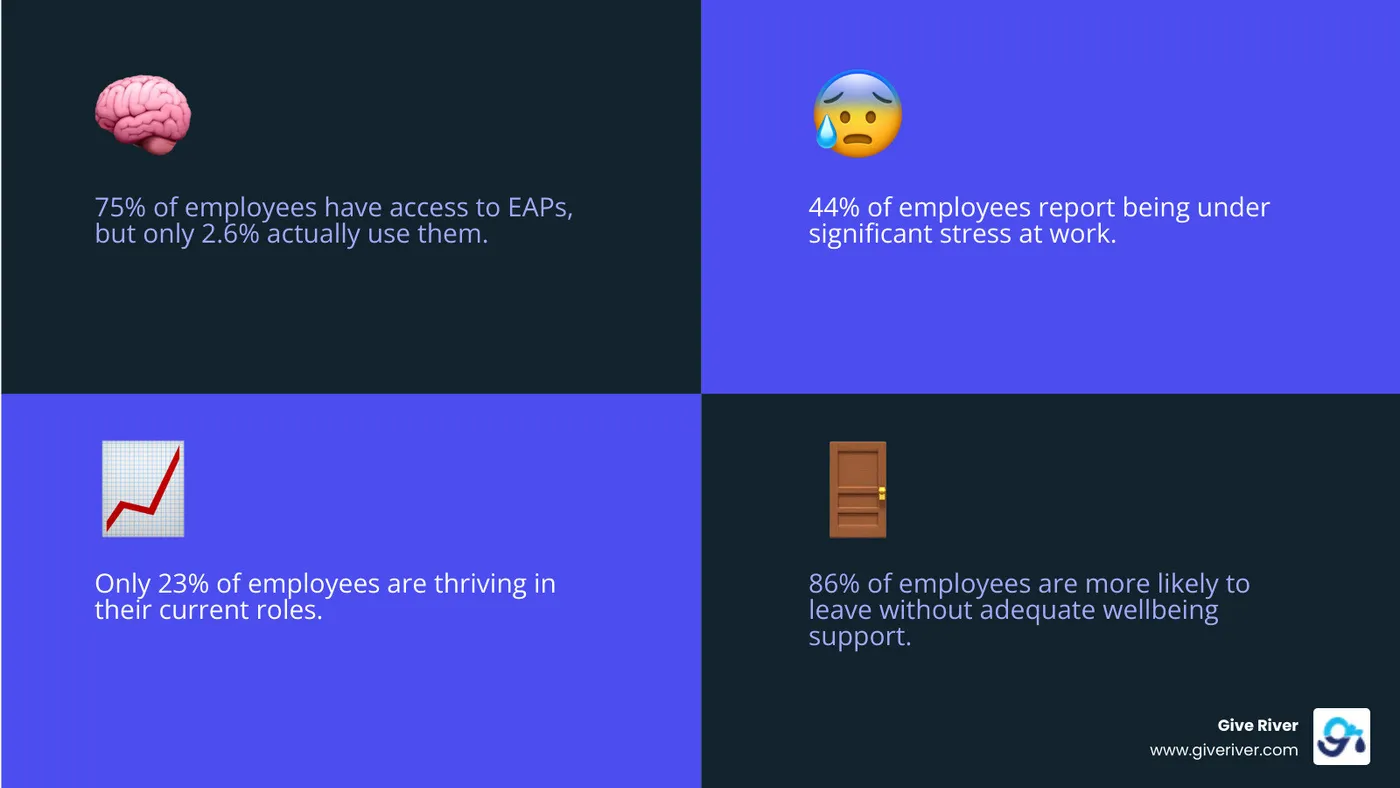
Here's the uncomfortable truth: despite 75% of UK employees having access to an EAP in 2022, only 2.6% actually used them, according to the EAPA. Meanwhile, 44% of employees report being under significant stress, and only 23% are thriving at work, according to Gallup. Perhaps most telling? 86% of employees are more likely to leave their jobs without adequate wellbeing support.
The problem isn't that organizations don't offer support—it's that traditional support systems are fundamentally broken. They exist in isolation, require phone calls to unknown counselors, lack integration with daily work experiences, and fail to address the complete picture of what makes employees thrive. When your support system sits unused while burnout climbs and turnover accelerates, you don't have a support problem—you have a system problem.
I'm Meghan Calhoun, Co-Founder of Give River, and I've spent over two decades building high-performing teams in high-pressure environments—from Fortune 100 sales floors to emotionally demanding client-facing roles. After nearly burning out myself, I've dedicated my career to reimagining employee support systems that actually work, combining gratitude, growth, and genuine connection into frameworks people want to use every day.
The research is clear: employees need more than access to counseling—they need integrated systems that combine mental health resources with daily recognition, professional growth opportunities, meaningful work connections, and a sense that their employer genuinely cares about their success. That's what a modern employee support system delivers, and that's exactly what we'll explore in this guide.
Simple guide to employee support system:
- HR data reporting
- employee retention metrics
- wellness platforms anonymized employee health data reporting
Defining the Modern Employee Support System: Beyond Traditional EAPs
To truly understand the employee support system, we have to look past the dusty pamphlet in the breakroom. Historically, support was synonymous with the Employee Assistance Program (EAP). By definition, an EAP is a voluntary, work-based program that offers free and confidential assessments, short-term counseling, referrals, and follow-up services to employees facing personal or work-related problems.
While EAPs are a vital foundation, they are often reactive. They wait for the employee to reach a breaking point before offering a phone number to call. A modern system is proactive. It doesn't just wait for a crisis; it builds a holistic employee experience that prevents the crisis from happening in the first place.

Comparing Support Models
When building your framework, you'll likely encounter three main delivery models. At Give River, we believe the most effective approach is one that feels "embedded"—where support is part of the daily workflow rather than a separate destination.
| Model | Description | Pros | Cons |
|---|---|---|---|
| Internal | Managed in-house by company staff. | Deep knowledge of company culture and specific stressors. | Potential privacy concerns; higher overhead costs. |
| External | Third-party vendors provide services. | High perceived confidentiality; objective perspective. | Can feel disconnected; lower utilization if not promoted. |
| Recognition-Only | Platforms like Bonusly or Kudos focusing on peer rewards. | High social engagement; easy to use. | Lacks mental health and professional growth integration. |
| Hybrid/Embedded | Combines external expertise with internal tools (like Give River). | Seamless integration; high trust; diverse range of services. | Requires strategic coordination. |
Core Services and the Evolution of Employee Support
The scope of a modern employee support system has expanded significantly. It’s no longer just about "stress management"; it’s about supporting the human being behind the job title. Core services now include:
- Mental Health & Emotional Well-being: Access to counseling for anxiety, depression, and grief. According to the WHO, 15% of working adults live with a mental disorder, making this a business-critical service.
- Substance Use Support: Proactive education and stigma-free referral paths for recovery.
- Crisis Intervention: Immediate response for workplace trauma, violence prevention, or natural disasters.
- Financial & Legal Aid: Resources to help with debt management, estate planning, or housing issues—factors that, if left unaddressed, lead to massive productivity losses.
- Specialized Health Support: Addressing specific life stages, such as menopause (which causes 10% of women to leave their jobs) and fertility (a priority for 70% of millennials).
For a deeper dive into these components, check out our employee health and wellness complete guide.
The Role of Coaching, Recognition, and Growth in a Holistic Support System
If mental health services are the "safety net," then coaching and recognition are the "fuel." A support system that only focuses on problems is incomplete. We need to support employee potential.
- Manager Coaching: Training leaders to move from "boss" to "coach." This involves empathy, active listening, and the ability to recognize signs of burnout before they lead to resignation.
- Peer Recognition: Tools that allow colleagues to express gratitude. This builds a purpose-driven workplace where employees feel seen.
- Gamified Growth: Support isn't just about feeling better; it's about getting better. Providing clear pathways for career progression—and making that journey engaging through gamification—addresses the 38% of employees who feel they lack advancement opportunities.
By building a supportive environment where recognition is a daily habit, you create a culture where people feel valued, not just managed.
Legal Frameworks: HIPAA, ADA, and Confidentiality
We can't talk about support without talking about trust. If employees don't believe their data is safe, they won't use the system. Several key laws govern how we handle this information:
- HIPAA: Applies if your EAP is considered a group health plan. It mandates strict privacy of health information.
- ADA (Americans with Disabilities Act): Governs mandatory referrals. You can't force an employee into counseling just because you "think" they have a mental health issue; it must be based on documented performance issues and "fitness for duty" concerns.
- Mental Health Parity Act: Ensures that mental health benefits are not more restrictive than medical/surgical benefits.
- ERISA: Regulates EAPs that provide direct counseling services.
Best Practice: Always obtain signed consent before sharing any specific information, and rely on anonymized, general utilization reports to measure program health.
Maximizing ROI: How to Support Your Support System
Investing in an employee support system is one of the smartest financial moves a company can make. However, a system is only as good as its utilization. 2.6% usage rate? That’s what happens when a support system lacks its own support.
Driving Retention Through Mentorship, Recognition, and Career Growth
Mentorship is perhaps the most undervalued component of employee support. The statistics are staggering: 93% of employees with a mentor feel confident about their career, and 90% feel enthusiastic. Yet, 56% of employees lack a mentor.
A robust support system bridges this gap by:
- Facilitating Reciprocal Benefits: Mentorship isn't a one-way street. Mentors develop better interpersonal skills and active listening, while mentees gain career navigation skills.
- Closing the Perception Gap: 70% of employers think they offer mentorship, but only 43% of employees agree. An integrated platform makes these opportunities visible and accessible.
- Linking Support to Retention: 36% of employees stay at a company specifically because of the health and wellbeing support offered.
Overcoming Implementation Hurdles and Low Awareness
Why do programs fail? Usually, it's one of three things: stigma, lack of awareness, or "friction" (the effort required to use the service). Here is how we recommend overcoming these hurdles:
- Leverage Gamification: Use challenges and rewards to encourage employees to explore wellness resources. Instead of a boring email, make "Wellness Quests" part of your culture.
- Manager Signposting: Train managers to "signpost" (direct) employees to services during regular 1-on-1s.
- Reduce Friction: If an employee has to find a password or call a phone tree to get help, they won't do it. Use integrated platforms that offer 24/7 digital access.
- Storytelling: Have leadership share their own stories of using support services to normalize the experience and reduce stigma.
For more practical tips, explore our employee wellness best practices.
Measuring the Impact of Your Employee Support System
To prove the value of your employee support system, you need data. While platforms like Bonusly or Kudos offer great recognition features, they often focus narrowly on peer-to-peer rewards. Give River is different because it treats recognition as just one pillar of a larger support system that includes mental health, mentorship, and career growth. A true support system needs to measure more than just "points sent."
Key metrics to track include:
- Turnover Rates: Are people staying longer since the program launched?
- Pulse Check Sentiment: Regular, short surveys to gauge if employees feel "supported" and "thriving."
- Healthcare Costs: Reductions in stress-related health claims.
- Utilization Rates: Moving past that 2.6% and seeing active engagement with growth and wellness content.
At Give River, we use our 5G Method (Guided, Gamified, Gratitude, Growth, and Generosity) to provide deep insights into how your team is actually doing. You can discover how data-driven insights transform culture to see the ROI in real-time.
Conclusion: The Future of Support is Integrated
The days of the "standalone" EAP are over. When 66% of employees believe there is a better job out there for them, your employee support system is your greatest competitive advantage.
By moving toward a model that integrates mental health, professional growth, and daily gratitude, you aren't just "checking a box." You are building a culture where employees feel enthusiastic (90% for those with mentors!) and confident in their future.
If you’re ready to move beyond basic perks and build a workplace where people truly thrive, we’re here to help. Explore our workplace wellbeing solutions or check out our workplace wellness program ideas to start your journey today.
Your employees are your greatest asset—isn't it time the system you use to support them was just as high-performing as they are?
More from this category.
Why Most Work Meetings Start on the Wrong Foot (And How to Fix It)
The best 2 truths and a lie ideas for work can transform an awkward, silent meeting opener into a moment your team actually looks forward to. Whether you're onboarding new hires, kicking off a remote all-hands, or just trying to shake off…

The Trust Deficit in Remote Work
Building trust in a virtual team is a critical challenge for modern organizations. While remote work offers flexibility, it can erode team cohesion if not managed intentionally.

Why Connection Building Activities Are the Secret to High-Performing Teams
Connection building activities are structured exercises that help teams develop trust, improve communication, and foster genuine relationships at work — and they're one of the most overlooked drivers of team performance.
See the platform in action.
30-day free trial. No credit card. River Guide included on Core and Growth.