Why Your Business Can't Afford to Ignore Employee Retention Metrics
Employee retention metrics are quantifiable measures that help organizations track how well they keep employees and understand why people stay or leave. Key metrics include overall retention and turnover rates, voluntary vs. involuntary…

Why Your Business Can't Afford to Ignore Employee Retention Metrics
Employee retention metrics are quantifiable measures that help organizations track how well they keep employees and understand why people stay or leave. Key metrics include overall retention and turnover rates, voluntary vs. involuntary turnover, cost of turnover, employee satisfaction scores, and retention broken down by categories like department or manager.
With over half of all workers actively seeking new opportunities, ignoring these metrics is a luxury no business can afford. The financial stakes are staggering: replacing a single employee can cost anywhere from six months to two times their annual salary. For a mid-sized company, even a modest turnover rate can translate to millions in replacement costs, not to mention the damage to productivity, morale, and institutional knowledge.
Too many organizations treat retention reactively, only learning why people leave during exit interviews. The real power lies in tracking the right metrics proactively to identify warning signs and implement targeted interventions before your best talent walks out the door. While 71% of executives see employee engagement as critical, only 33% of employees feel engaged, highlighting a major disconnect.
The good news is that data-driven companies are winning. Organizations that effectively use people analytics achieve profits 82% higher than their competitors. They use data to understand what makes employees stay and systematically build a better workplace.
I'm Meghan Calhoun, Co-Founder of Give River. After two decades of analyzing employee retention metrics for leading companies, I've seen that the most successful organizations are those that know which metrics matter and, more importantly, act on them.
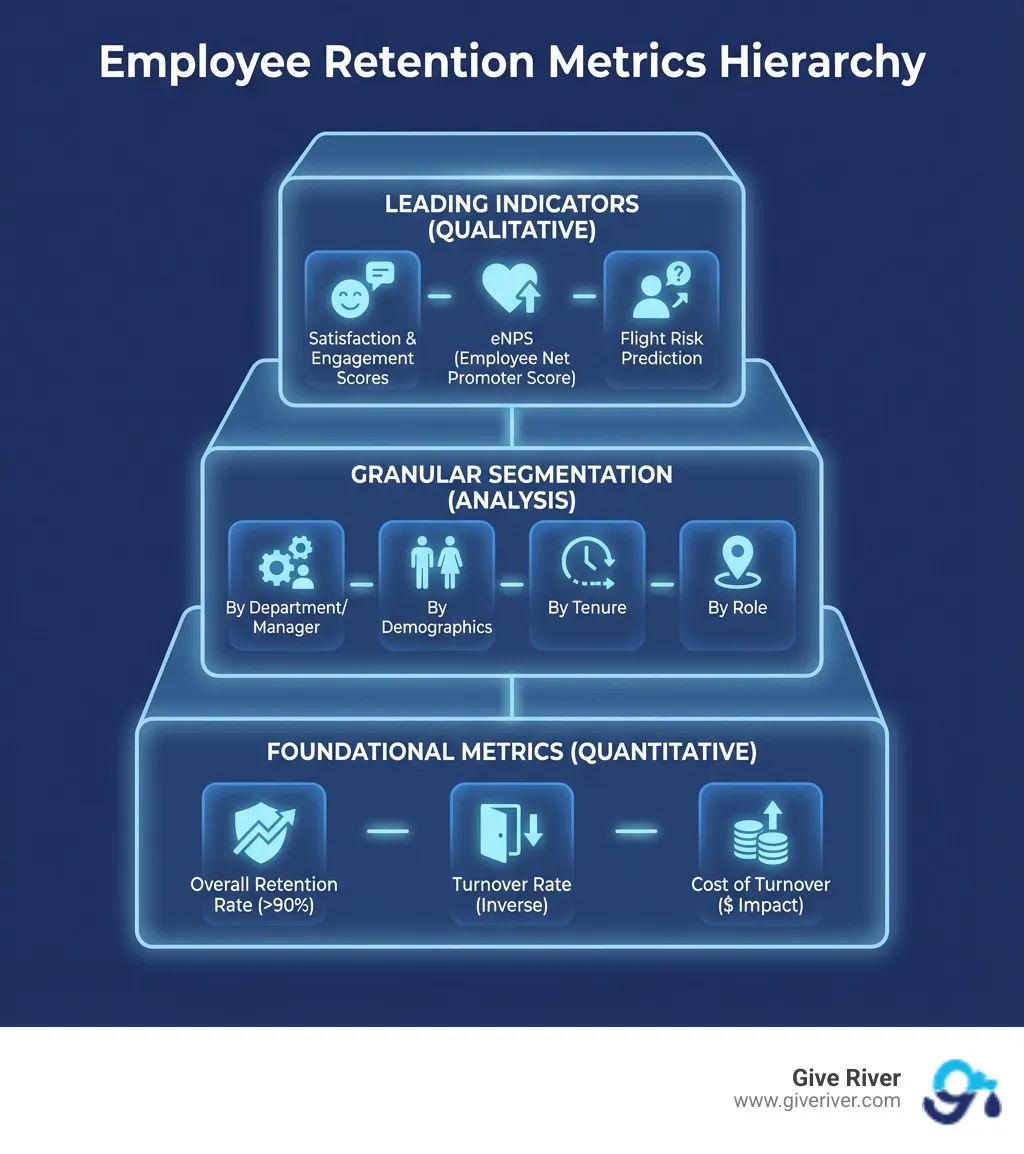
Key Employee Retention Metrics Framework: Starting with foundational quantitative metrics (Overall Retention Rate, Turnover Rate, Cost of Turnover), moving to granular segmentation (by department, manager, demographics, tenure), and topped with qualitative leading indicators (Employee Satisfaction, eNPS, Engagement Scores, Flight Risk). The visual emphasizes that successful retention strategies require tracking metrics across all three levels.
Find more about employee retention metrics:
The Essential Employee Retention Metrics Your HR Team Must Track
Understanding and effectively utilizing employee retention metrics is paramount for any business aiming for sustained success. These metrics provide a clear snapshot of your workforce's stability and overall health. Let's explore the core metrics we should all be tracking.
1. Overall Retention Rate vs. Turnover Rate
Retention and turnover rates are two sides of the same coin, offering a foundational view of workforce stability.
Employee retention rate measures the percentage of employees who remain with your company over a specific period. A high rate (ideally 90% or higher) indicates a stable, positive work environment.
Employee Retention Rate = (Number of employees who stayed / Number of employees at start) x 100
Conversely, the employee turnover rate is the percentage of employees who leave. It's crucial to distinguish between voluntary turnover (employees who resign) and involuntary turnover (terminations or layoffs). Tracking these separately helps pinpoint whether people are choosing to leave or being asked to leave, allowing for more targeted interventions.
Employee Turnover Rate = (Number of separations / Average number of employees) x 100
While benchmarks vary by industry (e.g., hospitality has higher turnover than finance), a low voluntary turnover rate is always the goal. However, some turnover can be healthy, bringing in fresh perspectives and creating growth opportunities for existing staff.
| Feature | Employee Retention Rate | Employee Turnover Rate |
|---|---|---|
| Definition | Percentage of employees who remain with the company | Percentage of employees who leave the company |
| Formula | (Stayed / Started) x 100 | (Left / Average Headcount) x 100 |
| Primary Insight | Company's ability to keep talent and foster stability | Rate at which employees depart, indicating churn |
| Focus | Employees who stay | Employees who leave |
| Ideal Scenario | High (e.g., 90%+) | Low (e.g., 10% or less voluntary) |
2. Granular Employee Retention Metrics: Digging Deeper
To get actionable insights, you must segment your retention data.
New hire retention is critical, as new employees are often the most likely to leave. Tracking retention in the first year reveals the effectiveness of your onboarding process. Strong onboarding can improve new-hire retention by 82%.
Analyzing retention rates by category uncovers hidden trends:
- Department and Manager: Pinpoints issues with team dynamics, workload, or leadership styles.
- Demographics: Reveals potential disparities in the employee experience related to age, gender, or ethnicity, highlighting areas to improve DEI initiatives.
- Role/Job Level: Shows if turnover is concentrated in specific positions, like entry-level or specialized roles.
The average employee tenure, or the average length of time an employee stays, is another key indicator of workforce stability and experience. According to the U.S. Bureau of Labor Statistics, the median tenure for workers was 4.1 years in January 2022. A low average tenure can signal underlying issues with company culture or career progression.
Segmenting data allows you to move from broad observations to targeted, effective retention strategies.
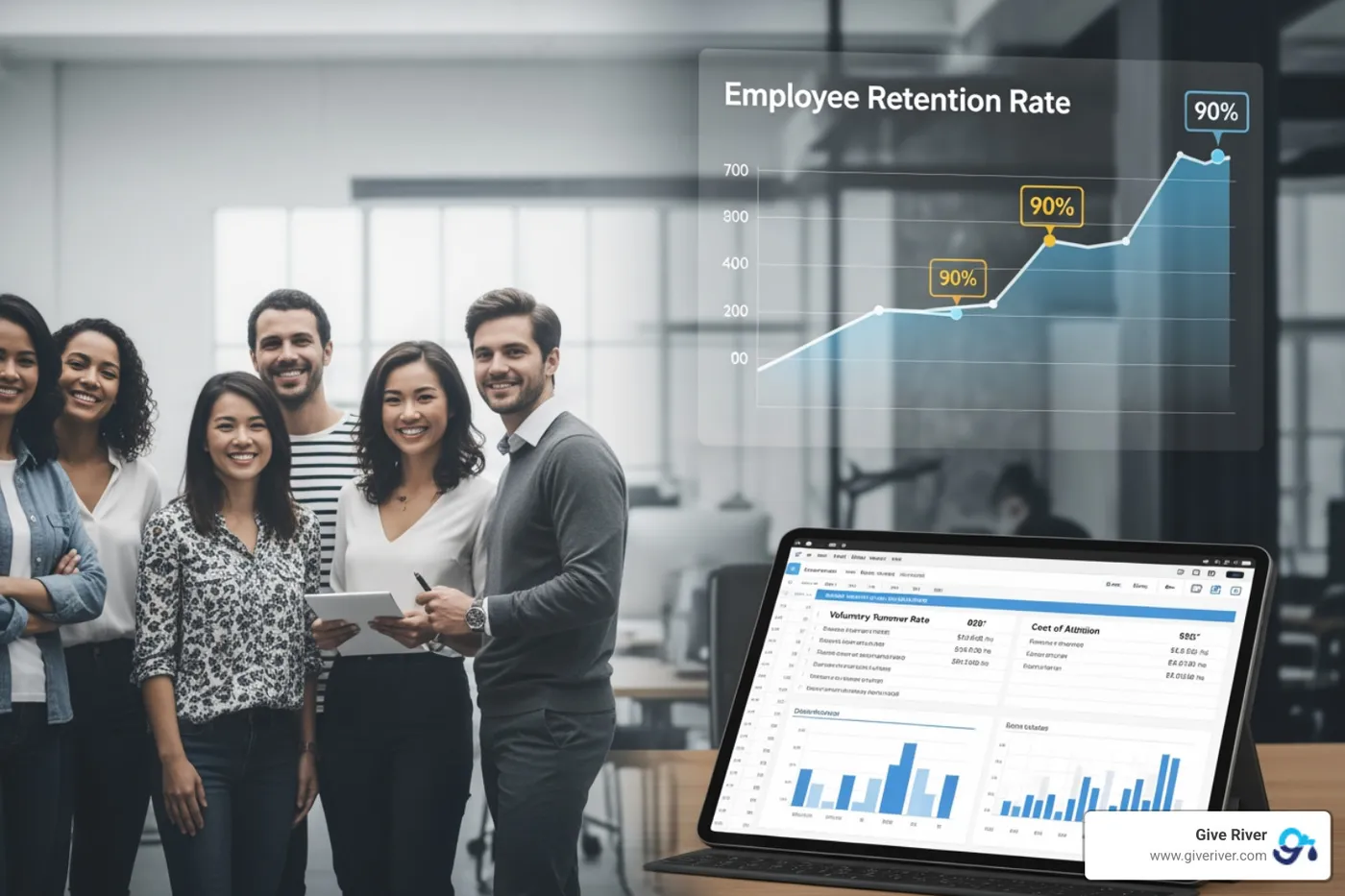
A people analytics dashboard showing retention rates broken down by department and role, allowing for granular insights into workforce stability.
For a deeper dive into how to keep your team engaged, explore our insights on employee engagement and retention.
3. Qualitative Metrics: Gauging Employee Sentiment
Quantitative metrics tell you what is happening; qualitative metrics explain why. These sentiment-based indicators are crucial for predicting and preventing turnover.
- Employee Satisfaction and Engagement Scores: These measure how content and connected employees feel. Low scores are a major red flag for future turnover, as disengaged employees are far more likely to leave.
- Employee Net Promoter Score (eNPS): This metric gauges employee loyalty by asking how likely they are to recommend your company as a place to work. It's a quick, powerful way to measure overall sentiment.
- Pulse Surveys: These are short, frequent surveys that provide real-time feedback on specific issues. They allow you to track morale continuously and react quickly to emerging problems.
By combining these qualitative insights, you can identify flight risks—employees who are likely to leave—and intervene proactively with support or new opportunities before it's too late.
An employee satisfaction survey question displayed on a mobile device, illustrating how companies gather real-time feedback.
To truly understand how to foster a thriving workplace, continually boost employee engagement.
4. The Financial Impact: Cost of Turnover
High turnover is a major drain on your company's bottom line. Calculating the cost of employee turnover makes the business case for investing in retention.
Costs include:
- Direct Costs: Recruitment expenses (advertising, interviews), onboarding and training time, and severance pay.
- Indirect Costs: Lost productivity while the role is vacant, decreased team morale, loss of institutional knowledge, and potential disruption to client relationships.
The financial impact is significant. Research shows the cost to replace an employee ranges from half to two times their annual salary. For specialized or leadership roles, this can be even higher. For example, replacing a manager can cost up to 200% of their salary.
Understanding these figures proves that investing in retention isn't just an HR initiative—it's a financial imperative.
Understanding the tangible financial benefits of keeping our employees happy and productive is crucial. Learn more about measuring the ROI of engagement.
From Data to Action: Strategies to Improve Your Retention Rate
Collecting employee retention metrics is just the first step. The real value comes from translating those insights into actionable strategies that create a loyal, thriving workforce.
Leveraging Technology and People Analytics to Improve Employee Retention Metrics
Modern HR software and people analytics platforms are essential for tracking retention metrics effectively. They automate data collection and analysis, allowing you to segment data and uncover trends in real-time. The true power lies in predictive analytics, which uses AI to identify employees at high risk of leaving. This gives you a crucial window to intervene proactively with support, new opportunities, or other targeted solutions.
While many platforms like Bonusly or Kudos excel at peer-to-peer recognition, a holistic approach is more effective for long-term fulfillment. At Give River, our unique 5G Method integrates recognition, guidance, wellness, growth, gamification, and community impact. This comprehensive strategy moves beyond simply tracking metrics to actively cultivating an environment where employees feel valued, supported, and connected to a larger purpose.
Find how our employee performance platform can help you achieve this.
Building a Culture That Retains: Key Drivers of Retention
Data provides the "what," but culture addresses the "why." To improve retention, focus on these key drivers:
- Competitive Compensation and Pay Equity: Fair and competitive pay is foundational. Regularly benchmark salaries and conduct pay equity analyses to ensure fairness.
- Career Development: Employees stay when they see a future. Provide clear growth paths, training, and mentorship. Explore effective career development programs.
- Employee Recognition: Feeling valued is a powerful motivator. Implement regular, meaningful recognition to boost morale and reinforce positive behaviors.
- Work-Life Balance and Flexibility: Over half of employees would consider quitting without flexibility. Offer flexible schedules and remote options to meet modern expectations.
- Leadership Quality: People leave managers, not companies. Invest in leadership training to ensure managers are supportive, communicative, and empowering.
- Employee Wellness Programs: A holistic approach to well-being shows you care. Implement impactful employee wellness programs.
- Positive and Inclusive Workplace Culture: A culture of trust, transparency, and psychological safety is a retention magnet. Build a strong winning workplace culture where everyone feels they belong.
By proactively addressing these drivers, informed by our employee retention metrics, we can build a resilient, purpose-driven team. This strategic approach turns data into a roadmap for creating a workplace where people not only want to stay but also want to excel.
An employee receiving an award from a manager, symbolizing recognition and appreciation as a key driver of retention.
To truly harness the power of your data, you need to leverage data for a stronger retention strategy.
Conclusion
Mastering employee retention metrics is a strategic imperative for long-term success. By tracking quantitative data like turnover rates and qualitative insights from employee surveys, you can move from a reactive to a proactive retention strategy. Understanding the significant financial cost of turnover makes it clear that investing in your people is a sound business decision.
The journey from data to action is powered by people analytics. While tools like Bonusly or Kudos offer strong recognition features, Give River’s comprehensive 5G Method fosters holistic fulfillment by integrating recognition, guidance, wellness, growth, and community impact. We help you build a culture where employees don't just stay—they thrive.
By building a culture rooted in competitive compensation, genuine care for employee well-being, robust career development, meaningful recognition, and strong leadership, we create an environment where our team members not only stay but thrive. It's about moving beyond reactive measures to cultivate a workplace where everyone feels valued, supported, and inspired to contribute their best.
Ready to transform your employee retention strategy with data-driven insights and a holistic approach to employee experience?
Request a Demo and let us show you how Give River can help you build a happier, healthier, and more engaged workforce.
More from this category.

The 5 Best Employee Engagement Platforms in 2026, Compared
Give River, Culture Amp, WorkTango, Engagedly, and Kudos compared from each vendor's own site: pricing, gamification, learning, surveys, and who each one fits.

Employee Engagement Software for Companies With 50–200 Employees (2026)
What a 50–200 person company needs from engagement software, what six platforms cost at that size, who each fits, and how fast you can launch.

What Is a Digital Engagement Platform? (And Why It Matters Right Now)
Understanding the digital engagement platform definition starts with a simple idea: it's a technology framework that centralizes how an organization communicates with, supports, and motivates its people — employees or customers — across…
See the platform in action.
30-day free trial. No credit card. River Guide included on Core and Growth.