Why Tracking Employee Growth Matters More Than Ever
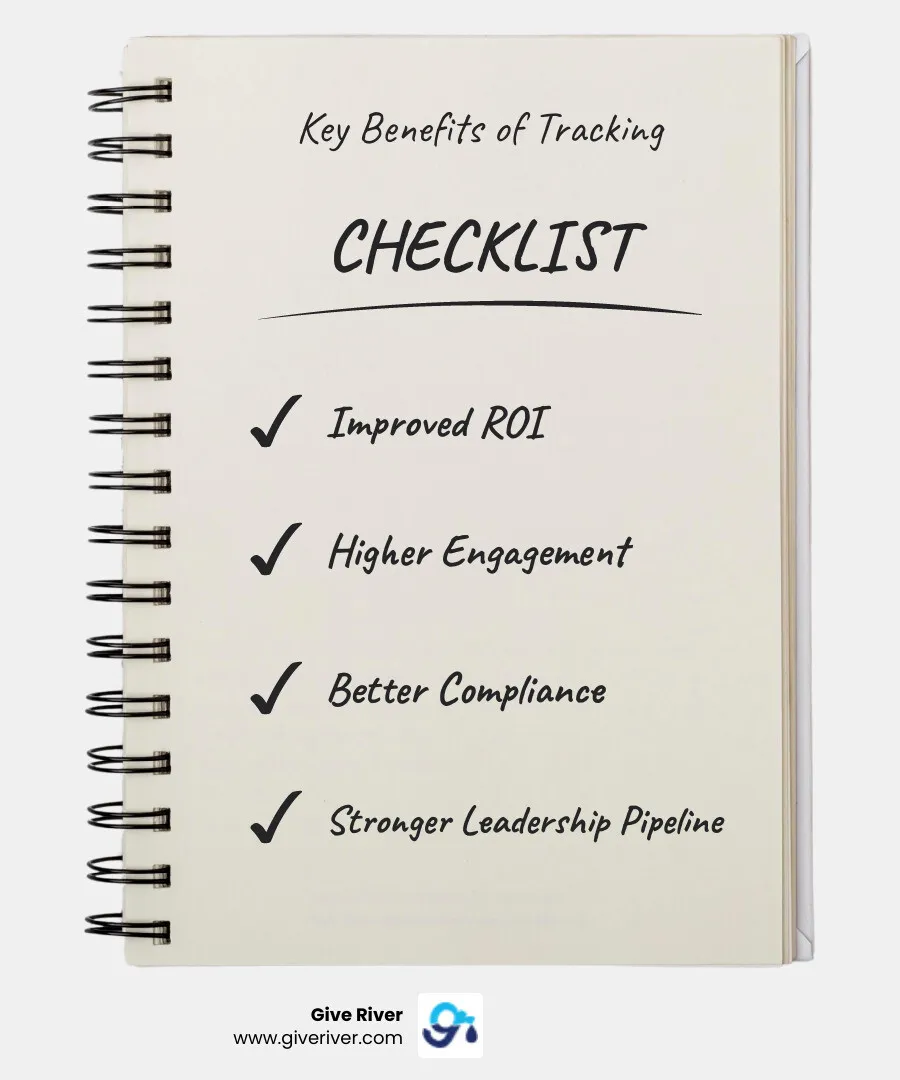
Employee development tracking is the process of monitoring and measuring how team members acquire new skills and apply them to their work. Effective tracking delivers significant benefits, including:

Why Tracking Employee Growth Matters More Than Ever
Employee development tracking is the process of monitoring and measuring how team members acquire new skills and apply them to their work. Effective tracking delivers significant benefits, including:
- Improved ROI on training investments
- Higher employee engagement and clearer growth paths
- Better compliance and reduced regulatory risk
- A stronger leadership pipeline for internal promotions
- Reduced turnover, saving businesses from significant costs (U.S. businesses lose over $630 billion annually to voluntary turnover)
If you've ever struggled to answer, "Did that training actually work?" you're not alone. Many organizations invest in development but lack systems to prove its impact. The problem isn't a lack of value for learning; it's that traditional methods fail to capture what matters: skill application, business outcomes, and retention gains.
Research shows only 30% of organizations measure behavior and business impact, missing the chance to turn development into a strategic driver. Moving beyond spreadsheets requires a smarter approach that connects learning to fulfillment. While platforms like Bonusly or Kudos excel at peer-to-peer recognition, they often operate separately from formal development and performance tracking. In contrast, a comprehensive Employee Performance Platform integrates development tracking, goal management, and recognition into a broader ecosystem of growth and purpose.
I'm Meghan Calhoun, Co-Founder of Give River. With over two decades of experience, I've seen how strategic tracking transforms retention and culture. This guide will show you how to implement systems that fuel genuine growth.
Quick Employee development tracking definitions:
A Strategic Framework for Employee Development Tracking
We've established why employee development tracking is crucial, but how do we actually do it effectively? It starts with a strategic framework that considers your organization's unique needs, resources, and goals.
Choosing Your Tracking Method: From Spreadsheets to Smart Software
When it comes to tracking employee training, methods range from simple spreadsheets to comprehensive software. The right choice depends on your company's size, budget, and goals.
Manual Tracking: Using spreadsheets or physical records is the most basic approach.
- Pros: Low cost and easy to set up for very small teams.
- Cons: Time-consuming, error-prone, difficult to scale, and creates data silos.
- Best for: Small businesses (under 20 employees) with minimal training needs.
Automated Tracking: This involves dedicated software like a Learning Management System (LMS) or Training Management System (TMS).
- Pros: Accurate, real-time data, advanced reporting, automated reminders, and excellent scalability.
- Cons: Higher initial cost and requires implementation time.
- Best for: Growing organizations and medium to large companies, especially in compliance-heavy industries.
Learning Management Systems (LMS): An LMS is a software platform for administering, tracking, and delivering training programs. It centralizes course management, user progress, assessments, and reporting. An LMS provides a consistent learning experience and comprehensive data, acting as an invaluable training tool. It's important to distinguish between different types of employee platforms. While tools like Bonusly or Kudos are excellent for fostering a culture of recognition, they are not designed for the structured administration and tracking of learning programs. An LMS, especially when integrated into a comprehensive Employee Performance Platform, is what connects formal development tracking with skill acquisition and career pathways.
Choosing the right method means evaluating your current needs and future growth. For most, automated solutions are non-negotiable for scalability and compliance.
| Feature | Manual Tracking (Spreadsheets) | Automated Tracking (LMS/Software) |
|---|---|---|
| Cost | Low (initial setup time) | Higher (software licenses, implementation) |
| Scalability | Poor (becomes unmanageable with more employees/training) | Excellent (handles large volumes of data and users) |
| Accuracy | Prone to human error, inconsistencies | High (automated data entry, reduced errors) |
| Reporting | Basic, time-consuming to generate | Advanced, real-time dashboards, customizable reports |
| Compliance | Difficult to prove, requires manual collation | Automated tracking of mandatory training, audit trails |
| User Experience | Poor for employees (no self-service), administrative burden | Good for employees (self-service, personalized paths), streamlined admin |
| Data Integration | None | Often integrates with HRIS, performance management systems |
| Real-time Insights | No | Yes |
| Notifications | Manual reminders | Automated reminders, overdue training alerts |
Key Metrics That Measure the Impact of Employee Development Tracking
Once you've chosen a method, you must define what to measure. Tracking completion rates isn't enough; we need to measure learning, behavior change, and business impact to prove the ROI of training.
Here are the key metrics to track:
- Completion Rates: A foundational metric tracking the percentage of employees who finish a program. Low rates can indicate issues with relevance or engagement.
- Assessment Scores: Quizzes and practical evaluations measure knowledge acquisition. Consistently low scores may signal that training content needs review.
- Behavior Change: This is where training proves its worth. Did it change how employees work? Measure this through:
- Manager Observation: Using rubrics to evaluate the application of new skills.
- Peer Reviews: Assessing improvements in soft skills like communication.
- Skill Demonstration: Having employees perform tasks to prove competence.
- Performance KPIs: Track relevant business metrics before and after training to measure impact. Examples include improved customer satisfaction scores or increased sales conversion rates.
- Employee Feedback: Surveys and interviews provide qualitative insights into training relevance and effectiveness, helping you improve programs.
- New-Hire Readiness: For onboarding, measure the time it takes for new hires to reach full productivity. Effective training should accelerate this.
- Leadership Pipeline Strength: Track how many leadership roles are filled internally by employees from development programs.
Measuring behavior and business impact is critical. The Kirkpatrick Model provides a widely recognized framework for evaluating training effectiveness across four levels: Reaction, Learning, Behavior, and Results. You can learn more about the model from this overview on the Society for Human Resource Management (SHRM) website. Aligning metrics with this model gives you a holistic view.
For a deeper dive into connecting training to performance, our Employee Goal Tracking Software can help link development directly to measurable goals.
The Role of Technology in Modern Learning and Development
Technology is a necessity for effective employee development tracking. Modern tools like LMS and AI-powered solutions have revolutionized how we manage and measure growth.

Learning Management Systems (LMS): An LMS is the backbone of automated tracking, centralizing all training data.
- Streamlined Administration: Automates course assignment, progress monitoring, and reporting.
- Centralized Database: Stores all training materials, records, and certifications in one place, crucial for compliance audits.
- Scalability & User Experience: Easily handles growth and provides a user-friendly interface for employees to manage their learning.
AI-Powered Tools: Artificial intelligence takes tracking to the next level with personalized and predictive solutions.
- Personalized Learning Paths: AI analyzes an employee's skills and goals to recommend relevant courses, making training more engaging.
- Predictive Analytics: Identifies learning patterns to predict skill gaps or flag employees at risk of disengagement.
- Skill Gap Analysis: AI quickly compares current competencies with future needs to inform targeted training initiatives.
By leveraging technology, we move from simply recording data to actively enhancing the learning experience. For more on this, explore our articles on AI Tools for Learning and Development and Micro Learning for Training Employees.
A 5-Step Guide to Implementing an Employee Development Tracking System
Implementing an effective tracking system can be straightforward if you follow a structured approach.
- Define Clear Objectives: First, articulate why you are tracking development. Are you trying to improve productivity, ensure compliance, or build your leadership pipeline? Your goals should be SMART (Specific, Measurable, Achievable, Relevant, Time-bound).
- Choose the Right Tools: Based on your objectives and budget, select the most suitable tracking method, whether it's an LMS or a simpler solution. Consider scalability and integration with existing HR systems. A comprehensive Learning and Development Solution can offer an integrated approach.
- Establish Baseline Metrics: To measure progress, you need a starting point. Collect data on your key metrics before implementing new training to create a baseline for comparison.
- Train Managers & Communicate to Employees: A new system requires buy-in. Train managers on how to use the system and interpret data. Communicate the benefits to employees, emphasizing how it supports their personal growth and career paths.
- Collect Feedback & Iterate: Implementation is an ongoing process. Regularly collect feedback from users and analyze data to identify trends. Be prepared to adjust your training programs and strategies based on these insights.
Following these steps ensures your tracking system becomes a strategic tool that drives growth and success.
Fostering a Culture of Growth and Continuous Feedback
An effective employee development tracking system thrives in a culture that values growth and open communication. Leadership's commitment is crucial, as 91% of employees cite their managers as a key source of inspiration to learn.
How to foster this culture:
- Lead by Example: Leaders and managers should share their own learning journeys to demonstrate a commitment to continuous improvement.
- Prioritize Regular Check-ins: Move beyond annual reviews. Conduct frequent, informal check-ins to discuss progress and offer support.
- Provide Constructive Feedback: Use tracking data to offer specific, actionable feedback that celebrates successes and guides improvement.
- Connect Development to Recognition: Acknowledge and celebrate employees' growth. Linking development to Employee Recognition Programs reinforces the value of learning.
- Support Mentorship: Encourage Career Development Mentoring Programs to complement quantitative data with qualitative guidance.
- Ensure Transparency in Career Paths: Make career progression visible and actionable, allowing employees to see the skills required for future roles.
When leadership champions a culture of learning, tracking becomes a tool that not only measures progress but also inspires employees to own their growth.
Conclusion: From Tracking Data to Fueling Fulfillment
We've explored the profound impact of effective employee development tracking, moving beyond mere record-keeping to using data as a strategic driver for organizational success and individual fulfillment. From understanding why choosing the right tracking methods, defining key metrics, leveraging cutting-edge technology, and implementing a robust system, we've seen how a thoughtful approach can transform your L&D landscape.
The benefits are clear: improved ROI on training investments, higher employee engagement, robust compliance, a stronger leadership pipeline, and significantly reduced turnover. By carefully tracking employee training progress, we gain the insights needed to refine our programs, personalize learning experiences, and ensure that every development initiative truly contributes to our business goals.
Effective employee development tracking is about more than just numbers on a dashboard. It's about demonstrating our commitment to our employees' growth, empowering them to reach their full potential, and fostering a workplace where continuous learning is celebrated. While specialized recognition tools like Bonusly or Kudos can boost morale, platforms like Give River offer a more holistic solution by integrating growth into a complete ecosystem of recognition, wellness, and purpose, turning development into a fulfilling journey. We believe that when employees feel valued, supported, and see a clear path for growth, they don't just perform better—they thrive.
Ready to build a workplace where growth and well-being go hand-in-hand? Explore our resources on workplace wellness to get started.
More from this category.

Why Most Work Meetings Start on the Wrong Foot (And How to Fix It)
The best 2 truths and a lie ideas for work can transform an awkward, silent meeting opener into a moment your team actually looks forward to. Whether you're onboarding new hires, kicking off a remote all-hands, or just trying to shake off…

The Trust Deficit in Remote Work
Building trust in a virtual team is a critical challenge for modern organizations. While remote work offers flexibility, it can erode team cohesion if not managed intentionally.

Why Connection Building Activities Are the Secret to High-Performing Teams
Connection building activities are structured exercises that help teams develop trust, improve communication, and foster genuine relationships at work — and they're one of the most overlooked drivers of team performance.
See the platform in action.
30-day free trial. No credit card. River Guide included on Core and Growth.