Why Data Privacy Matters in Modern Healthcare and the Workplace
Anonymized health data is health information processed to remove personally identifiable details, making it nearly impossible to trace back to individuals while allowing for research and analysis. With over 249 million patients affected by…

Why Data Privacy Matters in Modern Healthcare and the Workplace
Anonymized health data is health information processed to remove personally identifiable details, making it nearly impossible to trace back to individuals while allowing for research and analysis. With over 249 million patients affected by data breaches in recent years, protecting sensitive medical information is more critical than ever.
The challenge isn't just protecting data but balancing privacy with the need to use it for life-saving research and better patient outcomes. This tension is amplified by AI, which requires large datasets but introduces new privacy risks. Anonymization is key to this balance, but it faces evolving threats like sophisticated re-identification attacks.
Key Concepts in Data Anonymization:
- De-identification vs. Anonymization: De-identification removes direct identifiers but can be reversed, while anonymization is an irreversible process that makes data untraceable.
- Methods & Regulations: Techniques like masking and generalization are guided by frameworks like HIPAA and GDPR to protect patient privacy.
- Emerging Technologies: Advanced solutions like differential privacy and synthetic data offer stronger protection against new threats.
I'm Meghan Calhoun, Co-Founder of Give River. In my experience building high-performing teams, I've seen how crucial proper handling of anonymized health data is for workplace wellness programs. Understanding how anonymization works is essential for any organization handling sensitive health information, whether in clinical settings or employee wellness initiatives.
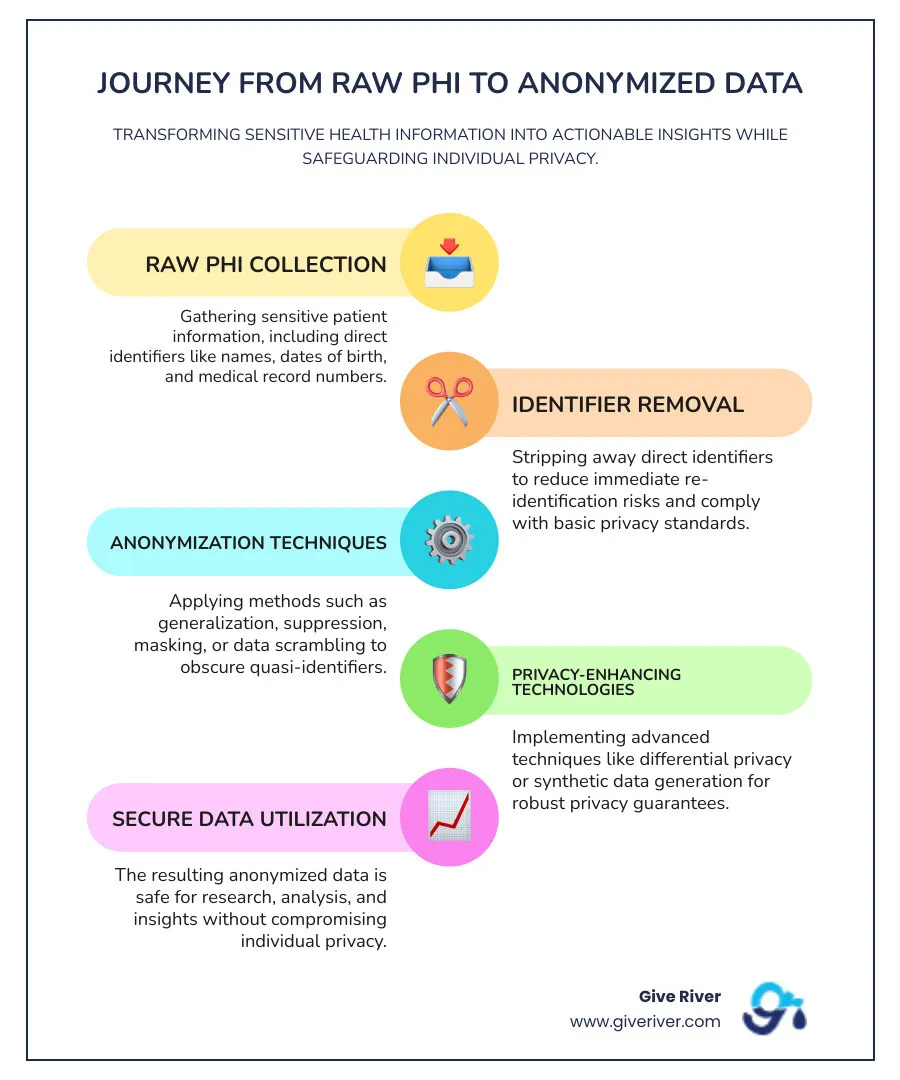
The diagram above illustrates how raw Protected Health Information (PHI) containing direct identifiers like names, dates of birth, and medical record numbers is transformed through various anonymization techniques—including removal of identifiers, generalization of quasi-identifiers, and application of privacy-enhancing technologies—into anonymized data that can be safely used for research, analysis, and organizational insights while protecting individual privacy.
Basic anonymized health data vocab:
Understanding Data Privacy: De-Identification and Anonymization Explained
The journey toward protecting sensitive health information begins with two critical processes: de-identification and anonymization. While often used interchangeably, they represent distinct levels of privacy protection.
De-Identification vs. Anonymization: What’s the Difference?
At its core, de-identification is the process of removing specific personal identifiers from health data to reduce the risk of identification. A common standard is the HIPAA Safe Harbor method, which requires removing 18 types of Protected Health Information (PHI). This includes direct identifiers like names, specific locations, dates, contact information, and unique numbers (e.g., Social Security or medical record numbers).
Crucially, de-identified data could still be linked back to an individual if an authorized entity holds a "re-identification key." It offers a balance between data utility and privacy but isn't completely untraceable.
Anonymization, in contrast, is a more stringent process. It aims to remove all information that could be used to re-identify a person, making the data permanently and irreversibly untraceable. While de-identification might suffice for internal research under strict agreements, true anonymization is often required for public data release.
Here's a quick comparison:
| Feature | De-identification | Anonymization |
|---|---|---|
| Reversibility | Potentially reversible with a re-identification key | Irreversible; data is completely untraceable |
| Risk Level | Low to moderate risk of re-identification | Negligible risk of re-identification |
| Use Cases | Internal research, controlled data sharing, specific regulatory compliance | Public datasets, broad research, open data initiatives |
| Regulatory Status | Governed by specific regulations (e.g., HIPAA) for permitted uses | Often falls outside direct privacy regulations as it's no longer "personal data" |
Common Methods for Creating Anonymized Health Data
Changing sensitive information into anonymized health data involves a variety of methods, often used in combination:
- Masking & Pixilation: Covering, blurring, or reducing the resolution of images or text to obscure direct identifiers.
- Metadata Removal: Stripping identifying information embedded in digital files, such as patient names or dates in medical images.
- Generalization: Replacing specific values with broader categories (e.g., replacing an exact age with an age range like "30-39 years") to retain statistical utility.
- Suppression: Removing entire data points or records that are too unique and could lead to re-identification.
- Synthetic Data Generation: Using AI to create new, artificial datasets that mimic the statistical properties of the original data without containing any real patient information.
These methods help strike a delicate balance between preserving privacy and ensuring the data remains useful for analysis.
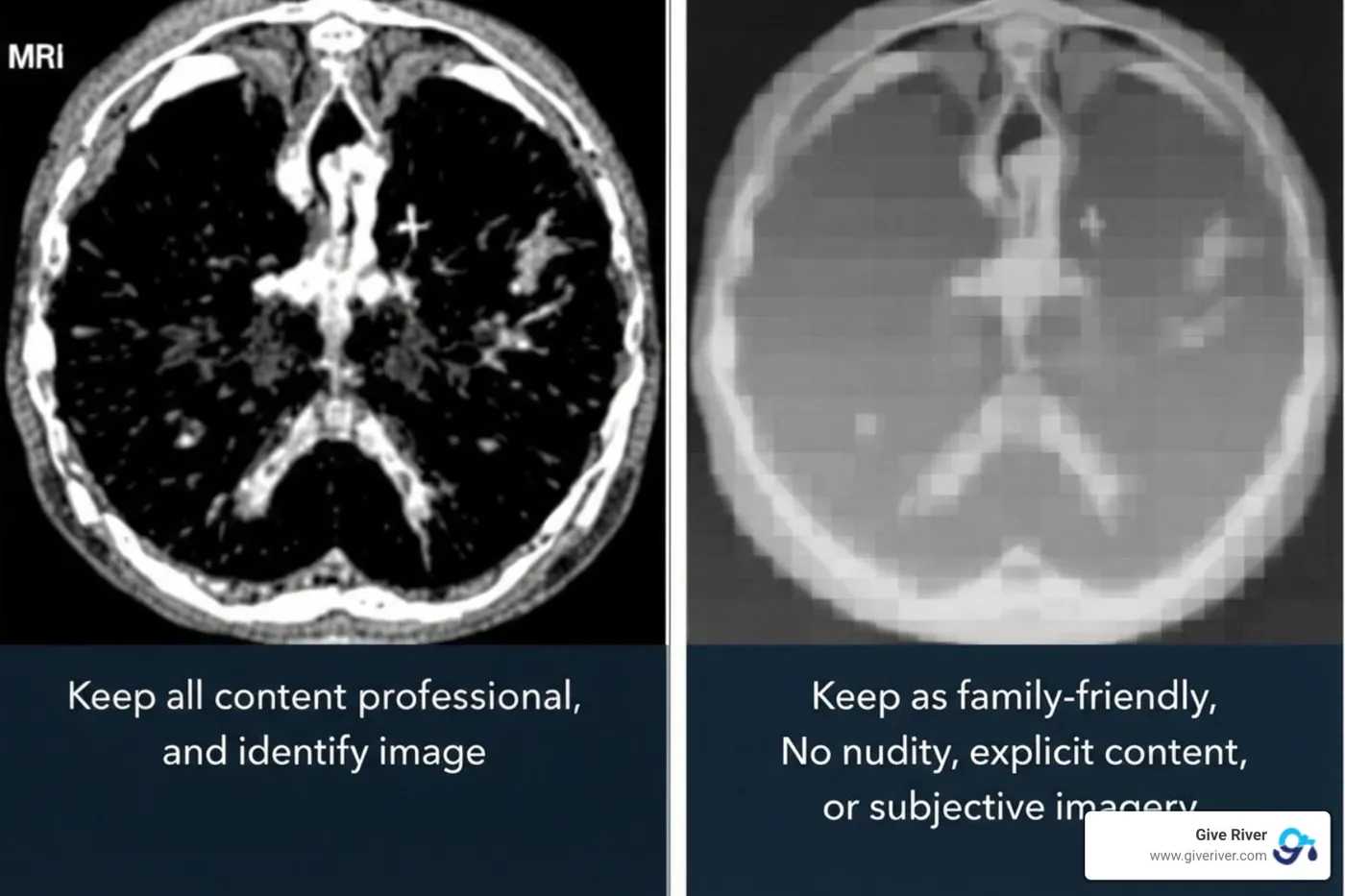
The image above demonstrates how various techniques, such as blurring or masking, are applied to medical images to remove Protected Health Information (PHI) like patient names, IDs, or specific dates, creating anonymized health data suitable for research or sharing while preserving the core clinical information.
The Limits of Traditional Methods and Emerging Threats
Traditional de-identification methods are increasingly vulnerable to sophisticated re-identification attempts. The main weakness lies in quasi-identifiers—pieces of information like gender, birth date, or zip code. While not identifying on their own, they can be combined to pinpoint an individual when cross-referenced with public data. A famous study by Latanya Sweeney proved this by re-identifying a governor's medical records using just these three data points.
This vulnerability leads to several emerging threats:
- Linkage Attacks: Attackers link "anonymous" data with public datasets (e.g., voter records, social media) using quasi-identifiers to re-identify individuals. Scientific research on re-identification risks shows that AI advances enable learning sensitive individual characteristics even without direct identifiers, eroding traditional privacy safeguards.
- Membership Inference Attacks (MIA): These attacks determine if a specific person's data was used to train a machine learning model, potentially revealing sensitive information (e.g., their participation in a rare disease study).
- AI-driven Attacks: AI models can inadvertently leak private information. Attackers may be able to reconstruct parts of the original training data, infer private inputs from model outputs (model inversion), or use AI to identify people from "anonymized" sources like gait patterns or ECGs.
The risk of re-identification is a real and evolving threat, making advanced privacy measures more critical than ever.

The diagram illustrates a linkage attack, where seemingly anonymized health data (Dataset A) is combined with publicly available information (Dataset B) using common quasi-identifiers (like age, gender, and general location). This cross-referencing allows an attacker to potentially re-identify individuals from the anonymized dataset, highlighting the limitations of traditional de-identification methods.
The Future of Privacy: Advanced Technologies and Frameworks for Anonymized Health Data
Evolving threats to anonymized health data require a proactive approach. Privacy-Enhancing Technologies (PETs) and robust frameworks offer advanced solutions to safeguard information while enabling valuable insights.
Advanced Privacy-Enhancing Technologies (PETs) in Healthcare
PETs are tools designed to minimize personal data use and maximize security. They are critical for navigating the privacy-utility tradeoff.
Here are some key PETs in healthcare:
- Differential Privacy (DP): Adds statistical "noise" to a dataset, providing a mathematical guarantee that an individual's data does not significantly affect the output. This makes it difficult to infer personal information from aggregated results, a method used by the U.S. Census Bureau.
- Homomorphic Encryption (HE): Allows calculations to be performed on encrypted data without ever decrypting it. This keeps data secure throughout its lifecycle but can be computationally intensive.
- Secure Multiparty Computation (SMC): Enables multiple parties (e.g., hospitals) to jointly analyze data without revealing their private datasets to each other.
- Federated Learning (FL): Trains AI models on decentralized data without moving it. The model learns locally at each institution, and only the model updates—not the raw data—are shared, preserving privacy.
- Synthetic Data: Involves creating artificial datasets that mimic the statistical properties of real data but contain no actual patient information, eliminating re-identification risk while preserving utility for training AI models.
How Regulations and Frameworks Guide the Use of Anonymized Health Data
The use of PETs is guided by regulatory frameworks that balance data utility with patient privacy. Global regulations like the Health Insurance Portability and Accountability Act (HIPAA) in the U.S. and the General Data Protection Regulation (GDPR) in the EU provide strict guidelines.
- HIPAA defines rules for de-identification through its Safe Harbor method.
- GDPR sets a high bar for anonymized health data, requiring that individuals not be identifiable "by any means reasonably likely to be used."
Beyond regulations, comprehensive privacy frameworks are essential. They guide the selection of PETs based on the specific task, data type, and user roles. This ensures protections are dynamic, not one-size-fits-all. Ethical principles like data minimization and purpose limitation, along with accountability mechanisms like access controls and audit logs, are vital for privacy engineering in healthcare.
Applying Data Anonymization in Workplace Wellness with Give River
At Give River, we build healthier, happier, high-performing teams, and a core part of that mission is the secure handling of employee health data. The principles of anonymized health data are indispensable to our approach to employee wellness programs.
We prioritize employee trust by ensuring any data collected for wellness tracking is transformed into anonymized health data before it reaches organizational leaders. Our platform provides valuable, aggregated insights—like overall participation in step challenges or stress management workshops—without ever revealing individual data. This allows companies to refine their wellness initiatives for the workplace and measure impact on employee health and wellbeing initiatives while protecting privacy.
Our unique 5G Method (Guided, Gamified, Gratitude, Growth, and Generosity) provides personalized wellness plans while ensuring management only sees aggregated, untraceable insights. This commitment to privacy is central to our HIPAA Compliant Wellness Tracking Platforms.
Unlike platforms like Bonusly or Kudos that focus primarily on recognition, Give River integrates wellness into a broader framework. Our focus on anonymized health data reporting empowers data-driven decisions for healthier teams, providing corporate wellness tools that offer real value without compromising privacy. By leveraging anonymized health data, we help organizations build a culture of trust and well-being, leading to better engagement and outcomes for their corporate wellness initiatives.
The dashboard above illustrates how Give River presents anonymized health data to organizations. It displays aggregated insights into employee wellness trends, such as participation rates in fitness challenges or overall stress levels, without revealing any individual-level data. This allows employers to make informed decisions about their corporate wellness goals and strategies while maintaining the highest standards of employee privacy.
Conclusion: Securing the Future of Health Data
The journey to manage anonymized health data is complex. We've seen that true anonymization offers an irreversible safeguard against re-identification, which is crucial as traditional methods become vulnerable to threats like linkage attacks.
The future of data privacy depends on Privacy-Enhancing Technologies (PETs) like Differential Privacy and Federated Learning, guided by robust frameworks like HIPAA and GDPR. These tools help balance data utility with the individual's right to privacy.
For organizations like Give River, using anonymized health data is fundamental to building trust in workplace wellness. By providing actionable, aggregated insights, we help companies improve employee well-being without compromising privacy, fostering healthier and high-performing teams.
As the privacy landscape evolves, our collective responsibility is to adapt and champion technologies that protect individuals while using data for the greater good.
Sign up for our newsletter to get updates, news and the latest in healthcare data solutions: /benefits/data-driven-insights
More from this category.

Core Elements of Modern employee wellbeing strategies
To build a truly resilient organization in April 2026, we must look beyond the surface level of "perks." Modern employee wellbeing strategies are rooted in the understanding that health is holistic. It isn't just about the absence of…

Why Virtual Wellness Challenges Are Essential for Modern Remote Teams
Virtual wellness challenge ideas are changing how companies support employee well-being in our increasingly remote work landscape. With 80% of employees experiencing stress at work and remote workers facing unique challenges like isolation…

Why Workplace Health Promotion Is Your Secret Weapon for Team Success
Workplace health promotion is more than a feel-good initiative—it's a strategic business imperative. It involves coordinated activities, policies, and environmental supports designed to improve employee health, safety, and well-being…
See the platform in action.
30-day free trial. No credit card. River Guide included on Core and Growth.